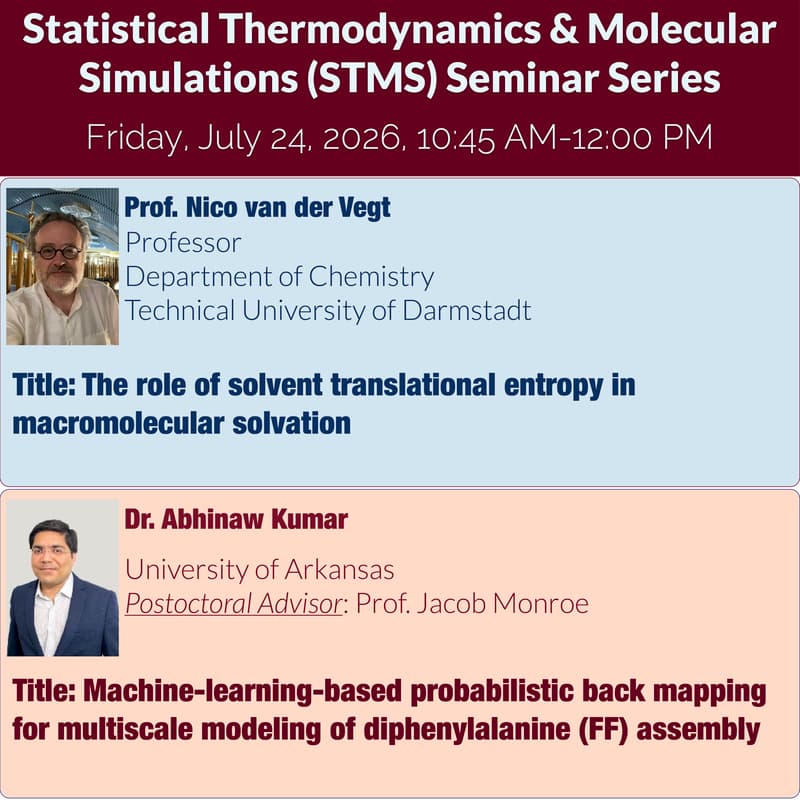
Statistical Thermodynamics & Molecular Simulations (STMS) Seminar Series: Prof. Nico van der Vegt (Darmstadt), Dr. Abhinaw Kumar (Arkansas)
These seminar series are aimed at providing a virtual platform for sharing scientific research in the area of statistical mechanics, molecular simulations, and computational materials science. In early 2020, the coronavirus pandemic disrupted many large in-person scientific gatherings, including conferences and department seminars. We launched STMS in October 2020 to fill this gap, and provide a venue for dissemination of research findings and exchange of ideas in the age of COVID. We are grateful for all the excitement and support that we have received from the community since then, motivating us to continue these series beyond the pandemic. We were proud to host the 100th STMS on January 30, 2026.
Each seminar will be a 60-minute event and will comprise of a long-form (30-minute) talk by a principal investigator or a senior research scientists from academia or industry and a short-form (15-minute) presentation by a graduate student or a postdoc. The remainder of the event will be dedicated to Q&A (10 minutes for the PI, 5 minutes for the student/postdoc). Long-form speakers will be chosen by the STMS Organizing Committee, while we encourage suggestions from the community at large. Student and postdoctoral speakers can either be nominated by their advisors or can self-nominate themselves by sending a CV to the organizers. We normally hold 1-2 seminars per month, and the events take place in the last two Fridays of each month, from 10:45 AM-12:00 PM Eastern Standard Time (EST):
This event's talks:
The Role of Solvent Translational Entropy in Macromolecular Solvation
Prof. Nico van der Vegt (Technical University of Darmstadt)
Abstract: Many properties of stimuli-responsive polymer systems – including gels, capsules, brushes, and thin films – are governed by changes in macromolecular solvation, most notably the coil-globule transition and its modulation by cosolvents. Molecular simulations have been instrumental in uncovering the microscopic mechanisms underlying these phenomena. In this talk, I will present a perspective on the role of solvent translational entropy in macromolecular solvation, drawing on work from my group over the past decade. I will discuss the molecular origins of cononsolvency, cosolvent-enhanced hydrophobic interactions driven by preferential binding, and related solvation phenomena.
Speaker Bio: Nico van der Vegt is a Dutch theoretical physical chemist. He received his PhD in chemical engineering from the University of Twente, the Netherlands, in 1998 and was a lecturer at the same university from 1998 to 2002. He was a postdoctoral fellow at the ETH Zurich, Switzerland, from 2002 – 2003, before starting his independent career as a research group leader at the Max Planck Institute for Polymer Research in Mainz, Germany. In 2009, he moved to the Technical University of Darmstadt, Germany, where he is currently Professor of Chemistry. His main research interests are in the thermodynamics and statistical mechanics of liquids and soft matter systems. His work includes studies of the physical fundamentals of aqueous solvation, including the effects of ions, osmolytes and cosolvents on the water solubility of macromolecules, hydrophobic interactions, and the stability of proteins. He also works on the development of models and methods for coarse-grained molecular dynamics simulations that aim to link chemistry, structure and dynamics over a wide range of time and length scales.
Machine-Learning-Based Probabilistic Backmapping for Multiscale Modeling of Diphenylalanine (FF) Assembly
Dr. Abhinaw Kumar (University of Arkansas)
Abstract: Diphenylalanine (FF) exhibits polymorphic self-assembly behavior and forms nanostructures such as nanotubes and vesicles via distinct assembly mechanisms. While numerous promising applications exist in nanotechnology and biomedicine, understanding how these structures emerge requires insight into the molecular-level interactions that govern their formation. Multiscale simulations are essential for capturing the complete description of self-assembly dynamics as these processes span multiple lengths and time scales, from fast atomic fluctuations to slow mesoscale organization. Coarse-grained (CG) molecular simulations help study these systems in simulations as they offer computational efficiency, but they lose critical atomistic structural information. A key challenge is accurately reconstructing atomistic structures from CG representations (backmapping). While regular backmapping offers a means to recover atomistic detail, these approaches often fail to capture molecular systems' inherent randomness and conformational variability.
In this work, we present a machine learning-based backmapping approach that reconstructs atomistic structures from CG representations. Our decoder model integrates geometric algebra attention, masked normalizing flows, and neural network architectures to learn from atomistic trajectories and predict full atomic coordinates from CG inputs. The model is trained on atomistic simulation trajectories and learns to predict full atomic coordinates from CG positions. We have trained separate models to predict either Cartesian (XYZ) or internal (bond-angle-torsion, BAT) coordinates. Comparing predicted atomistic structures with the simulated ones shows that our trained model can reproduce most of the essential structural features, bond lengths, angles, and dihedrals of the FF peptide. BAT coordinates improve model performance by providing structured, periodic representations of molecular geometry. Mutual information analysis reveals that the predicted structures retain the same correlation patterns between degrees of freedom as observed in atomistic simulations, indicating the model captures meaningful interdependence among molecular components. Though focused on FF peptides in this work, our approach is generalizable to other molecular systems and proteins. It offers a probabilistic framework for recovering atomistic detail that can enable a better understanding of molecular assembly.
Speaker Bio: Abhinaw grew up in India and received his Integrated Bachelor’s and Master’s degrees from the Indian Institute of Science Education and Research (IISER), Pune. He earned his Ph.D. from the University of Utah under the guidance of Prof. Valeria Molinero, where his research focused on the self-assembly of nanoparticles and the nucleation and polymorph selection of zeolites. He subsequently worked in the groups of Prof. Dave Thirumalai and Prof. Jeetain Mittal, studying intrinsically disordered proteins. Currently, he is a Postdoctoral Researcher at the University of Arkansas, where his research focuses on developing machine-learning-based probabilistic backmapping approaches for multiscale modeling of biomolecular systems.