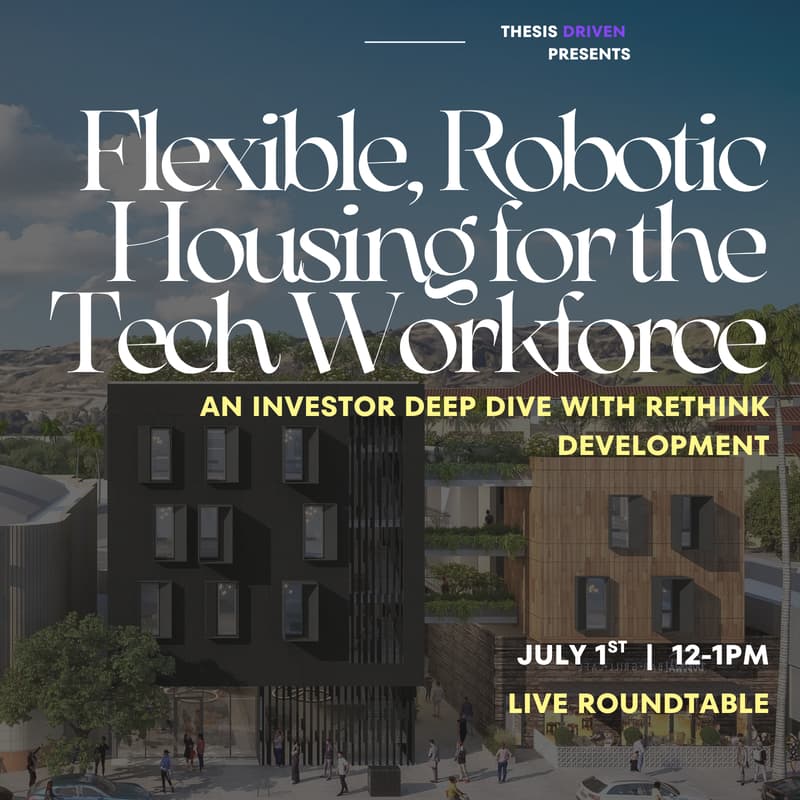

Flexible, Robotic Housing for the Tech Workforce: A Deep Dive on REthink Development
Date & Time: Wednesday, July 1st | 12PM - 1PM EDT
Hosted by: Thesis Driven
Culver City is a magnet for creative talent. Amazon Studios, Sony, Apple TV, HBO, and TikTok occupy millions of square feet within blocks of each other.
But housing hasn't kept pace. Creatives on short shoots, relocating executives, and traveling production staff need furnished, flexible-term apartments for weeks or months, without a year lease or hotel rates. The market doesn't serve them. Land is scarce, construction costs are among the highest in the country, and conventional unit sizes make the economics punishing.
REthink Development, founded by veterans Steve Edwards and Greg Reitz, has an elegant answer. Build smaller units, and integrate Ori Living systems so they live like spaces nearly twice their size. Then furnish them and offer flexible terms. A 350-square-foot studio costs less to build than a conventional 600-square-foot unit but commands $11 per foot furnished versus $6 to $7 unfurnished across the street.
The model fits HNW & family office capital. Stage Right Residences, REthink's 34-unit project in downtown Culver City, is a $24 million capitalization seeking $7 million in LP equity. The boutique size and higher yields create a return profile institutional funds can't replicate at their check size.
Stage Right is the first proof point for a broader thesis. Mid-market housing is where most supply gets built, but institutional capital isn't structured to fund it. Smarter design, flexible operations, city partnerships, and family office capital turn a starved segment into a repeatable platform.
Join us for a 60-minute conversation with the REthink team on how unit design and lease structure are reshaping residential development, and why boutique multifamily is the most attractive opportunity in housing for institutional and family office capital.
In this session, we'll cover:
Why Culver City's density of tech and entertainment employers is creating acute demand for furnished, flexible-term housing—and why the market has failed to serve it
How REthink's smaller-unit, Ori-integrated model flips the cost-yield equation and generates 6.7% yields with upside to 7.43%
What Stage Right Residences looks like in practice: Brooks + Scarpa architecture, robotic systems, and a fully de-risked development structure
How REthink's city partnerships create a competitive moat and deliver better projects than conventional entitlements
Why the boutique project size and higher yields make this a natural fit for family office and private wealth capital
The broader platform thesis: why mid-market housing is becoming the next frontier for smart capital allocation
Speakers Include:
The Team
Steve Edwards – Principal & President, REthink Development
Greg Reitz – Principal, REthink Development
The Interviewers
Paul Stanton – Thesis Driven
Brad Hargreaves – Thesis Driven
Register now to hear how REthink is using design innovation, technology, and municipal partnerships to build housing that serves the workers these major employers cannot recruit—and why that solution is becoming the blueprint for a new category of investment returns.