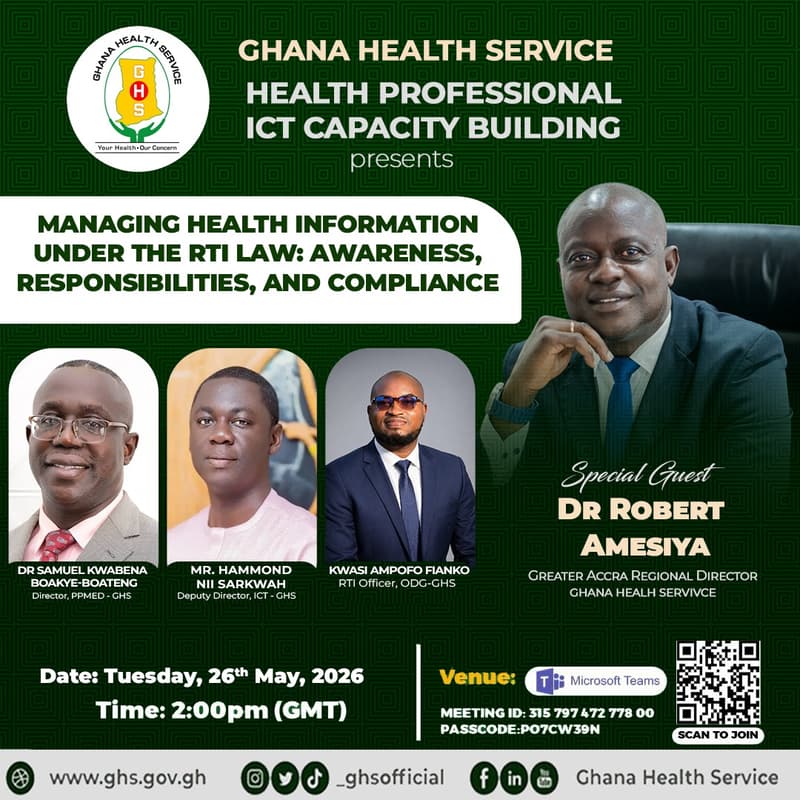
Managing Health Information Under the RTI Law -Awareness, Responsibilities and Compliance
Background:
The Right to Information (RTI) Act, 2019 (Act 989) grants Ghanaian citizens a legally enforceable right to access information held by public institutions, including health sector agencies such as the Ghana Health Service (GHS). While the Act promotes transparency, accountability, and improved service delivery, it also imposes clear duties on information holders to protect exempt information, particularly personal medical data and privileged communications between healthcare providers and patients.
Problem Statement:
Health information is inherently sensitive. Without proper training, health sector staff may inadvertently disclose confidential patient records in response to RTI requests, leading to legal penalties, reputational damage, and erosion of patient trust. On the contrary, unlawful withholding of non-exempt information undermines the public's right to know. There is a critical need to balance disclosure obligations with confidentiality protections.
Purpose of the Presentation:
To equip health sector staff, particularly information officers, administrators, and clinical managers with the knowledge and practical skills to handle RTI requests lawfully, ethically, and efficiently.
Key Objectives:
To provide an overview of the RTI Act (Act 989) and its relevance to healthcare institutions.
To distinguish between publicly accessible health information, exempt information, and privileged communications.
To explain the legal grounds for withholding patient data under Sections 15 and 16 of Act 989.
To outline the procedural steps for receiving, processing, and responding to RTI requests.
To highlight the consequences of non-compliance, including financial penalties and criminal liability.
To present best practices for records management, secure storage, and ethical information sharing.
Key Legal Provisions Referenced:
Section 1: Right to access information.
Section 15: Privileged communications (doctor–patient confidentiality).
Section 16: Disclosure of personal matters.
Section 17: Public interest override (e.g., threats to public health).
Section 18: Application procedures.
Section 31: Internal review of denied requests.
Section 81: Offences and penalties for unlawful disclosure.
Major Highlights:
Patient medical records are exempt from disclosure unless the patient provides written waiver or a public health emergency overrides confidentiality.
The RTI Commission has imposed significant penalties (e.g., GH¢100,000 on EOCO) for non-compliance, signalling strict enforcement.
Health staff must implement secure record-keeping, redaction protocols, and need-to-know principles.
Target Audience:
Health service administrators and records officers.
Clinical staff who manage patient data.
Legal and compliance officers within the GHS and other public health institutions.
Expected Outcomes:
Upon engaging with this presentation, participants will be able to:
Identify which health records can and cannot be disclosed under Act 989.
Process RTI requests within statutory timelines.
Apply exemptions lawfully to protect patient privacy.
Mitigate institutional risk through proper documentation and ethical conduct.
Conclusion:
Managing health information under the RTI law requires a deliberate balance between transparency and confidentiality. With awareness of the Act's provisions and a commitment to compliance, health sector staff can uphold both the public's right to know and the patient's right to privacy.
For more inquiries, call Benjamin +233 24 124 6642