
Hosts: Junfan Zhu, Aurora Feng
discord.gg/WH7DrTHRXK
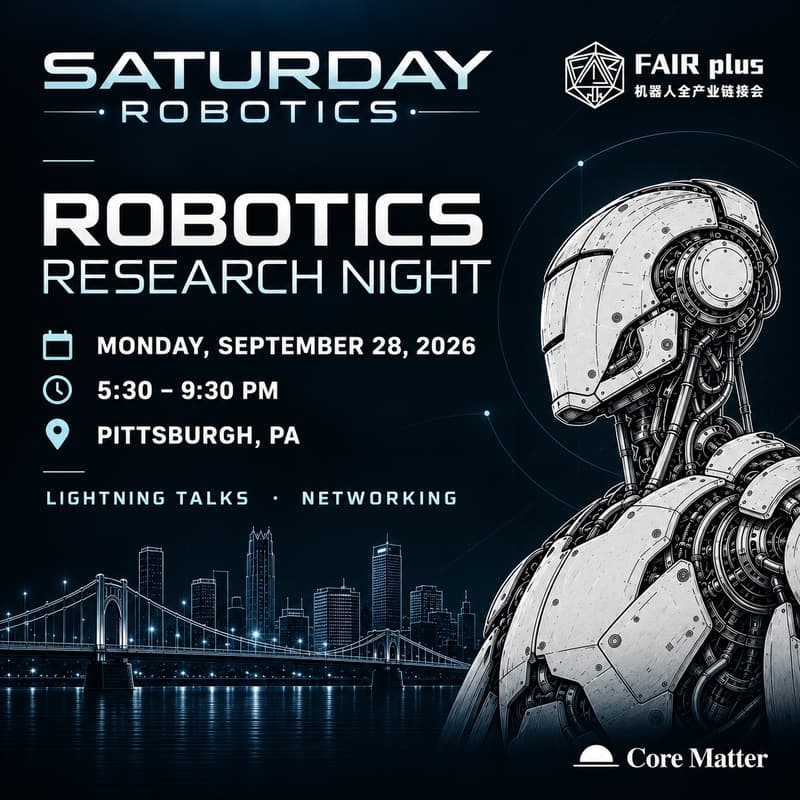
🍾 IROS 2026 x Saturday Robotics x FAIR Plus — Robotics Research Night | Reading Club 31. Pittsburgh 9/28
🍾 IROS 2026 x Saturday Robotics x FAIR Plus — Robotics Research Night | Reading Club 31. Pittsburgh 9/28
📅 Monday, September 28
🕠 5:30 PM – 9:30 PM
📍 Pittsburgh, PA (walking distance from David L. Lawrence Convention Center)
About Event
After a full day of technical sessions at IROS 2026, join Saturday Robotics for an evening of high-signal technical discussions, lightning talks, and networking with researchers, founders, engineers, investors, and students building the future of robotics.
Saturday Robotics has become one of Silicon Valley's largest community-driven robotics research groups, bringing together researchers from Google DeepMind, NVIDIA, Stanford, UC Berkeley, CMU, MIT, Physical Intelligence, Tesla, Figure, Agility Robotics, Skild AI, Boston Dynamics, and many leading robotics startups.
Support Saturday Robotics Inc: https://donate.stripe.com/28EcN52rjgeY1fJboYgEg00
This event is brought to you by FAIR Plus, our title sponsor. FAIR Plus is an annual trade exhibition and technology exchange platform held in Shenzhen, China, focusing on artificial intelligence, hardware development, and robotics. Their upcoming exhibition is April 21-23, 2027.
Whether you're presenting at IROS, recruiting collaborators, building a startup, or simply interested in meeting others working on Physical AI, we'd love to see you in Pittsburgh.
Agenda
🕠 5:30 PM – 6:00 PM
Doors Open & Happy Hour Networking
Grab a drink, meet fellow attendees, reconnect with old friends, and make new ones before the technical sessions begin.
🕕 6:00 PM – 7:30 PM
Lightning Talk 1
Lizhi(Gary) Yang is a Ph.D. candidate in Mechanical Engineering at Caltech, advised by Professor Aaron Ames in the AMBER Lab. Lizhi’s research focuses on humanoid robotics, robot safety, and learning-based control.
Today, He will present PAC-MAN, a framework that combines onboard perception, reinforcement learning, and control barrier functions to teach humanoid robots to dodge incoming objects while staying balanced. The work explores how perception and safety must be designed together for fast, whole-body robot reactions.
https://arxiv.org/abs/2607.28623v1
PAC-MAN: Perception-Aware CBF-RL for Whole-Body Safety in Humanoid Dodgeball presents a perception-aware reinforcement learning framework designed to improve the safety and robustness of humanoid robots operating in dynamic environments. The work combines Control Barrier Functions (CBFs) with reinforcement learning and realistic onboard perception, addressing a key challenge in robot learning: policies can achieve impressive performance but may behave unsafely when exposed to unexpected disturbances or imperfect observations.
The system is demonstrated on a Unitree G1 humanoid robot performing a dynamic dodgeball task. During deployment, the robot relies only on proprioception and depth information from a head-mounted RGB-D camera. A segmentation model isolates the incoming ball from the depth image, creating a compact perception representation that closely matches the training setup. This design reduces the sim-to-real gap and allows the learned policy to operate without additional fine-tuning.
PAC-MAN introduces two levels of CBF-based safety guidance. Link-CBF represents collision clearance for every robot body link, rather than protecting only the torso. The safety constraint is incorporated into the training reward, encouraging the policy to learn collision-free behavior directly. Importantly, no runtime safety filter is required during deployment. Joint-CBF, meanwhile, provides stronger guidance through joint-space constraints and can serve as a privileged safety filter during training or evaluation, although its effectiveness depends strongly on accurate perception of the approaching object.
The framework also incorporates an adversarial human-motion prior, encouraging natural evasive behaviors such as ducking, sidestepping, leaning, and jumping. In real-world experiments, the G1 successfully dodged 19 of 20 throws (95%) with zero falls, while using onboard perception and no policy fine-tuning. The results demonstrate that integrating perception-aware safety constraints directly into robot learning can produce more robust, transferable, and deployment-ready whole-body behaviors for humanoid robots.
Lightning Talk 2
Aaron Li (Rhoda AI, Robot Data System Lead, Research Member of Technical Staff)
How in-context learning is reshaping robot learning data at scale.
Lightning Talk 3
X2Real: an eXtensive simulation benchmark for real-world generalist policies
Liangwang Ruan, X Square Robot, Simulation Tech Lead
Generalist robot manipulation policies have developed rapidly, yet their reliable evaluation remains challenging due to fundamental flaws in existing simulation benchmarks: prominent sim-to-real gaps, narrow task coverage, and unfair evaluation caused by ambiguous training-test pipelines. Prior works only partially resolve these issues and lack simultaneous faithfulness, diversity, and fairness, while static benchmark designs fail to sustain long-term policy development. We presents X2Real, an evolvable simulation benchmark for faithfully evaluating the real-world performance of robotic manipulation policies. Following three core principles—faithfulness, diversity, and fairness—X2Real calibrates simulation visual and physical properties to align with real hardware, achieving a 0.84 linear correlation between simulated and real-robot evaluation results. It features a comprehensive taxonomy with 10 capability dimensions and 44 hierarchical long-horizon tasks, covering basic manipulation skills and advanced capacities such as visual grounding, language understanding, and bimanual control. We further adopt multi-axis domain randomization and strictly disjoint training-evaluation pipelines to mitigate benchmark exploitation and ensure credible evaluation. Powered by a custom physical domain-specific language, the Mana simulation ecosystem supports modular task design and iterative performance analysis, alongside a nearly 300-hour annotated simulation trajectory dataset. X2Real offers a faithful, diverse, and fair evolving evaluation infrastructure, effectively bridging the sim-to-real evaluation gap and supporting the advancement of generalist robotic manipulation policies.
Lightning Talk 4
Rethinking Generalist Robotic Manipulation: Architecture, Data and Inference for Real-World Deployment
Peiyan Li (Chinese Academy of Sciences)
Generalist robotic manipulation is largely limited by heavy data reliance and saturated training paradigms, with conventional VLA models struggling to generalize reliably in real daily scenarios. This work advances generalist manipulation along two core directions. First, we propose a series of optimized 3D VLA architectures, memory-augmented designs and motion-based representation learning. These architectural innovations greatly reduce the demand for expensive robot teleoperation data, leveraging standalone ego and UMI human interaction priors to achieve more robust generalization and long-horizon manipulation. Second, we explore real-world model scaling with large-scale robotic pre-training. Our extensive experiments reveal the inherent limitations of simulation benchmarks for real-robot generalization. Beyond offline scaling, we further empower policies via inference-time contextual learning and closed-loop correction, showing that inference intelligence substantially lifts real-world performance without retraining. Together, our architecture-efficient and scaling-aware paradigms pave a practical path toward deployable everyday robotic manipulation systems.
Lightning Talk 5
HiRE: Hindsight Reward Editing for Policy Finetuning (CoRL 2026 accepted)
Haoyi Niu (UC Berkeley)
Pre-trained robot policies always require finetuning to adapt to specific environments. Reinforcement Learning (RL) offers high performance potential because it improves action optimality rather than simply mimicking data. However, such potential depends heavily on reward quality. Sparse rewards lack process feed- back, human-designed rewards are costly and biased, and semantic rewards from foundation representations are often not control-centric. We propose Hindsight Reward Editing (HiRE), a training-free framework to break this reward bottle- neck. HiRE bridges the broad knowledge of foundation representation models with physical control awareness, by contrasting successful and failed trajectories in hindsight. It calibrates foundation representation models by identifying "trap states" that are predicted as high-rewarding states yet eventually result in failure, and vice versa. HiRE explicitly penalizes these traps while boosting rewards for critical successful states. This approach can be flexibly compatible with any foundation representations and RL algorithms. Experiments show that HiRE consistently outperforms other reward recipes by delivering dense, control-aware feedback that prevents value function collapse and reward hacking, thereby achieving superior sample efficiency, stable policy updates, and higher performance ceilings, e.g., at least 3× performance of the base policies.
Lightning Talk 6
We're opening a limited number of community lightning talk slots.
~10 minutes each
Research-focused and technical
A few slides are sufficient
Frontier papers, new projects, open problems, practical lessons, demos, or startup technical insights
Topics include (but are not limited to):
World Models
Physical AI
Humanoid Robotics
Vision-Language-Action Models
Robot Foundation Models
Robot Learning
Manipulation
Reinforcement Learning
Simulation & Sim-to-Real
Spatial Intelligence
Computer Vision
Embodied AI
📣 Call for Lightning Talks
Interested in speaking?
Please email junfanzhu98@gmail.com with:
Talk title
Abstract
Name & affiliation
Relevant links (arXiv paper, GitHub, slides, blog, etc.)
Priority will be given to technically deep talks that encourage hot takes & discussion within the robotics research community.
🕢 7:30 PM – 8:00 PM
Open Discussion & Paper Roundtable
Bring a paper you'd like to highlight!
We'll host informal roundtable discussions (approximately 10–20 minutes per topic) where participants can briefly introduce recent papers, explain why they matter, and discuss technical ideas, implementation details, open questions, and future directions.
Everyone is welcome to start a discussion.
🕗 8:00 PM – 9:30 PM
Happy Hour & Networking
Continue conversations over food and drinks with fellow researchers, founders, students, and engineers.
Who Should Join?
Anyone attending IROS interested in:
Physical AI
World Models
Humanoid Robotics
Robot Learning
Vision-Language-Action Models
Embodied Foundation Models
Manipulation
Reinforcement Learning
Simulation & Digital Twins
Spatial Intelligence
Whether this is your first Saturday Robotics event or you've attended one of our Reading Clubs before, everyone is welcome.
About Core Matter
Core Matter is a newsletter focusing on the full Physical AI stack and supply chain. It analyzes the economics, hardware component and deployment economics through company filings.
Join the Community
Support Saturday Robotics Inc: https://donate.stripe.com/28EcN52rjgeY1fJboYgEg00
💬 Join our Discord Community
Join Discord Server
𝕏 Follow Saturday Robotics on X
saturdayrobotic
Subscribe to Core Matter:
https://corematter.substack.com
⚠️ Space is limited. Please RSVP so we can estimate attendance.
Looking forward to meeting everyone at IROS 2026 in Pittsburgh!
Hosts: Junfan Zhu, Aurora Feng
discord.gg/WH7DrTHRXK