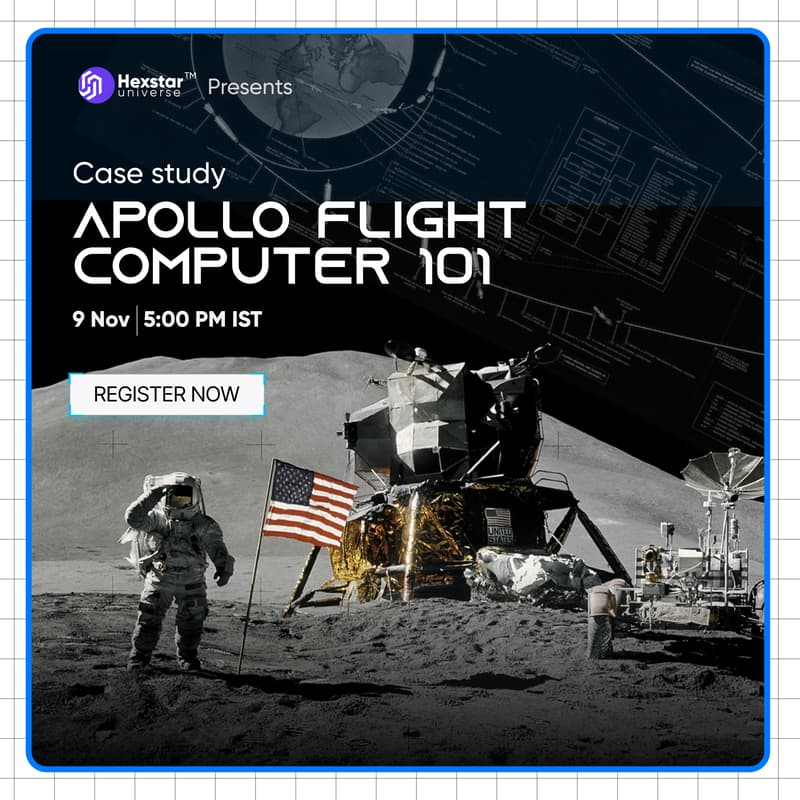
Apollo Flight Computer 101 case study
Apollo Flight Computer 101: Engineering the Software That Landed Humans on the Moon
Journey through one of humanity's greatest engineering achievements. This live case study decodes the Apollo Guidance Computer (AGC) the revolutionary computer that guided Apollo 11 to the lunar surface with just 2 MHz of processing power, 4 KB of RAM, and 72 KB of ROM. Less computing power than a modern smartwatch, yet it performed calculations that changed history.
What You'll Discover:
Hardware & Software Marvel – Explore the miniaturized computing system that replaced room-sized computers, featuring MIT's groundbreaking integrated circuit design and real-time operating system architecture
The Lunar Landing Procedure Decoded – Walk step-by-step through the descent algorithm, understanding how the AGC managed orbital dynamics, trajectory calculations, and autonomous descent control in real-time
Pioneering Design Principles That Saved the Mission – Learn how Margaret Hamilton's software engineering team built failure-resistant systems with no known bugs. Discover the famous 1201/1202 alarm that nearly aborted the landing—and how intelligent system design recovered gracefully under extreme pressure
Robust-by-Design Software – Understand modular architecture, priority-based task scheduling, error detection & recovery mechanisms, and constraint-driven excellence that influenced modern software engineering
From 1969 to Today – See how Apollo's design principles still shape embedded systems, avionics, satellite guidance, and mission-critical software