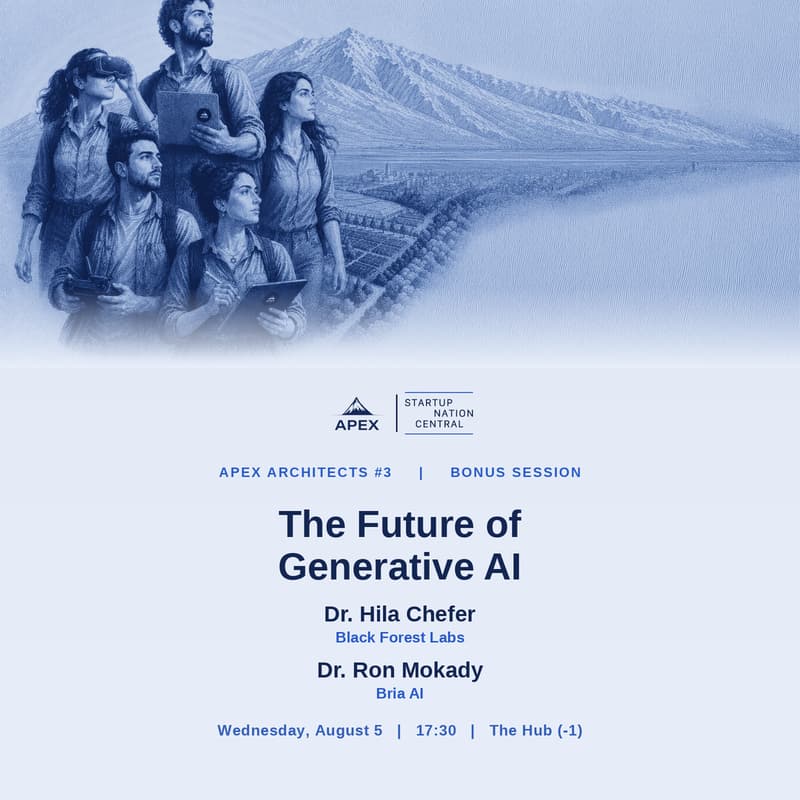

The Future of Generative AI · Hila Chefer & Ron Mokady
This Wednesday, we go inside the black box of generative AI.
Two researchers, two perspectives, and one central question: what should the next generation of generative AI become?
Should we build complete multimodal systems that understand video, audio, and the physical world? Or should we invest in finer control, making generative models more precise, predictable, and production-ready, closer to advanced rendering engines than full world models?
AGENDA
18:45–19:00 · Gathering
19:00–20:00 · Lecture: Dr. Hila Chefer, Black Forest Labs
20:00–20:15 · Break
20:15–21:15 · Lecture: Dr. Ron Mokady, Bria AI
21:15–21:30 · Closing
DR. HILA CHEFER · BLACK FOREST LABS
Researcher on the Fundamental Research team at Black Forest Labs and incoming Assistant Professor at Tel Aviv University in October 2026. Hila completed her PhD under Prof. Lior Wolf and previously conducted research at Meta AI and Google Research, contributing to projects including VideoJam and Lumiere. Her work spans controllable generation, including Attend-and-Excite, and transformer explainability.
Toward Generative Models That Understand the Real World
Frontier generative models can produce visuals that once seemed impossible, yet they still fail at basic physics, spatial consistency, and simple instructions. This talk looks inside the black box, examining internal representations and failure modes to develop methods that improve fidelity, coherence, and instruction-following without relying solely on massive scale. These approaches can sometimes outperform far more resource-intensive proprietary models.
DR. RON MOKADY · BRIA AI
VP of Research at Bria AI, where he leads the development of visual generative models trained on licensed data. Ron completed his PhD at Tel Aviv University under Prof. Daniel Cohen-Or and Dr. Amit H. Bermano, and previously conducted research at Google and Meta. His widely used works include Null-Text Inversion and Prompt-to-Prompt.
Beyond Text-to-Image: Building Controllable and Production-Ready Generative Models
What happens when text is not enough? Ron will discuss adding numerical parameters for finer control, identifying gaps in available training data, and using reward hacking as a lens for understanding broader research challenges in generative AI. The talk will then move from research to deployment: what it takes to make generative models predictable enough for production, and where the key opportunities lie across market needs, efficiency, and open-source development.