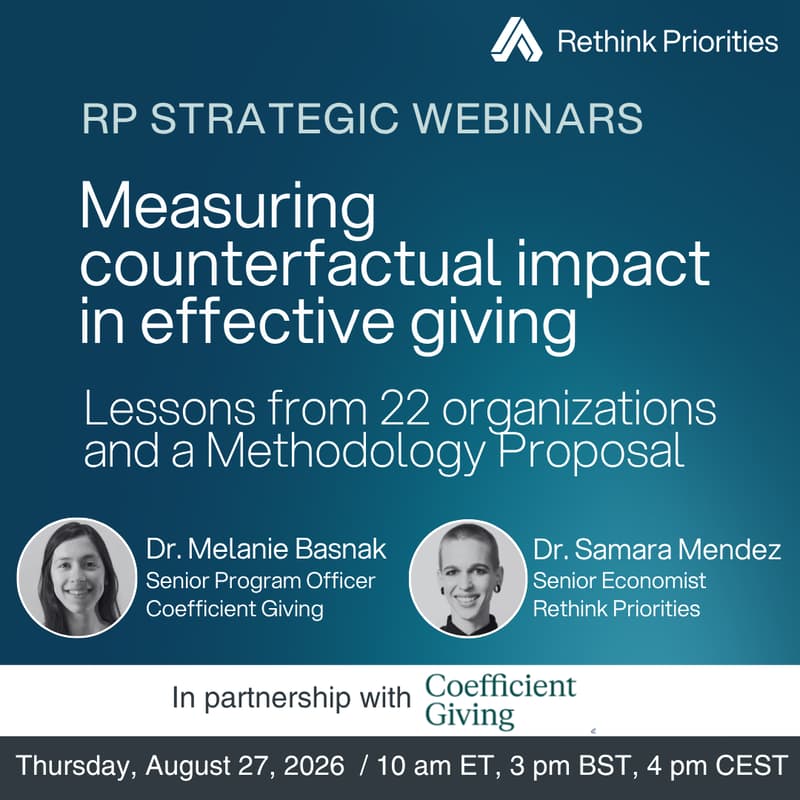
Measuring Counterfactual Impact in Effective Giving
Organizations whose theory of change relies (in part, or completely) on informing donors about effective giving opportunities often report their impact as "money moved," the total amount donated through their platform or thanks to their advice. But that headline number can overstate the real contribution. If a donor would have given the same amount to an equally effective charity anyway, that organization didn't cause the impact; it just happened to be in the room. The question that matters is how much of the money moved is genuinely additional, and how much would have happened regardless.
Most organizations try to answer this with short donor surveys, but survey designs vary widely, and the resulting estimates aren't directly comparable from one organization to the next. So when two organizations report very different counterfactual numbers, it's hard to know whether that reflects a real difference in their donors or just a difference in how they did the math.
A new Rethink Priorities report tackles this problem head-on. Drawing on counterfactual impact data voluntarily shared by 22 effective giving organizations across more than 10 countries (2022 to 2026), it re-expresses every organization's estimate on a common methodological basis, separating genuine differences between donor populations from artifacts of measurement. The headline finding: among organizations who use roughly similar types of surveys, around 60% of the apparent difference in reported counterfactual estimates comes down to methodology, not real differences in their donors’ motivations. The report also challenges the common assumption that donors from the effective altruism community would have given anyway, and offers concrete, standardized guidance any organization can adopt to make its own measurement more accurate and more comparable across the field.
This webinar shares key learnings and proposes an improved methodology that could help organizations align and improve their impact tracking. The session is designed to bring you up to speed and show what adopting the approach would look like in practice.
What to expect
The session will open with a brief introduction from Dr. Melanie Basnak, Senior Program Officer at Coefficient Giving, on why this work matters for funders and practitioners in the effective giving space.
Dr. Samara Mendez, the Rethink Priorities researcher who developed the methodology, will then give a 15- to 20-minute talk walking through the core ideas: what "counterfactual share" means and why it's the right thing to measure, what the cross-organization data revealed, and the practical recommendations organizations can put into place, including what questions to ask donors and how to weight results.
Ample time for Q&A will follow.
Who should attend
This session is for anyone who designs, reports, or relies on counterfactual impact estimates for money moved from retail donors (especially those working at effective giving organizations), as well as funders and researchers interested in how the sector measures its own effectiveness. Whether your organization already runs a checkout survey or is thinking about how to start, you'll leave with a clearer picture of what good measurement looks like and how to move toward it.
Speakers
Dr. Samara Mendez is a Senior Economist at Rethink Priorities and the author of the report Measuring Counterfactual Impact in Effective Giving: Methods Review and Recommendations.
Dr. Melanie Basnak is a Senior Program Officer at Coefficient Giving, where she supports their Effective Giving and Careers program.