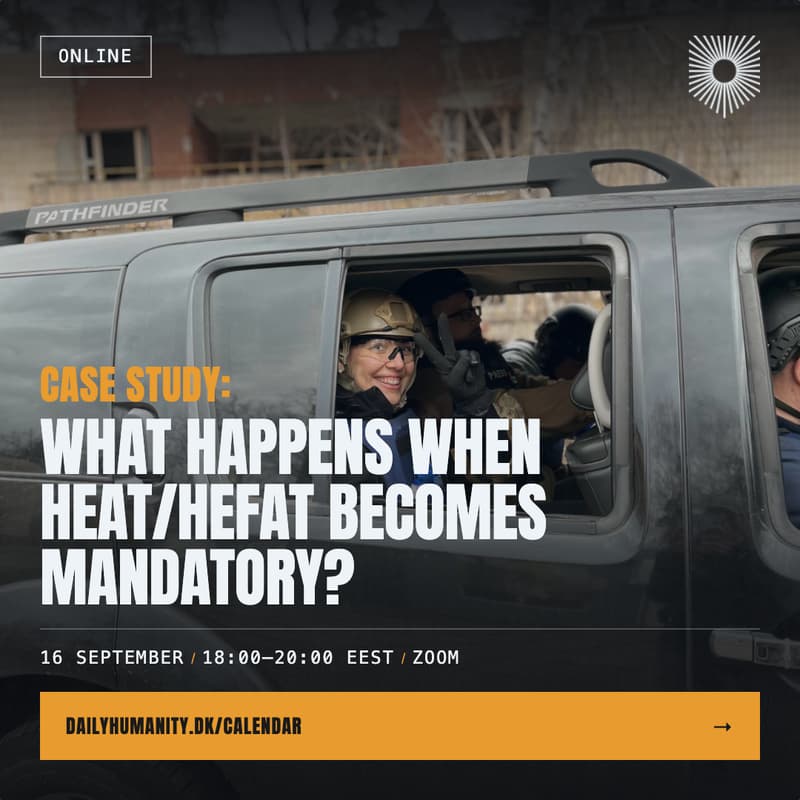

Case Study: What Happens When HEAT/HEFAT Becomes Mandatory?
As reporting from high-risk environments becomes increasingly complex, safety training can no longer be treated as a one-off requirement.
Daily Humanity invites journalists, editors, media managers and safety professionals to an online discussion presenting the findings of a new case study on the experience of the Ukrainian editorial team of Radio Free Europe/Radio Liberty (RFE/RL) and its implementation of mandatory HEAT/HEFAT certification.
The study, commissioned by Daily Humanity and conducted by independent researcher Hanna Hrytsenko, examines how mandatory safety certification has affected the newsroom’s safety culture, fieldwork and team dynamics — and what other media organisations can learn from this experience.
We will explore what effective safety training looks like in practice and present the key findings of the case study:
Why RFE/RL introduced mandatory HEAT/HEFAT certification
How the policy has changed safety practices inside the newsroom
What skills journalists and crews rely on in real-life emergencies
How regular training and refreshers contribute to preparedness
How common training affects teamwork and trust in the field
The benefits and challenges of making HEAT/HEFAT mandatory
Can mandatory safety training become a lasting part of newsroom culture — rather than simply another box to tick before deployment?
Key questions
What makes safety training effective beyond the classroom?
How often should journalists refresh their skills?
How can news organisations balance safety requirements with the realities of field reporting?
Does shared training make teams more effective under pressure?
What can smaller media organisations learn from the RFE/RL model?
How should safety training evolve as threats change?
Speakers:
Gavin Rees - Senior Advisor for Training and Innovation, Global Center for Trauma and Journalism, formerly director of Dart Centre Europe.
Hanna Hrytsenko - Independent researcher, sociologist
Katerina Sergatskova (host) - Director, Risk manager, Daily Humanity.
The event is open to journalists, media organisations, safety professionals, humanitarian organisations and others working in high-risk environments.