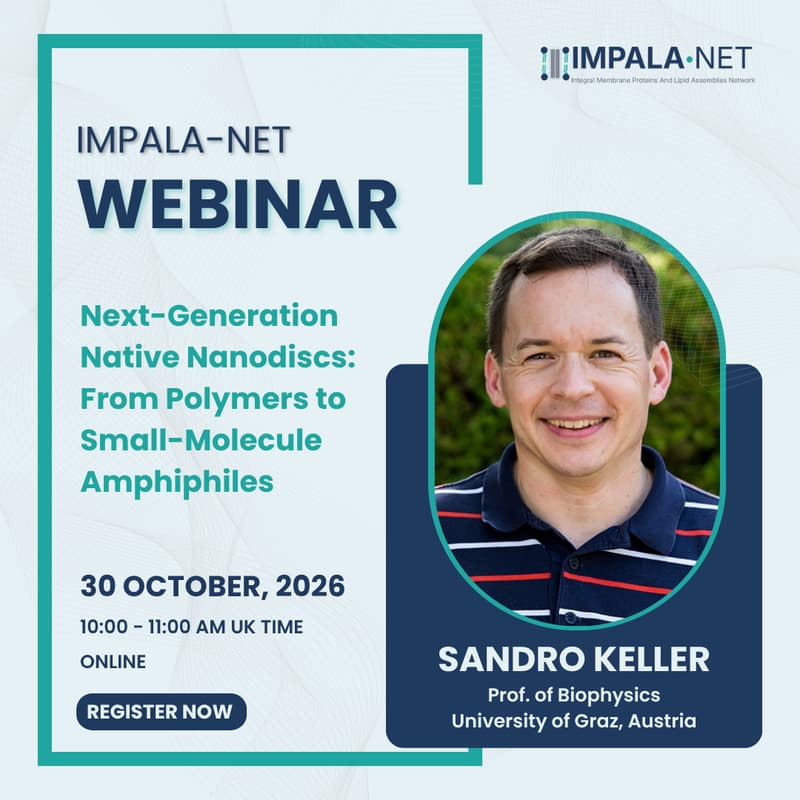

Next-Generation Native Nanodiscs: From Polymers to Small-Molecule Amphiphiles
Join us for the first webinar in the IMPALA Network Webinar Series.
How can we study membrane proteins while preserving the lipid environment that surrounds them?
Join Professor Sandro Keller to explore recent advances in native nanodiscs, platforms that hold membrane proteins or protein complexes within a lipid bilayer, enabling biophysical and structural studies under controlled, native-like conditions.
Professor Keller will introduce his laboratory’s approaches to extracting membrane proteins directly from cellular membranes without detergents, preserving both the bilayer architecture and the local lipid composition. He will discuss new amphiphilic polymers and small-molecule amphiphiles designed to form nanodiscs compatible with a wide range of biophysical techniques.
Selected applications will include:
Measuring oncoprotein–antibody and peptide–lipid interactions using microfluidic diffusional sizing (MDS) and flow-induced dispersion analysis (FIDA).
Analysing membrane-protein complexes using mass spectrometry.
Examining large membrane-protein assemblies using cryo-EM.
The presentation will be followed by a live Q&A and discussion with Professor Keller: an opportunity to explore the methods, discuss their applications and consider how they might relate to your own work.
The session is open to researchers interested in membrane proteins, lipid–protein interactions, biophysics, structural biology and related fields.
ABOUT THE SPEAKER
Professor Sandro Keller is Full Professor of Biophysics and Head of the Biophysics Division at the University of Graz, Austria. His group develops native nanodiscs for membrane-protein research, fluorescence-based microfluidic methods for measuring interactions at membranes, and computational approaches to predicting protein allostery.
SESSION FORMAT
10:00 am | Welcome and introduction
10:05 am | Presentation by Professor Sandro Keller
10:40 am | Questions and discussion
10:55 am | Closing remarks
11:00 am | Session ends
Attendees are encouraged to bring questions and contribute to the discussion.