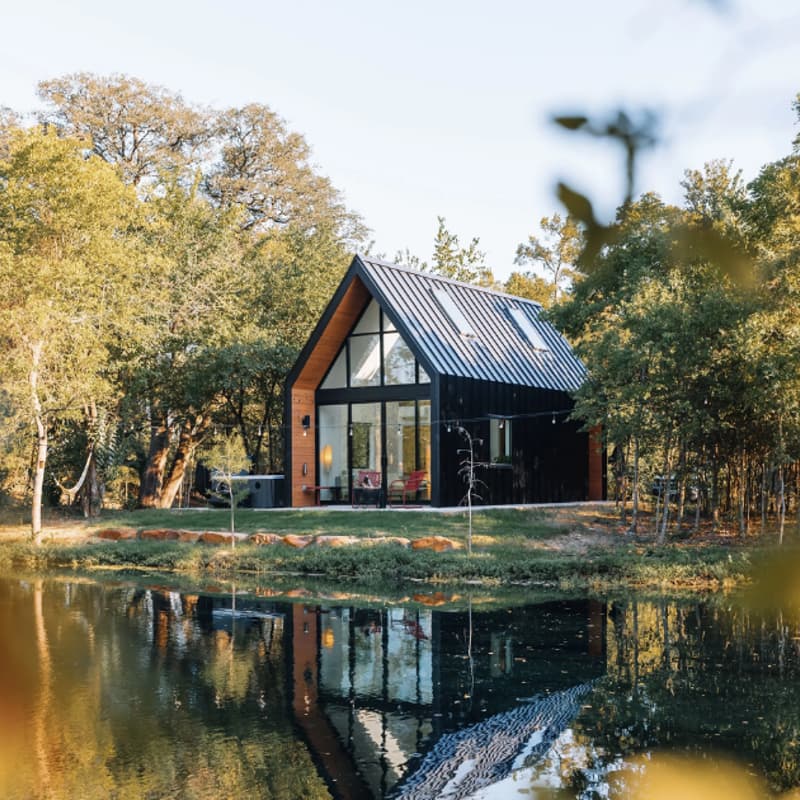

Building & Funding Micro-Resorts
About This Event
A two-hour interactive workshop designed for real estate investors, developers, and hospitality entrepreneurs who want to understand—and build—the micro-resort asset class: purpose-built experiential lodging properties, typically 5–20 keys, founder-led, story-driven, and located within drive distance of a major metro.
Led by Isaac French, founder of Live Oak Lake—one of the most recognized micro-resorts in the country. At 24, Isaac bought five acres of raw Texas land and built a seven-cabin resort for $2.3M. A year later, he sold it for $7M ($1M per key), driven by an Instagram following he built from scratch to 150K, 80%+ direct booking rates, and 94% first-year occupancy. Isaac now teaches the Experiential Hospitality masterclass and advises operators building in the category he helped define.
Tuesday, June 9: 12:00pm–2:00pm ET
The session will be recorded and shared with all participants via Circle.
Over two hours, you’ll learn where the micro-resort category came from and why it’s now attracting institutional attention, what makes the best micro-resorts work (and what kills them), how to evaluate sites, build a brand, and structure capital—from rewards-based crowdfunding through SBA lending to GP fund vehicles. The session includes real case studies from Live Oak Lake, Bolt Farm Treehouse, Onera, and other leading properties.
Participants will receive post-course access to Circle, where we’ll share recordings, financial models, and deal examples.
You’ll Learn How To
Understand the micro-resort category: what it is, where it came from, why small key counts are a structural advantage (not a limitation), and why institutional buyers are paying real multiples for founder-built properties
Evaluate what makes a winning micro-resort: the DNA that separates properties commanding $1M+ per key from the rest—founder presence, visual identity, storytelling from day one, deliberate location, and a reason to exist beyond comfort
Assess sites and markets: drive-time analysis, what makes a location investable, zoning and permitting in rural counties, and how proximity to major metros shapes the entire business model
Build the brand that drives the business: how the best operators use social media, storytelling, and community-building to achieve 80%+ direct booking rates and pre-sell properties before the first cabin is built
Structure capital for every stage: rewards-based crowdfunding to prove the concept, SBA and construction lending to build, and GP fund aggregation for thoughtful scale—sequential tools, not competing ones
Navigate the risks honestly: founder dependency, operational intensity, bespoke construction, the gap between personal timeline and asset readiness, and why “passive income” is the wrong frame for this category
You’ll leave with a practical framework for evaluating, building, funding, and operating micro-resorts—and a clear-eyed view of what separates this category from conventional hospitality.
The Workshop Will Cover
Part One: The Category, the DNA & the Brand (approx. 60 min)
Where Micro-Resorts Came From & When the Market Crystallized
How Airbnb democratized distribution, then commodified it—creating the vacuum that founder-led experiential lodging filled. The COVID acceleration, the drive-to leisure boom, and how a coherent category emerged: purpose-built, 5–20 keys, founder-led, story-driven, within 1–3 hours of a major metro.
The DNA of a Winning Micro-Resort
What the best properties—Live Oak Lake, Bolt Farm Treehouse, Onera, The Cliffs at Hocking Hills—have in common. Founder presence in the design, hospitality, and marketing. A visual identity strong enough to spread organically. Storytelling that starts before the land is cleared. Deliberate location. A reason to exist beyond comfort. And the occupancy math at small scale: 12 keys at 85% occupancy and $350/night ADR generates ~$1.3M in annual revenue.
Brand as the Asset: Building Direct Booking Dominance
How the best operators build Instagram followings, pre-sell properties through public storytelling, and achieve 80%+ direct booking rates—making them independent of OTAs. Why the storytelling and the business are the same operation. The crowdfunding-as-marketing playbook: operators who’ve raised $400K–$1M+ on Indiegogo or their own platforms by pre-selling stays before breaking ground.
The Part Nobody Likes to Talk About
Why this is not passive income. Founder dependency as both competitive advantage and liability—across performance, valuation, and exit. How to build a brand strong enough to outlast the founder’s most intense season of involvement. The selection mechanism: operators who treat it as a yield play consistently underinvest in what drives returns. Burn-out, the misalignment between personal timeline and asset readiness, and how to manage both.
Part Two: Capital, Deals & the Path Forward (approx. 60 min)
Creative Capital for a Creative Asset
Why the capital markets haven’t caught up—and how that’s changing. The three-stage capital stack: rewards-based crowdfunding to prove the concept and validate demand, SBA 7(a) and 504 programs as the workhorse of the middle stage, and the GP fund vehicle as the institutional answer. How a properly sequenced stack turns each stage into a foundation for the next.
Rewards-Based Crowdfunding: The Playbook
How 20+ operators have raised $400K–$1M+ without giving up equity—pre-selling stays in exchange for discounts and perks. Why backers are frequently future guests and the founder’s public story is also the pitch. How a well-run campaign validates demand, generates press, and convinces lenders who wouldn’t otherwise look at a 10-key cabin project. Case study: Cypress Resort, which crowdfunded over $800K in 4 months.
SBA Lending & Construction Finance
Navigating the SBA 7(a) and 504 programs for experiential hospitality. How to package a rural hospitality deal for a conventional lender. Construction lending for bespoke builds where nothing is off the shelf. Why operators who understand these programs have a meaningful financing advantage.
The GP Fund Structure: Scaling the Category
The thesis: aggregate 8–15 micro-resort projects under a single GP vehicle anchored by an experienced developer-operator. Why the LP base looks different from traditional real estate—the pitch is cash flow and brand appreciation, not IRR. How to keep founders economically invested and creatively autonomous while providing capital and infrastructure. The risk: destroying what made the asset special by installing professional management to optimize RevPAR.
Why Now: Exits, Demand & the Institutional Signal
Live Oak Lake sold at $1M/key (8% cap rate). Onera was acquired by Summit Hotel Properties. Under Canvas bought The Fields. Marriott bought Postcard Cabins. Institutional buyers paying real multiples for founder-built assets. Experience spending up 65% vs. 2019 while goods spending grew 12%. The second generation of operators who understand storytelling requirements before they break ground. And the AI tailwind: as generated content proliferates, the appetite for real places made by real people with taste and intention will grow.
Who’s Teaching
Isaac French — Founder, Live Oak Lake
Isaac is the founder of Live Oak Lake—one of the most recognized micro-resorts in the country and an early catalyst for the category. At 24, he bought five acres of raw land in Waco, Texas, and built a seven-cabin resort for $2.3M using a construction loan, maxed-out credit cards, and loans from friends and family. Within a year, the property was operating at 94% occupancy with 80%+ direct bookings, driven by an Instagram following Isaac built from scratch to 150K. He sold the property in 2023 for $7M ($1M per key, 8% cap rate) to a group of HNW investors. Isaac now teaches the Experiential Hospitality masterclass and community, advising the next generation of micro-resort operators from his farm in Waco, Texas.
Thesis Driven
A media-led real estate & capital-markets platform teaching investors and sponsors the strategies shaping the built world.
Format & Access
One live session: Two hours on Tuesday, June 9 from 12:00pm–2:00pm ET
Post-workshop access via Circle: All participants will receive an invitation to join our private Circle community after the workshop concludes.
Within one week of the workshop ending, participants will receive access to:
Full session recording
Slides and presentation deck
Financial models, capital stack templates, and crowdfunding playbook resources
Circle is where we host all workshop materials and continue the conversation. Members also gain access to a live, active community of real estate investors, developers, operators, and capital allocators to connect, ask questions, and continue the discussion beyond the session.
Frequently Asked Questions
Will participants receive a copy of the materials?
Yes. All registered participants will receive an invitation to join our private Circle community. Recordings, slides, models, and case studies will be uploaded within one week of the workshop ending.
I can’t make this time—will a recording be available?
Yes. All registered participants receive access to the recording and materials via Circle, even if they cannot attend live.
Do I need hospitality or development experience to attend?
No. This workshop is designed for anyone interested in the micro-resort category—whether you’re an investor evaluating the asset class, a developer considering your first project, or an operator looking to scale. Isaac starts with the fundamentals and builds to advanced capital structuring.
Is this relevant for people who already operate short-term rentals or glamping properties?
Absolutely. If you’re already in experiential hospitality, this workshop covers the capital structures, brand-building strategies, and scaling frameworks that separate one-off properties from a real platform. The crowdfunding playbook and GP fund structure sections are especially relevant for operators looking to grow beyond their first property.