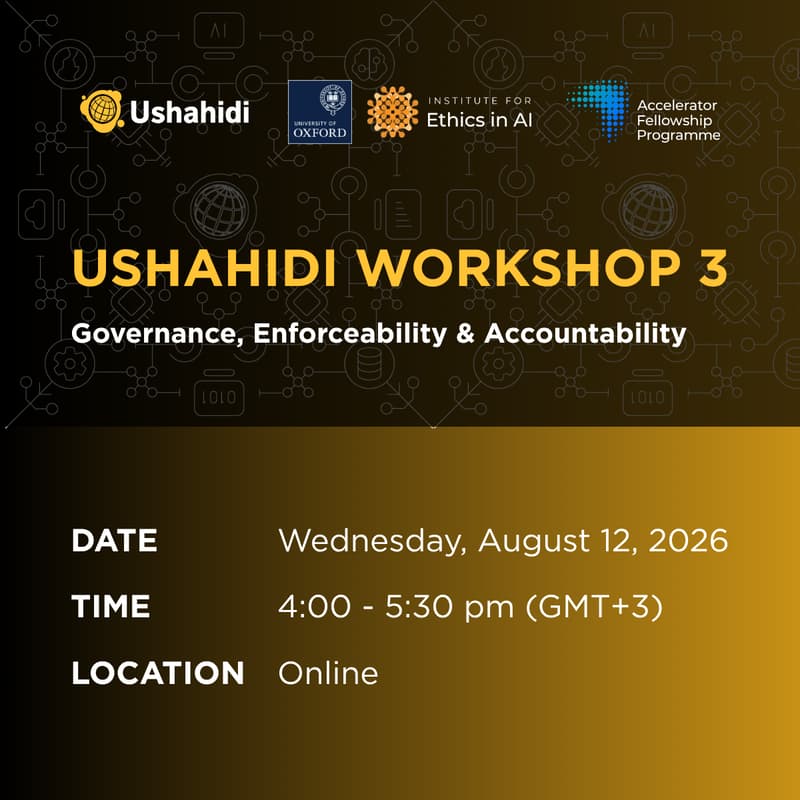

Data is Destiny: Governance, Enforceability & Accountability
In our second Data Is Destiny session, we worked through what meaningful consent looks like for vulnerable communities in low-connectivity environments, whether classifying data by sensitivity changes that picture, and what communities themselves recognise as protection. The result was a draft consent framework and a data classification schema, built with community intermediaries, deployment partners, and data protection practitioners in the room.
This third session picks up where the July session left off. It asks:
What a governance body for community data should actually look like, in its composition, its decision-making, and how much authority communities themselves hold within it.
What happens when the framework is tested against real violation scenarios, not hypothetical ones.
What it costs to run governance like this, and what it would take to sustain it.
The Oxford workshop's legal practitioners were direct about this: governance without enforcement is tokenistic. This session takes that warning as its starting point.
This session is for legal practitioners, governance design experts, policymakers working on data sovereignty, funders who understand operational costs, and community representatives.
Together, we'll design the governance body itself, stress-test enforcement against concrete violation scenarios, and cost the governance model honestly enough to talk about sustainability.
This is the third of four workshops working toward a draft governance framework for Ushahidi's data commons, with questions and learnings we expect to be useful to anyone handling community-generated data. The work will be co-authored with Oxford's Institute for Ethics in AI and published as a white paper in October 2026.