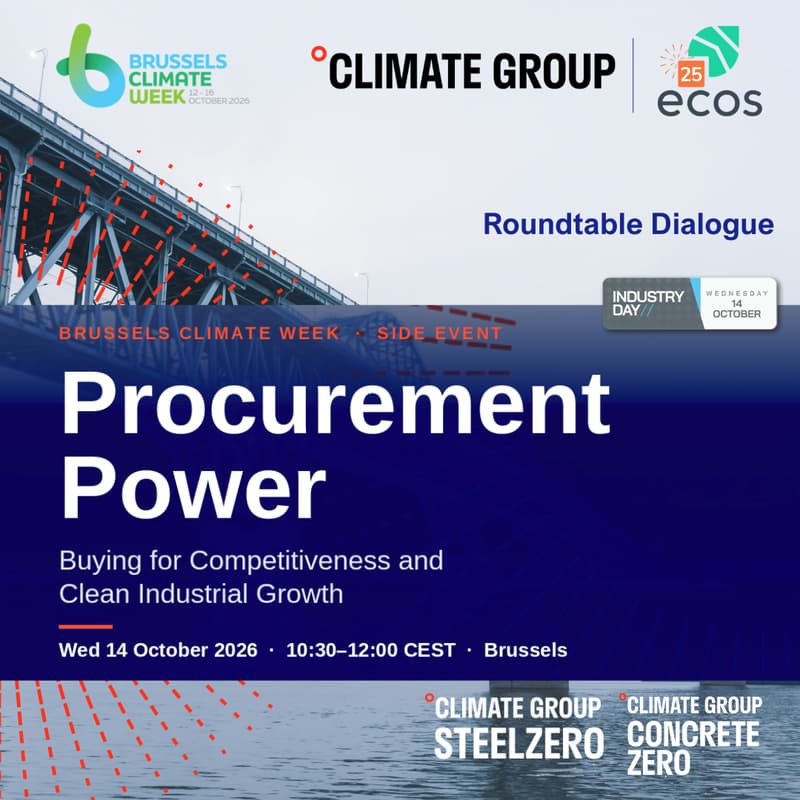

Procurement Power: Buying for Competitiveness and Clean Industrial Growth
Procurement Power: Buying for Competitiveness and Clean Industrial Growth
How green public procurement can activate markets for low-carbon steel and concrete, and what public buyers need to make it work in practice
A Brussels Climate Week partner event
Date: Wednesday, 14 October 2026 | Time: 10:30–12:00 CEST
Location: Brussels (venue details will be shared with confirmed participants)
Format: In-person roundtable dialogue
Convened by: Climate Group, in partnership with ECOS
Join us for a focused roundtable dialogue bringing together industry, subnational governments, EU stakeholders and technical experts to explore how green public procurement can become a stronger lever for industrial decarbonisation, market creation and European competitiveness, using low-carbon steel and concrete as practical test cases.
Europe's direction of travel is clear: climate action and industrial competitiveness increasingly need to be delivered together. The Green Deal Industrial Plan, the Clean Industrial Deal and the proposed Industrial Accelerator Act are sharpening the focus on creating demand and lead markets for low-carbon products. The Clean Industrial Deal explicitly positions decarbonisation as a driver of industrial growth and competitiveness, while the Industrial Accelerator Act proposes measures to increase demand for low-carbon and European-made products, including through public procurement.
Public procurement is a powerful part of that equation. Accounting for around 15% of EU GDP, it gives public buyers significant influence over markets, investment and the uptake of cleaner products.
The Commission's proposed Public Procurement Act, presented on 9 September 2026, creates a timely opportunity to examine what this means in practice. The proposal strengthens the use of best price-quality approaches, enabling environmental, innovation and resilience considerations to play a greater role alongside price across major areas of public investment, including works and key utility sectors such as transport and energy.
Steel and concrete underpin much of the infrastructure these sectors require. Construction alone accounts for around 37% of European steel demand, with steel also underpinning transport, electricity grids and key clean technologies such as wind turbines and electric vehicles. For cement, a core input to concrete, public procurement represents around 31% of the overall European market, reflecting the scale of public demand for roads, bridges, public buildings and transport infrastructure. This gives public buyers significant leverage to stimulate demand for low-carbon construction materials.
Together, these factors make steel and concrete powerful real-world tests of whether Europe’s green procurement ambitions can translate into credible market demand for low-carbon materials.
The roundtable will bring buyers and suppliers into the same conversation to address two core questions:
What capacity, guidance, tools and technical support do public buyers need to operationalise green procurement for low-carbon steel and concrete effectively?
What makes public procurement a credible market signal for industry, and how can it help scale low-carbon steel and concrete while supporting European competitiveness?
Core objectives
Identify the capacity and implementation needs of public buyers, including the skills, guidance, data, tools and technical support required to operationalise green procurement for low-carbon steel and concrete.
Examine what makes procurement requirements workable for buyers and suppliers, including the role of clear criteria, standards, verification and market engagement in creating credible demand.
Explore how strategic public procurement can accelerate markets for low-carbon materials while strengthening European competitiveness.
Who should attend?
This roundtable is designed for stakeholders involved in shaping, implementing or responding to green public procurement, including:
Regional and local governments and public procurement teams
National and EU policy and procurement stakeholders
Public authorities responsible for construction, infrastructure, transport and energy procurement
Steel, cement and concrete producers and suppliers
Construction and infrastructure companies
Standards, certification and technical experts
Organisations working on industrial decarbonisation, green procurement and European competitiveness
Expected outcomes
The roundtable will identify practical implementation gaps, lessons from existing approaches and priority areas for action, generating:
An evidence base on priority implementation and capacity gaps facing public buyers and industry in procuring low-carbon steel and concrete.
Priority actions to strengthen implementation, including needs around guidance, common criteria, standards, verification tools, technical assistance and capacity-building.
Practical recommendations for strengthening public procurement as a market signal, helping turn Europe’s green procurement ambitions into effective demand for lower-carbon materials and supporting investment in competitive, cleaner production.
Agenda
10:30–10:35 | Welcome and opening
Welcome, introduction to the purpose of the roundtable and framing of the two core questions.
10:35–10:45 | Opening keynote: Public procurement for Europe’s clean industrial transition
A short keynote on the evolving EU procurement and industrial policy landscape, including the role of strategic public procurement in supporting climate action, European competitiveness and the development of lead markets for lower-carbon products.
10:45–11:05 | Procurement in Practice: Setting the Scene
Two short interventions focused on practical implementation:
ECOS: The role of credible criteria, standards and verification in enabling effective green public procurement for lower-carbon materials.
SKAO: Lessons from the CO₂ Performance Ladder on translating sustainability objectives into procurement practice and supporting public buyers in implementation.
11:05–11:50 | Moderated roundtable dialogue
An interactive discussion bringing in public buyer and industry perspectives around the two core questions:
What capacity, guidance, tools and technical support do public buyers need to operationalise green procurement for low-carbon steel and concrete effectively?
What makes public procurement a credible market signal for industry, and how can it help scale lower-carbon steel and concrete while supporting European competitiveness?
The discussion will draw out practical experience from buyers and suppliers, including implementation barriers, capacity gaps, workable procurement approaches and areas where stronger support, coordination or common approaches may be needed.
11:50–12:00 | Key takeaways and closing remarks
Reflections on priority capacity gaps, implementation needs and practical recommendations emerging from the discussion, followed by closing remarks and next steps.
Participation
Attendance is subject to confirmation of registration. Venue details and final joining information will be shared directly with confirmed participants.