
🤖 Saturday Robotics Reading Club on Robotics & World Models for AI Researchers in SF
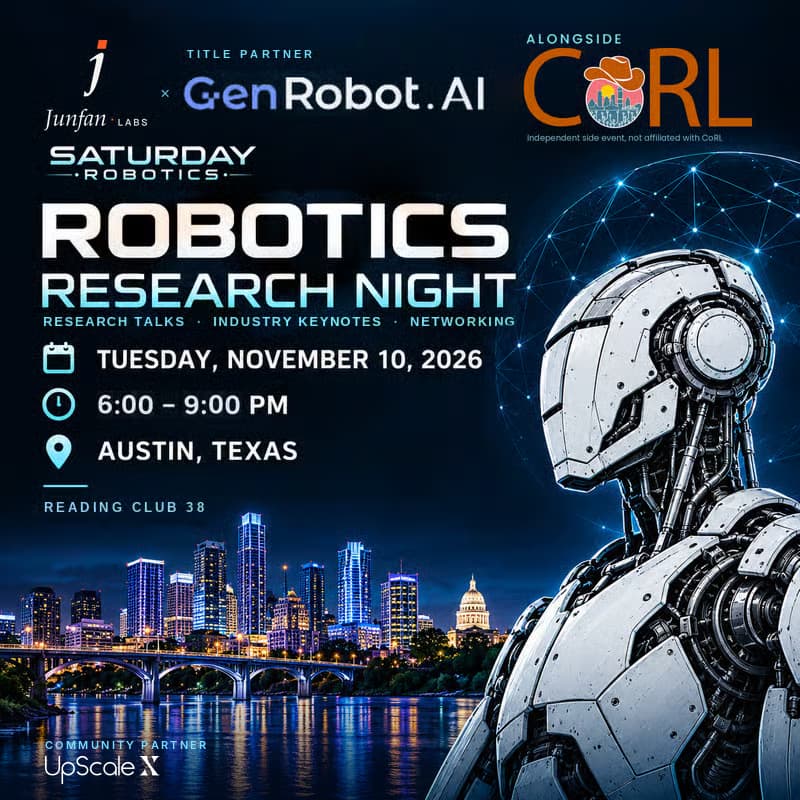
🍾 CoRL 2026 Junfan × GenRobot × Saturday Robotics Research Night | Reading Club 38. Austin 11/10
🍾 CoRL 2026 Junfan × GenRobot × Saturday Robotics Research Night | Reading Club 38. Austin 11/10
📅 Tuesday, November 10
🕠 6:00 PM – 9:00 PM
📍 Austin, TX (🚶6min walk from conference, 🏙️ 18th Floor Austin city view, 🍾 Asian buffet dinner, hot 🔥 take robotics research talks)
About Event
After a full day of technical sessions at CoRL 2026, join Junfan & Saturday Robotics for an evening of high-signal technical discussions, lightning talks, and networking with researchers, founders, engineers, investors, and students building the future of robotics.
Junfan: Junfan Labs is an independent research and technology initiative focused on robotics, world models, and Physical AI. We advance research in AI evaluation and intelligent systems, while providing technical advisory and collaborating with industry to translate frontier research into real-world applications. Our mission is to help build, evaluate, and deploy AI systems that can operate reliably in the physical world.
Saturday Robotics has become one of Silicon Valley's largest community-driven robotics research groups, bringing together researchers from Google DeepMind, NVIDIA, Stanford, UC Berkeley, CMU, MIT, Physical Intelligence, Tesla, Figure, Agility Robotics, Skild AI, Boston Dynamics, and many leading robotics startups.
Support Saturday Robotics Inc: https://donate.stripe.com/28EcN52rjgeY1fJboYgEg00
Whether you're presenting at CoRL, recruiting collaborators, building a startup, or simply interested in meeting others working on Physical AI, we'd love to see you in Austin.
At IROS 2026 October's Saturday Robotics Research Night, we were one of the coolest side events.
Agenda
🕠 5:30 PM – 6:00 PM
Doors Open & Happy Hour Networking
📍 Austin, TX (🚶6min walk from conference, 🏙️ 18th Floor Austin city view, 🍾 Asian buffet dinner, hot 🔥 take robotics research talks)
🕕 6:00 PM – 6:15 PM
Welcome Remarks
Speaker Sharing:
6:15PM – 7:30 PM
⚡ Lightning Talks
Opening Keynote 1
GenRobot: Breaking the Data Bottleneck: Scaling Human Data for Embodied AI
As embodied AI advances toward more generalizable real-world intelligence, data has emerged as one of its most critical bottlenecks. Unlike language and vision models, embodied AI requires large-scale, diverse, and high-quality data that captures not only what humans see, but also how they move, interact, and manipulate the physical world.
In this talk, GenRobot will explore the challenges of scaling human data for embodied AI and share our approach to building a Data Foundation Model that transforms diverse human experiences into structured, actionable data for robot learning.
We will also introduce our latest data acquisition systems, DEX 2.0 and EGO 2.0, designed to capture fine-grained hand motion, tactile interactions, and first-person multimodal experiences. Together, these technologies represent our efforts to bridge the gap between human skills and robot intelligence, unlocking new possibilities for scalable embodied AI development.
Lightning Talk 2
XSquareRobot: WALL-OSS: From Action-Ready Pretraining to Native Unified Embodied Intelligence
Cyril Zhang, Embodied Foundation Model Researcher @X Square Robot
Despite rapid progress in Vision-Language-Action (VLA) models, building general-purpose robotic foundation models remains challenging due to limited cross-embodiment generalization, fragmented multimodal modeling, and insufficient adaptability to novel tasks. In this talk, we introduce WALL-OSS, an open-source VLA model family that advances toward native, unified embodied intelligence. WALL-OSS-0.5 establishes a strong foundation for generalizable robotic capabilities through large-scale VLA pretraining, leveraging over one million robot trajectories per epoch across more than 20 embodiments. It introduces a gradient-bridged co-training framework that jointly optimizes discrete action prediction, multimodal understanding, and continuous action generation, enabling directly executable zero-shot manipulation capabilities on real robots while providing strong priors for downstream adaptation. Building upon this foundation, WALL-OSS-1.0 takes a significant step toward a more native and unified modeling paradigm, integrating multimodal perception, language understanding, and robotic action within a more cohesive framework. This evolution substantially enhances the model's general capabilities while unlocking stronger in-context learning, allowing the model to leverage contextual information and demonstrations to adapt to novel tasks with greater flexibility and generalization. These improvements further strengthen the model's ability to handle diverse manipulation scenarios and complex embodied interactions. Together, WALL-OSS-0.5 and WALL-OSS-1.0 demonstrate a progressive path from action-ready VLA pretraining toward scalable, unified embodied foundation models, highlighting the potential of native multimodal modeling and in-context learning for general-purpose robotic intelligence.
Lightning Talk 3: RAX (Robot Agent eXploration)
Runhan Huang. PhD student @Harvard | Prev. @Tsinghua_IIIS (Yao Class)
Robot learning has advanced by scaling demonstration datasets and model capacity; however, deploying a new robot embodiment or task typically necessitates a dedicated teleoperation corpus. The resulting policies remain bounded by their imitation distributions, limiting generalization and continual self-improvement. We introduce RAX (Robot Agent eXploration), an open-source framework for robot agents centered on scaling exploration: enabling agents to improve by acquiring online experience and synthesizing executable programs. In RAX, a general-purpose coding agent generates robot control code, operating without action demonstration data, hand-engineered action primitives, or value-function guidance. Through online exploration, the agent identifies decision sequences that achieve task goals and compiles them into modular programs encapsulating the full perception-planning-control loop. Using RAX, we present a systematic multi-embodiment study on scaling online exploration across precision and long-horizon manipulation tasks using single-arm, bimanual, dexterous, mobile, and humanoid systems in simulation and on real robots. Generalization performance on unseen environments improves consistently as exploration scales. In simulation, RAX outperforms top baseline models by +37.4% on average. On real robots, RAX autonomously learns memory-dependent, articulated, high-precision, deformable, and long-horizon mobile manipulation tasks without human demonstrations, continually improving performance by composing verified skills from prior exploration sessions. As exploration scales, we observe emergent capabilities including active perception, error recovery, safety guardrails, and human-robot collaboration. We open-source RAX as a generalist robot-agent platform in which new robot embodiments are integrated through their APIs alone, without teleoperated data collection or policy training.
Lightning Talk 4: From Video World Models to Touch: Data-Efficient Visuo-Tactile World-Action Models
Haoran Yuan (UC Berkeley, UIUC)
Video world models learn rich priors about how physical interactions unfold, but contact is often hidden from cameras, and touch has no data at web scale. Tactile world-action models usually address this with large-scale tactile pretraining. In this talk, I argue that tactile world modeling does not need large-scale tactile pretraining and can instead be transferred from a pretrained video world model. I present two models built on this idea.
VTAM fine-tunes a pretrained video world model to jointly predict future visual and tactile latents from about 100 demonstrations per task. A flow-matching action expert reads these predictive latents in a single forward pass, with no video generation at inference, and a light flow-force proxy derived from tactile optical flow keeps the policy from ignoring touch.
On four real-robot tasks across two platforms with different tactile sensors, VTAM outperforms all baselines. On eight UniVTAC tasks, it reaches 83.4% average success, comparable to models pretrained on over 30K hours of visuo-tactile data. Its frozen video encoder reads new tactile sensors zero-shot. DexTacWAM extends this recipe to bimanual dexterous hands, where contact is spread across ten fingertips. A finger- and pose-aware tactile compressor aggregates the fingertip signals into one compact latent per hand, and the world model learns to predict how multi-finger contact evolves.
On six dexterous tasks, DexTacWAM achieves the highest score on every task, averaging 70.6 against 38.0 for the strongest baseline. Removing tactile prediction cuts the four-task mean from 74.7 to 26.6. Insights for future data collection: Abundant video can supply general world-modeling priors, while scarce tactile data may be best spent on breadth and diversity, aiming for zero-shot generalization to unseen contact-rich tasks.
Lightning Talk 5
Yifei Shao (UPenn GRASP Lab, Dyna Robotics)
Robot policies are becoming a commodity, but multi-task robot learning is still limited by human effort: data is expensive to collect and label. I present SymSkill (ICRA ‘26), which learns long-horizon manipulation from just five minutes of unlabeled play. It discovers symbolic actions and stable skills on its own, then plans and replans over them in real time, composing them zero-shot into new tasks with 85% success on RoboCasa. I then introduce AttentionBench, a benchmark that measures how much human attention coding agents need to write robot policies. Every help request has a cost, and success is checked both by a hidden simulator check and by an independent evaluator agent, so policies that only look successful get caught. Together, these point toward robot systems whose cost is measured in minutes of human time, not hours of teleoperation.
Lightning Talk 6
Leo Huang, Cofounder of Cortix AI
We explore how Emg signals can be used to estimate the forces humans apply during object manipulation. Our research focuses on combining muscle activation and interaction forces, particularly challenges like generalization across tasks.
Lightning Talk 7: Robotics Data is an Alignment Problem
Shumo Chu, General Intelligence Labs
What is the endgame of robotics data: egocentric video, UMI, teleoperation, or robot deployment? The Tesla analogy suggests machines can learn from their own fleets. The LLM analogy points to the enduring value of human knowledge and feedback. Robotics will need both. Teleoperation and deployment teach robots how to act in the physical world; human demonstrations and feedback teach them how to work with us. Even a billion deployed robots won’t make human data obsolete. The best robotics models will need more than dexterous manipulation—they will need physical alignment with the people around them.
We're opening a limited number of community lightning talk slots.
~10 minutes each
Research-focused and technical
A few slides are sufficient
Frontier papers, new projects, open problems, practical lessons, demos, or startup technical insights
Topics include (but are not limited to):
World Models
Physical AI
Humanoid Robotics
Vision-Language-Action Models
Robot Foundation Models
Robot Learning
Manipulation
Reinforcement Learning
Simulation & Sim-to-Real
Spatial Intelligence
Computer Vision
Embodied AI
📣 Call for Lightning Talks
Interested in speaking?
Please email junfanzhu98@gmail.com with:
Talk title
Abstract
Name & affiliation
Relevant links (arXiv paper, GitHub, slides, blog, etc.)
Priority will be given to technically deep talks that encourage hot takes & discussion within the robotics research community.
💰 Call for Sponsors
We are also looking for sponsors to help make this community event possible.
Saturday Robotics is a community-driven, research-focused organization. Sponsorship directly helps us cover:
🍾 Food & drinks
🏠 Event space
📣 Community programming
🤖 Future robotics research events
For companies building robotics, AI infrastructure, simulation, foundation models, developer tools, hardware, or Physical AI, this is an opportunity to put your company directly in front of a highly technical robotics audience during CoRL.
Potential sponsor opportunities include:
Event sponsorship
Food & beverage sponsorship
Technical demo / showcase
Recruiting & talent networking
Community partnership
Co-branded programming
We'd love to work with companies that want to genuinely support the robotics research community — not just put a logo on a slide.
Interested in sponsoring?
📩 Email junfanzhu98@gmail.com with “CoRL Sponsor” in the subject line.
We have limited sponsor slots for this event.
🕢 7:30 PM – 8:00 PM
📄 Open Discussion & Paper Roundtable
Bring a paper you'd like to highlight!
We'll host informal roundtable discussions (approximately 10–20 minutes per topic) where participants can briefly introduce recent papers, explain why they matter, and discuss technical ideas, implementation details, open questions, and future directions.
Everyone is welcome to start a discussion.
🕗 8:00 PM – 9:30 PM
🍻 Happy Hour & Networking
Continue conversations over food and drinks with fellow researchers, founders, students, and engineers.
🤝 Who Should Join?
Anyone attending CoRL interested in:
Physical AI
World Models
Humanoid Robotics
Robot Learning
Vision-Language-Action Models
Embodied Foundation Models
Manipulation
Reinforcement Learning
Simulation & Digital Twins
Spatial Intelligence
Whether this is your first Saturday Robotics event or you've attended one of our Reading Clubs before, everyone is welcome.
About Sponsors
GenRobot AI is building the infrastructure that Physical AI scales on. We turn large-scale human experience into the data, representations, and evaluation systems needed to train and validate general-purpose embodied intelligence. Our stack connects Data Acquisition Systems, Data Foundation Models, and large-scale robot-fleet evaluation into a continuous loop — where data improves models, and models improve data. At the core is our Data Foundation Model: a foundation model for embodied models, transforming raw human behavior into structured, model-ready intelligence. With over several million hours of accumulated data, GenRobot is scaling Physical AI. From Human for Human.
About Community Partners
UpScaleX is a pre-seed to seed fund co-building with technically strong founders across the AI stack, from AI infrastructure to applications. We support founders from day one with capital, hands-on product and GTM work, and a network of 10,000+ innovators.
💙 Support Junfan
Junfan: Junfan Labs is an independent research and technology initiative focused on robotics, world models, and Physical AI. We advance research in AI evaluation and intelligent systems, while providing technical advisory and collaborating with industry to translate frontier research into real-world applications. Our mission is to help build, evaluate, and deploy AI systems that can operate reliably in the physical world.
Saturday Robotics is community-driven and sponsorship-supported. If you'd like to support future programming:
https://donate.stripe.com/28EcN52rjgeY1fJboYgEg00
Junfan WhatsApp: Join WhatsApp Group
Saturday Robotics WhatsApp: Join WhatsApp Group
Discord community: Join Discord Server
Follow Junfan: junfanlabs · https://junfanlabs.com
Follow Saturday Robotics: saturdayrobotic · YouTube saturdayrobotic
Subscribe to the Luma calendar: https://luma.com/junfanlabs; https://luma.com/saturdayrobotic
⚠️ Space is limited. Please RSVP so we can estimate attendance.
Looking forward to meeting everyone at CoRL 2026 in Austin!
🤖 Saturday Robotics Reading Club on Robotics & World Models for AI Researchers in SF