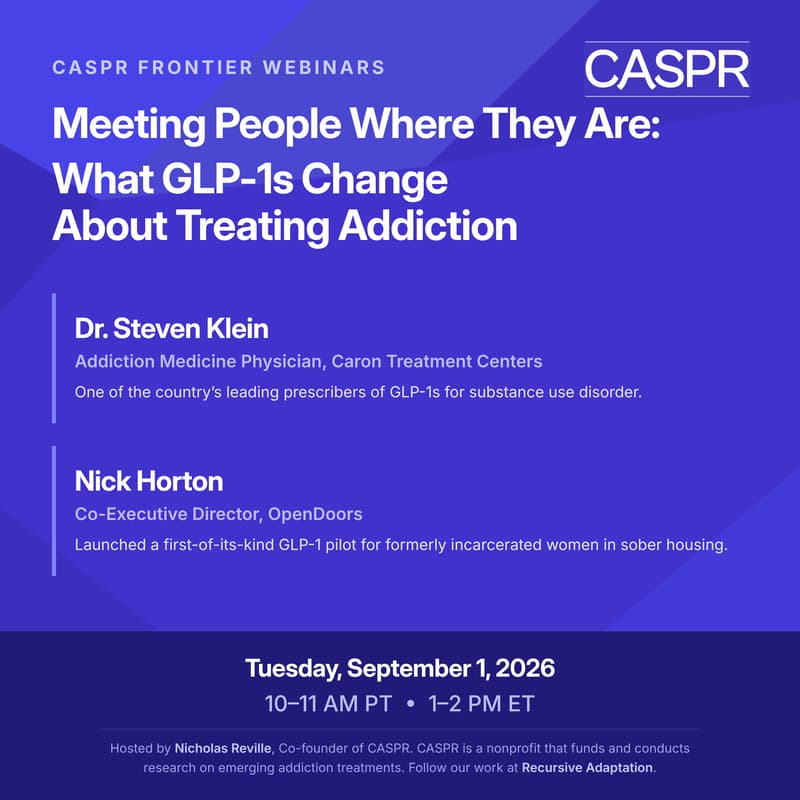
Meeting People Where They Are: What GLP-1s Change About Treating Addiction
Welcome to the CASPR Frontier Sessions and the talk, “Meeting People Where They Are: What GLP-1s Change About Treating Addiction.”
Date: Tuesday, September 1, 2026 from 10-11AM PT
About: Roughly 45 million Americans live with a substance use disorder, yet effective medications reach only a fraction of the people who could benefit. For people facing unstable housing, reentry, or other barriers to traditional care, starting and staying in treatment can be especially difficult.
Early research suggests GLP-1s could be a promising new treatment for substance use disorders, with evidence emerging from preclinical studies, large observational datasets, and randomized trials. They may also open up new ways to deliver treatment. GLP-1s can be started without detox, taken weekly, self-administered, and have no abuse potential—characteristics that may make them a good fit for lower-barrier models of care.
Hear from the people already putting GLP-1 treatment into practice. Dr. Steve Klein will share lessons from prescribing GLP-1s in residential treatment at Caron Treatment Centers, and Nick Horton, Co-Executive Director of OpenDoors Rhode Island, will discuss introducing semaglutide in transitional housing for people leaving incarceration.
We'll also explore what it could look like to reach people earlier in their treatment journey, offering GLP-1s in settings like emergency departments, harm reduction programs, and street outreach. Nicholas Reville, Co-Founder and Executive Director of CASPR, will introduce GRACE (GLP-1 Rapid Access Care), a proposed model for meeting people where they are already seeking care.
About CASPR: CASPR is a 501(c)(3) nonprofit working to expand effective treatment options for addiction through research, policy, and real-world programs. Learn more at caspr.org or follow our work at Recursive Adaptation.