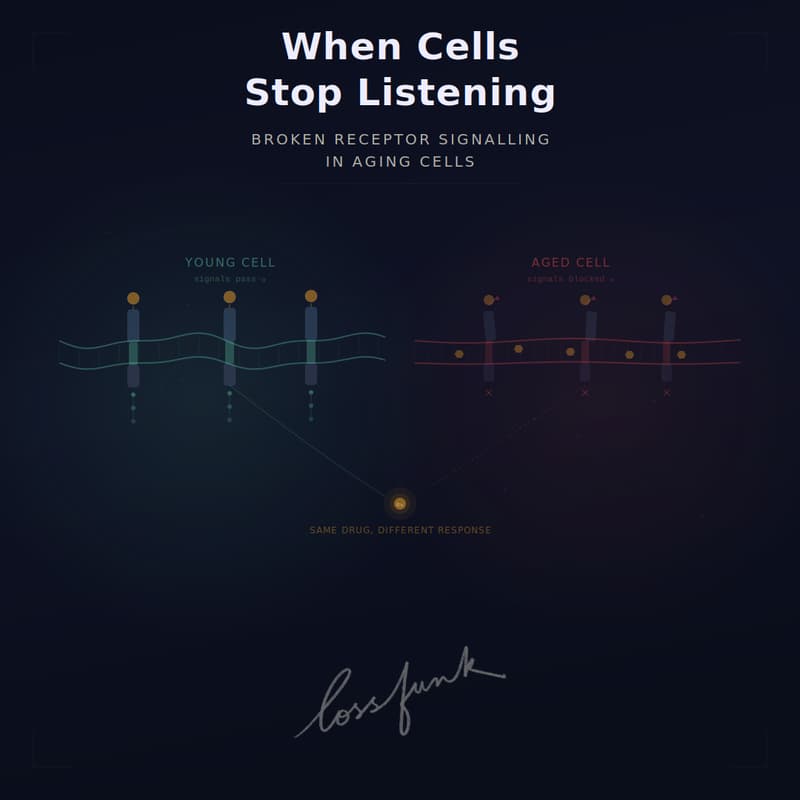

When Cells Stop Listening: Broken Receptor Signalling in Ageing cells and implications for Drug Discovery
Older adults consume the most medicines yet are the least represented in the clinical trials that test them; ageing and the drugs themselves may work differently in an aging body.
Many common drugs act on receptors embedded in cell membranes. As we age, these membranes change: cholesterol-like molecules called oxysterols accumulate and stiffen them, altering how receptors respond.
Using cellular experiments and molecular simulations, we show how these shifts blunt drug-relevant signaling. Accounting for the ageing membrane and for older patients themselves points toward safer, more effective medicines for the people who use them most.
Speaker:
Suramya Asthana is a Mazumdar-Shaw Longevity Postdoctoral Fellow at the Indian Institute of Science (IISc), Bengaluru.
Her research sits at the intersection of GPCR signalling, lipid homeostasis, and the cell biology of ageing in particular, how the changing membrane environment of ageing cells disrupts receptor signalling, and how that disruption can be exploited for therapeutic target discovery.
She is leading the BHARAT Study, India's first large-scale multi-omics ageing cohort. Beyond the bench, she works with ResearchHub and Nucleate India, sup:porting open science and the early-stage biotech ecosystem.
To attend online:
Add to calendar: https://shorturl.at/zslSpsignallingageing
Pre-read:
Oxysterols Modulate Protein–Sterol Interactions to Impair CXCR4 Signalling in Ageing Cells
Are β-Blockers Efficacious as First-line Therapy for Hypertension in the Elderly?
Underrepresentation of the elderly in clinical trials, time for action
Looking forward to seeing you!