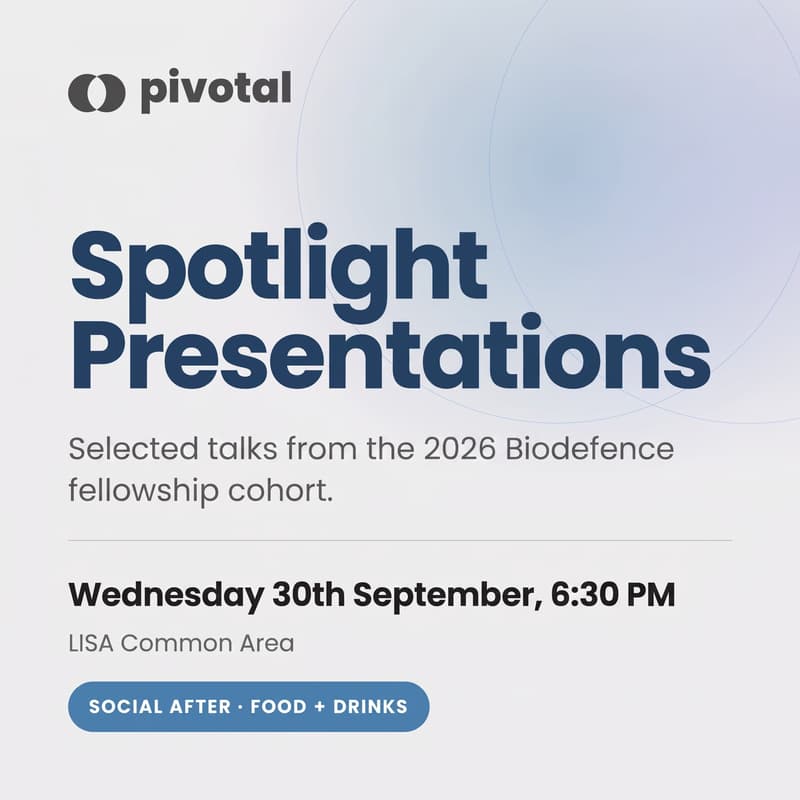
Pivotal Frontier Biodefense Spotlight Presentation
Pivotal's first Biodefense Fellowship is wrapping up, and we're spotlighting research projects for the wider biodefence and biosecurity community. Presentations will begin at 7pm but guests are welcome to arrive at 6:30 to view posters highlighting the fellows' findings.
Come along to hear our fellows present, join the Q&A, and enjoy 🍕 pizza, 🍸 cocktails and snacks.
Posters from the cohort will be up around LISA from 4 PM onwards, so feel free to arrive early.
✨ Spotlight Talks Overview✨
Miranda Smith | Frontier AI-C(B)RN Commitments Observatory
This project creates the Observatory, a public, source-linked dataset of frontier AI companies’ biological commitments. It records what is specific to biological risk beneath a generic “CBRN” label, who can authorise crossing a threshold, and whether each claim is binding or aspirational.
--
Vlada Sedlacek | Upgrading SecureBio’s P2RA Model for High-Depth Wastewater Biosurveillance
This project improves estimates of how sensitive wastewater sequencing is at detecting respiratory viruses by pairing untargeted nasal-swab prevalence data with deep wastewater metagenomics. It will help public health agencies price and size biosurveillance programmes against a defensible detection threshold rather than a guess.
--
Georgie Hau Sorensen | Risk assessment of AI-uplift potential for Mirror Life Development
This project identifies current obstacles to developing mirror life and assesses the risk that AI could accelerate research to overcome them.
--
Michelle Bruno Hernandez | Virology Data Landscape: Implications for AI-Enabled Biotools and Biosecurity
This project systematically maps the virology data landscape to investigate how the availability, quality, diversity, and accessibility of data influence the development and performance of AI-enabled biological tools. By integrating a comprehensive database inventory with a critical literature review, it examines the types of virological data available, their distribution across viral taxa, and their utility for model training, fine-tuning, and evaluation. It pays particular attention to the gap between abundant sequence data and more limited experimentally validated functional information, as well as evidence linking data characteristics to model performance. The project also explores how AI-assisted access and emerging sources of biological data could change this landscape. It aims to inform biosecurity risk assessment and data governance while preserving the benefits of open data for research and public health.