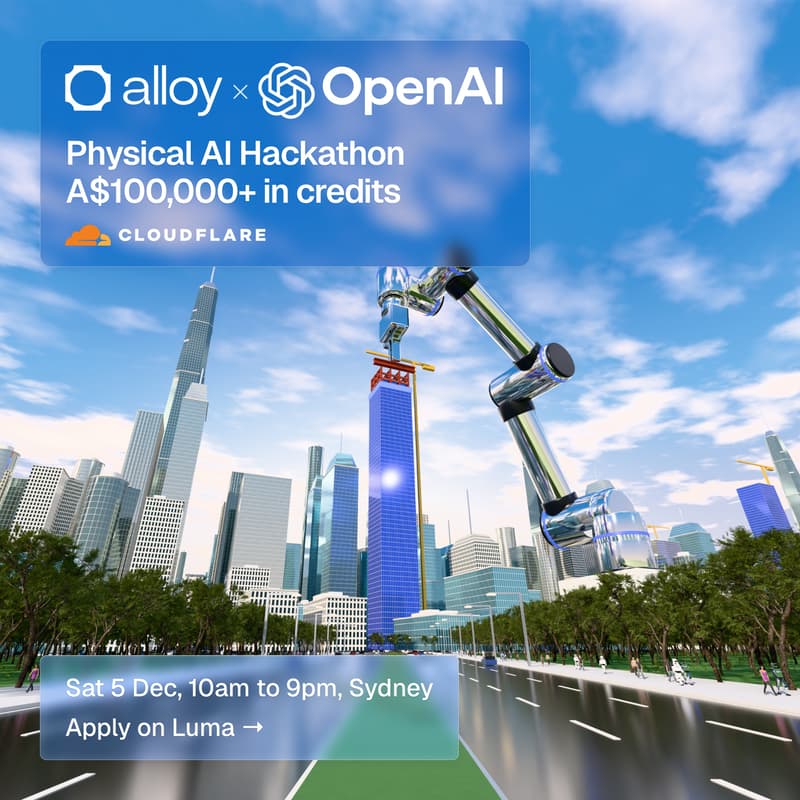
Alloy × OpenAI Physical AI Hackathon
Over A$100,000 in credits for the winners.
First place: A$70,000 (US$50,000) in Cloudflare credits + A$21,000 (US$15,000) in OpenAI credits
Second place: A$14,000 (US$10,000) in OpenAI credits
Third place: A$7,000 (US$5,000) in OpenAI credits
Every builder: unlimited Codex on the day
The event
Australia's largest physical AI hackathon. One day in Sydney, 10am to 9pm. 20 teams build robots that learn from their own runs and fail less, in simulation, on real hardware, or both. Judges and mentors from OpenAI, Cloudflare and Alloy Robotics. Food and drinks all day.
Who it's for
Software and ML engineers who've never touched a robot. If that's you, it's time to pivot. You can build entirely in simulation, and robotics needs people who can ship software.
Students and early-career engineers in robotics, mechatronics and embedded systems who want to build something real in a day.
Anyone already building robots who wants theirs to fail less.
No robotics experience needed if you can build.
Why robotics, and why now
Software ate the world. Now cheap intelligence is going to rebuild the physical world: every object that can sense, decide or move becomes programmable. The barrier to getting started in robotics has never been lower, and the biggest shortage in this wave isn't actuators, it's robotics engineers. If you go all in on robotics now, you'd still be early.
We're in the midst of an inflection point in robotics. Capability can jump overnight, but adoption is the long game, and what stands in the way is reliability. A robot that's right 99% of the time on each action finishes a 100-action task only about 37% of the time. At 99.9% it's 90%; at 99.99%, 99%. Andrej Karpathy calls getting there "a march of nines": every extra nine takes about as much work as the last, and each one means ten times fewer failures.
We believe that tightening the learning loop for robots is what will bring in the age of abundance. This hackathon is one day spent on exactly that.
Why some robotics companies win
Every robotics company sits somewhere on one scale. At one end is Tesla: millions of cars on the road, every failure sent back to make the next version better, a fleet that keeps improving. Close behind are Waymo and the companies running tens of thousands of robots in the real world, like Pudu and Brain Corp. At the other end are the robots that never left the demo video, and the companies that ran out of money waiting for them to work.
What separates the two ends usually isn't the hardware or the model. It's the learning loop: how fast every run, and every failure, makes the next run better. Tesla's Autopilot team built theirs by hand, with triggers across the fleet that sent failures straight back into training. The teams that reach 1,000 robots make every failure fix every robot.
What's a learning loop?
A learning loop is how one robot run turns into a better robot. It has five parts:
Run: the robot attempts the task, in simulation or on real hardware.
Capture: everything it saw and did gets recorded: sensors, logs, video, every decision and when it made it.
Find the failure: work out where the run went wrong, and why.
Fix: change the code, tune the controller, or retrain the policy on what you found.
Run again: and check it really fails less.
Every turn of the loop is a step up the nines. Google's QT-Opt robots learned from 580,000 of their own grasps and went from 78% to 96% on objects they'd never seen.
The challenge
The challenge itself stays under wraps until the day. The full brief, how it's judged and the rubric are revealed at the 10:00 kick-off. What we can tell you is what it's about: the learning loop, and what happens to the world when it turns faster.
Software changed how the world works with information. Most of the world's economy is still physical: growing food, building homes, moving goods, caring for people. Robots that can do that work reliably have been "five years away" for decades, and the reason is the loop. When robots learn faster, they leave the lab sooner and do real work: on farms, in warehouses, in aged care homes. Every builder in the room on 5 December is working on how quickly that happens.
Logistics
When: Saturday 5 December. Doors open 9:00am, kick-off at 10:00am, finished by 9:00pm.
Where: Sydney CBD. The exact address goes to accepted builders only, with your acceptance email. Entry is by acceptance: if you haven't been accepted, there's no spot for you on the day.
Food and drink: supplied.
Bring your own hardware: welcome. Robot arms, rovers, drones, dev boards, sensors: if you can carry it in and it runs off a normal power point, bring it, and tell us what it is in your application. No hardware? Simulation entries are judged the same way.
Bring: your laptop, charger, and any cables or adapters your hardware needs.
Codex: unlimited Codex for every builder on the day. We'll help you set it up on the day with the right Codex license granted by the OpenAI team.
Teams: up to 6 people. Apply solo or as a team. If you're applying as a team, every teammate must submit their own application. We'll match solo builders into teams on the morning.
Cost: free.
Run of show
9:00 Doors open, mingling, team formation
10:00 Welcome and challenge brief
10:30 Build time
13:00 Lunch available
18:30 Submissions close & Dinner available
19:00 Finalists announced
19:15 Presentations and judging
20:15 Winners announced, wrap
21:00 Doors closed
How to apply
Apply below by Sunday 29 November, 11:59pm. It takes about 3 minutes. We'll pick the 20 teams and let everyone know by Tuesday 1 December. Accepted builders get the starter kit and a Discord invite by email, so keep an eye on your inbox, and check your spam folder in case it lands there.
Presented by Alloy Robotics and OpenAI. Gold sponsor Cloudflare. Ecosystem partner Stone & Chalk.