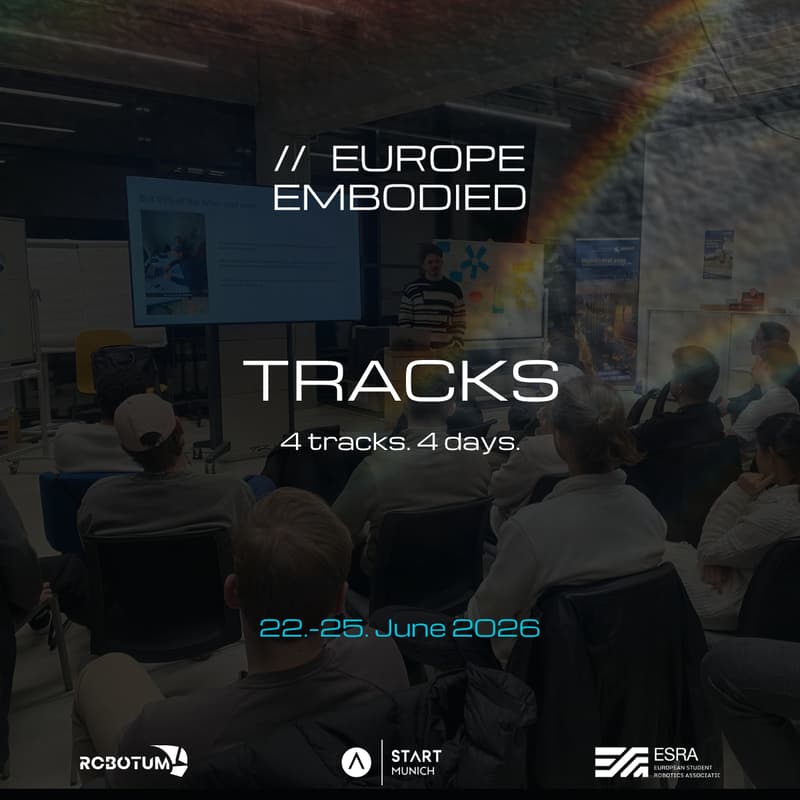

EUROPE EMBODIED Tracks – City-wide Events
EUROPE EMBODIED Tracks — City-wide Events
Bring Europe's physical AI field into the same room. Four working tracks. One week. Part of Europe Embodied — Robotics Week Munich 2026.
Where physical AI gets built.
Europe Embodied Tracks are four dedicated working rooms for the people turning robotics from research demos into deployed systems. Not a conference. Not a keynote series. Four focused sessions where researchers, engineers, founders, operators, and investors work on the problems that actually define whether physical AI scales in Europe — data, use-cases, talent, capital, and hardware at scale.
4 tracks. 4 days. The people building physical AI in Europe.
If you are working on any layer of the physical AI stack — from model training to deployment to scaling — one of these tracks is built around your problems.
Our Tracks:
Track 1 - Data & Model Building
The physical AI field has the architectures, but lacks the data infrastructure to train them: scalable collection pipelines, shared benchmarks, and the open model foundation that general-purpose robotics requires. Especially challenging is the current dependence on human teleoperation for data collection: it is perceived as expensive, slow, and impossible to scale without fundamentally rethinking the pipeline.
Track 2 - Real-world Robotics Uses
The economics of robotics have never been stronger. The bottleneck is no longer the technology, it is the workflow redesign, safety certification, and commercial structures that turn pilots into operations that actually scale. One of the main hurdles lies in the gap between a successful pilot and a system that delivers sustained ROI. That is a gap that is as much organisational and regulatory as it is technical.
Track 3 - Talent, Funding & Community
Europe produces researchers who define the global frontier of physical AI, but loses too many before or while they build here. This track works on the funding frameworks, commercialisation pathways, and ecosystem infrastructure that change that. Among the hardest problems to solve is the structural misalignment between European capital markets and the timelines hardware companies actually need.
Track 4 - Hardware, Operations & Scaling
Proving a robot works is one problem. Scaling it is an entirely different one. In a world of concentrated component supply and legacy factory infrastructure, building the supply chain, manufacturing processes, as well as many other operations around the core development streams becomes increasingly difficult to match with rapidly shifting markets and high development speed. Particularly acute is the concentration of critical component manufacturing outside Europe: actuators, rare earth materials, and edge compute all carry strategic dependencies that no individual company can resolve alone.
europe-embodied.com
RoboTUM × START Munich
- A Generation Robotics Event, by ESRA