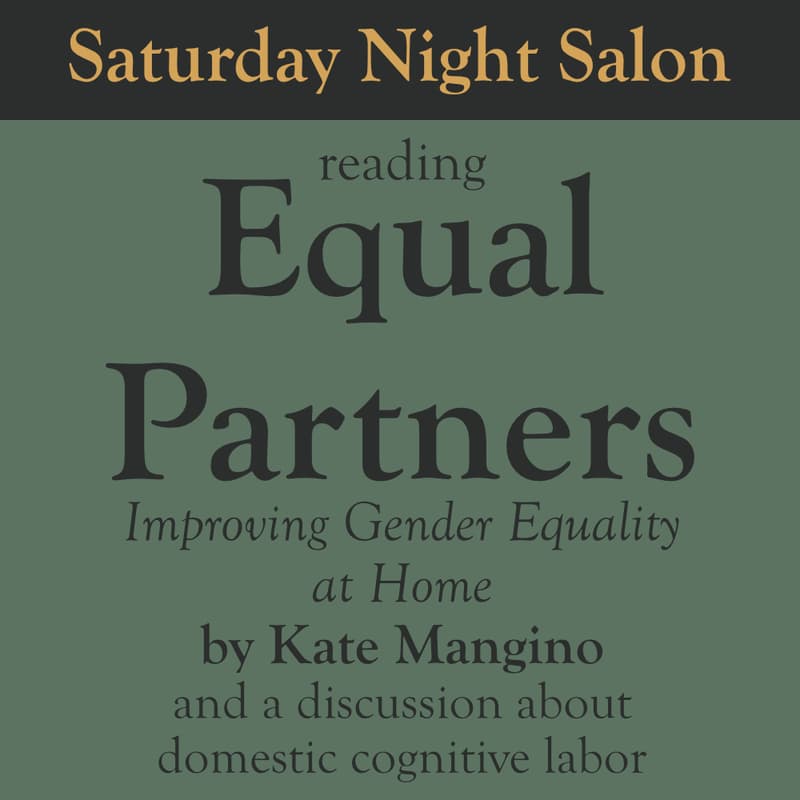

Saturday Night Salon (Pilot): Equal Partners by Kate Mangino
Note: We are looking into GMeet for interested people that cannot make it, but no promises!
Are you a parent overburdened and distracted with tracking schedules, groceries, and tuition progress in the middle of the workday? A dad striving for an equal partnership, yet your partner primarily manages the household, delegating tasks to you?
Or a single or newly partnered woman, wondering if family life always demands sacrificing your career? Are you stretched thin caring for aging parents?
There are many feeling this way. In Singapore, publicly, women now make up 50% of university graduates and hold 46.7% of white-collar PMET roles¹, yet private life reflects what US sociologists call the "stalled revolution" of feminism². Most couples live in "neo-traditional"³ households—meaning they support equality in public, but automatically default to traditional gender roles in private⁴. Instead of shared freedom, women face a broken promise: they are held to high career and mothering standards simultaneously, forcing them into a relentless "second shift"⁵. In Singapore, working-age women perform an estimated 52.3% of all unpaid domestic work compared to 14.4% for men⁶, and couples caught in this mismatch report the lowest relationship satisfaction—below even traditional gendered households (though women in traditional households report the lowest mental health)⁴. Outsourcing chores does not fix this. Even with a live-in helper or grandparents helping out, mothers still carry "domestic cognitive labor"—the invisible mental load of anticipating needs, planning logistics, and managing schedules⁷. Locally, paternal involvement is lower when helpers and grandmothers are present, and on weekdays, a father's caregiving time remains unchanged even when the mother works full-time⁸.
Kate Mangino’s Equal Partners: Improving Gender Equality at Home is the required reading for the salon. Mangino recognizes and proposes solutions to couples facing this disparity in deed and in expectations. The book is divided into three parts:
Part 1: Acknowledging Inequality. Diagnoses the modern household gender divide through data and sociological concepts (such as the "neo-traditional" home and the "second shift"), while examining how gender norms shape life milestones like partnership and the arrival of a first child.
Part 2: What Equal Partners Look Like. Focuses on the "EP40"—forty diverse men who intentionally share 50% of the physical and emotional load. It explores their origins, motivations, daily strategies, and interviews with their partners to define what true parity looks like in practice.
Part 3: Living Gender Equality. Provides actionable strategies and personal reflections for readers to reevaluate their own daily routines, vocabulary, and workplace boundaries to foster greater equity in their homes and communities.
Optional Readings
Eve Rodsky’s Fair Play: This book introduces the "CPE" (Conception, Planning, and Execution) framework. Rodsky claims that outsourcing physical tasks (like hiring a helper or delegating a chore) often leaves the mental load intact. To achieve true equity, she proposes that couples adopt the framework and keep Conception, Planning, and Execution together rather than reducing a partner to an "employee" waiting for instructions.
A 2024 USC study¹² conducted 2 cohorts interventions based on the Fair Play framework, and while it reported promising results among those that went through it, there was heavy attrition.
Darcy Lockman’s All the Rage: Lockman investigates why couples often revert to conventional divisions of labor once children arrive. Drawing on interviews with parents, she questions whether modern celebrations of "involved fatherhood" reflect genuine parity or merely obscure how little daily chore allocations have shifted. It offers a candid examination of how cultural defaults, maternal gatekeeping, and paternal withdrawal can undermine overt egalitarian goals.
We have also prepared a document containing core selections if you don't have time to read the whole book, as well as some questions for reflection and analysis as you read through! https://docs.google.com/document/d/1cI6rCGx5wTI6wgmDiNpJs-W6hrXWzPh3JNNjanjJ6bk/edit?usp=sharing
References and Further Reading
PMET & Tertiary Education Parity (Singapore): Ministry of Social and Family Development (MSF), Progress on Singapore Women's Development (2024), citing Ministry of Manpower (MOM) 2023 Labour Force data and Department of Statistics (DOS) 2013–2023 graduate data. https://www.msf.gov.sg/api/media/de25ab14-7faf-4170-b37b-a012e68038cc.pdf
"The Stalled Revolution": England, Paula (2010). "The Gender Revolution: Uneven and Stalled." Gender & Society, 24(2), 149–166. https://doi.org/10.1177/0891243210361475
"Neo-Traditional Household": Gerson, Kathleen (2010). The Unfinished Revolution: Coming of Age in a New Era of Gender, Work, and Family. Oxford University Press. https://doi.org/10.1093/oso/9780195371673.001.0001
Gender Ideology, Mental Health, & Marital Satisfaction (Singapore): Haifan, Nadya; Sayri, Erra Natalia; Tan, Micah; and Tadai, Mindy Eiko (2022). Gender Role Ideology and Implications for Well-being Among Older Adults in Singapore. SMU Centre for Research on Successful Ageing (ROSA), 1–23. https://ink.library.smu.edu.sg/rosa_reports/7/
"The Second Shift": Hochschild, Arlie Russell, and Machung, Anne (1989). The Second Shift: Working Parents and the Revolution at Home (Viking)
Unpaid Domestic Labor Split (Singapore): Tan Poh Lin, Christopher Gee, Emily Ortega et al. (September 2026). Singapore's National Time Transfer Accounts. Institute of Policy Studies (IPS) Working Paper No. 76, National University of Singapore. https://lkyspp.nus.edu.sg/docs/default-source/ips/ips-working-papers-no-76.pdf
"Domestic Cognitive Labor" & Mental Load: Daminger, Allison (2019). "The Cognitive Dimension of Household Labor." American Sociological Review, 84(4), 609–633. https://doi.org/10.1177/0003122419859007; for mental load and time measurement in Singapore, see Qaiser, Zara (August 28, 2026), Lightening the Load: Why Singapore Needs to Measure Time, Lee Kuan Yew School of Public Policy (Global-is-Asian). https://lkyspp.nus.edu.sg/gia/article/lightening-the-load--why-singapore-needs-to-measure-time
The Outsourcing Paradox & Paternal Time (Singapore): Yeung, Wei-Jun Jean, and Lee, Jiyeon (July 2021). Preschool Children's Time with their Fathers in Singapore, NUS SG-LEADS Research Brief Issue 5[cite: 6, 12] (https://sg-leads.org/wp-content/uploads/2024/10/research-brief_5_july-2021.pdf), SRCD presentation slides (Time with Dads: Unique Family Contexts in Singapore, https://fass.nus.edu.sg/cfpr/wp-content/uploads/sites/17/2021/04/013-07Apr2021_Time-with-Dad_SRCD.pdf), and SG-LEADS portal (https://sg-leads.org/reports/).
"Egalitarian Familism" vs. "Flexible Egalitarianism": Han, Sinn Won; Gowen, Ohjae; and Brinton, Mary C. (2024). "When Mothers Do It All: Gender-Role Norms and Women’s Fertility Intentions in Post-Industrial Societies." European Sociological Review, 40(2), 309–325. https://ink.library.smu.edu.sg/soss_research/4101
Women's Earnings & Outsourcing (US): Gupta, Sanjiv (2006). "Her Money, Her Time: Women’s Earnings and Their Housework Hours." Social Science Research, 35(4), 975–999 (cited in Mangino, Equal Partners, Ch. 3). https://doi.org/10.1016/j.ssresearch.2005.07.003
Marriage & Parenthood Priorities (Singapore): Cultivate SG (2025). Marriage, Parenthood and Success Survey 2025. https://cultivate.sg/research-recommend/marriage-parenthood-and-success-survey-2025/
USC Fair Play Study (US): USC Dornsife Public Exchange. (2024, December). Cognitive household labor: Gender disparities and consequences (Fair Play Final Report). University of Southern California. https://public-exchange.org/usc/wp-content/uploads/sites/2/2025/09/PX_FairPlay-Final-Report_Dec2024-2.pdf
(Disclaimer: this agenda was co-researched and co-written with AI chatbots)