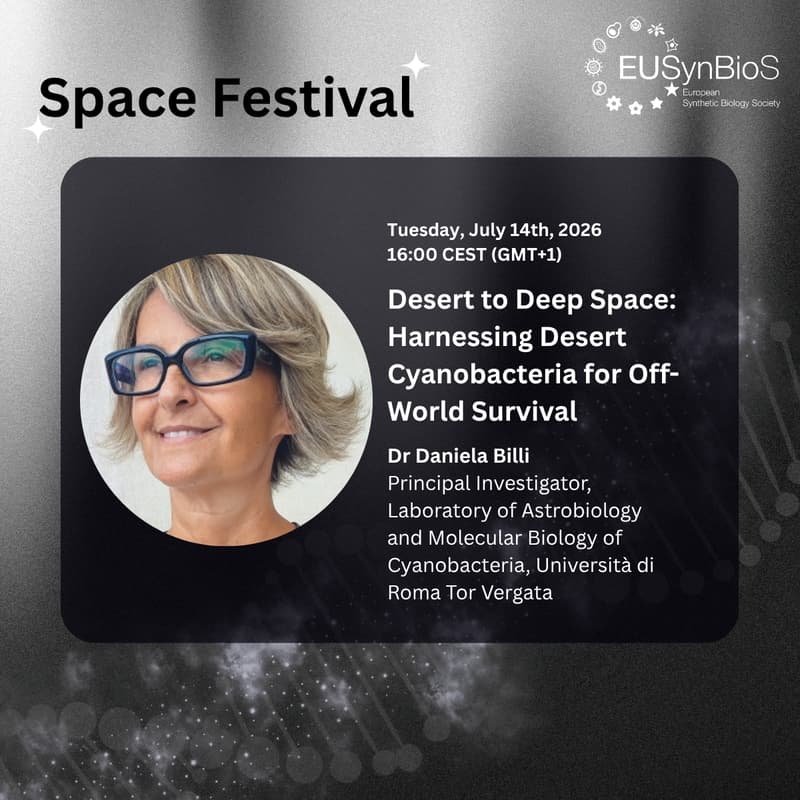

The Radiation Shield: Decoding Cellular Survival in Deep Space
If we want to build permanent human habitats on the Moon and Mars, we must look to Earth’s ultimate survivors. In the hyper-arid Dry Valleys of Antarctica and the scorched sands of the Negev Desert, microscopic organisms have already spent millions of years perfecting the art of extreme survival. They don't just endure absolute desiccation and lethal radiation, they thrive in it.
Welcome to Week 3 - The Micro-Frontier: From Extremophiles to Biology-on-a-Chip.
Join us for a stellar masterclass titled "Desert to Deep Space: Harnessing Desert Cyanobacteria for Off-World Survival," featuring Dr. Daniela Billi, Professor of Botany and Director of the Laboratory of Astrobiology and Molecular Biology of Cyanobacteria at the University of Rome Tor Vergata.
Dr. Billi will take us on a journey from Earth’s harshest deserts straight into low Earth orbit. Drawing from her decades of pioneering spaceflight research, she will reveal how desert cyanobacteria belonging to the genus Chroococcidiopsis survived up to two years exposed to the raw vacuum of space and simulated Martian environments outside the International Space Station (ISS). Discover how these remarkable microbes repair their own shattered DNA upon rehydration, photosynthesise using far-red infrared light, and how synthetic biology can harness them to consume astronaut waste and Martian regolith to manufacture life-essential oxygen and biomass.
What you’ll learn:
The Ultimate Survivors: Inside the cellular and molecular mechanisms that allow Chroococcidiopsis to survive extreme desiccation, sub-freezing temperatures, and cosmic radiation.
Lessons from the ISS: Strategic insights from the BIOMEX and BOSS space missions, exploring how biofilms mixed with lunar and Martian soil simulants endure the vacuum of space.
In-Situ Resource Utilisation (ISRU): How to leverage extreme phototrophs as biological factories to recycle crew waste (like urine) into breathable oxygen and food for deep-space colonies.
Whether you are a synthetic biologist eager to design climate-resilient strains, an astrobiologist tracking biosignatures, or a space systems enthusiast, this talk will rewrite your understanding of what life can endure.
🎤 About the speaker
Dr. Daniela Billi - Professor of Botany, University of Rome Tor Vergata
Dr. Daniela Billi is a premier global authority in astrobiology and the molecular biology of extremophilic microorganisms. She is a Professor at the University of Rome Tor Vergata, where she directs the Laboratory of Astrobiology and Molecular Biology of Cyanobacteria. For nearly three decades, her research has focused on deciphering the genetic and cellular adaptations of desert cyanobacteria to extreme environments. Notably, she holds the scientific responsibility for the historic Culture Collection of Microorganisms from Extreme Environments (CCMEE), originally established by polar desert pioneers E. Imre Friedmann and Roseli Ocampo-Friedmann.
As a Principal Investigator for breakthrough European Space Agency (ESA) and Italian Space Agency (ASI) missions, including the BIOMEX and BOSS experiments aboard the ISS EXPOSE-R2 facility, Dr. Billi routinely tests the boundaries of life in low Earth orbit. She currently serves as the Co-Chair of the ESA Astrobiology Topical Team and is preparing the CyanoTechRider experiment for the upcoming ESA Space Rider flight, actively bridging fundamental astrobiology with synthetic biology applications for human deep-space exploration.