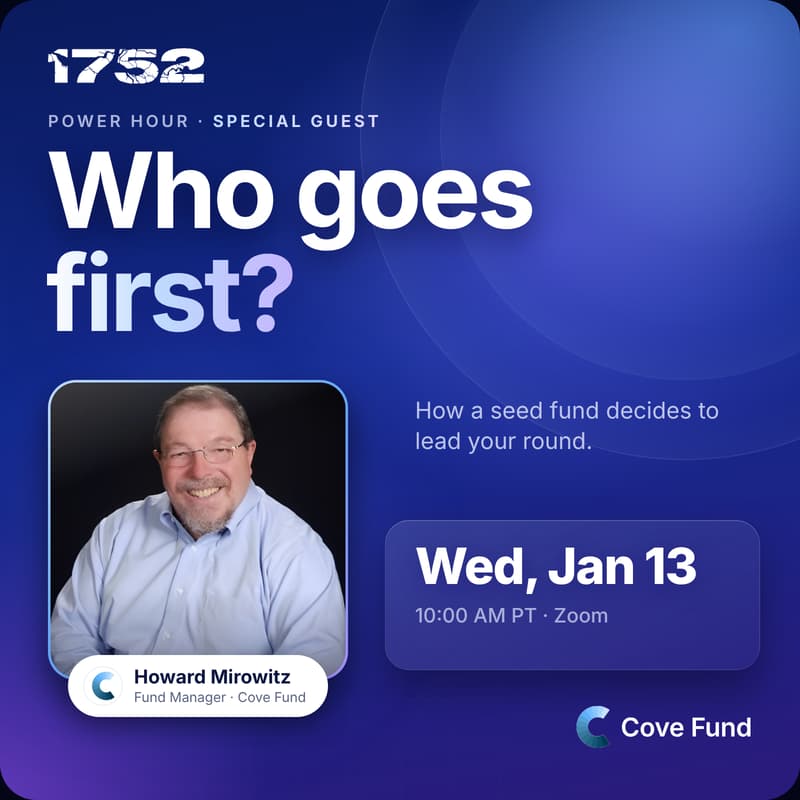

Power Hour: How a Seed Fund Decides to Lead with Howard Mirowitz of Cove Fund
Most seed rounds need someone to go first. This session is about what it takes to get a seed fund to lead.
This 1752vc exclusive, weekly Power Hour session is part of our Startup Programs and reserved for our founders and founders who've received an offer to join.
For more information about our programs, visit our website.
1752vc Power Hour: How a Seed Fund Decides to Lead with Cove Fund
Join us for a live session with Howard Mirowitz, Fund Manager at Cove Fund, a family of seed-stage venture funds affiliated with UC Irvine and based at The Cove at UCI Beall Applied Innovation. Howard manages Cove Fund II, where he runs deal flow from sourcing and due diligence through investment and portfolio oversight, and previously served on the Investment Committee of Cove Fund I.
Howard will walk through how a seed fund evaluates a company and decides to lead a round, followed by an open AMA.
Who this is for
Founders preparing to raise a pre-seed or seed round
Founders looking for a lead investor to anchor their round
What you'll walk away with
How a deal moves through a seed fund, from sourcing and due diligence to an investment decision
What makes a fund willing to lead, not just follow
How to position your product and market so investors see a large, differentiated opportunity
AMA topics
What seed investors expect to see before writing the first check
Common mistakes founders make when they pitch to a fund
How to work with angels, angel groups and seed funds in the same round
Bring: the question you'd ask a fund manager before your next pitch.
About the speaker
Howard Mirowitz is a fund manager, operator and longtime teacher of entrepreneurship.
Fund Manager of Cove Fund II since 2017, after serving on the Cove Fund I Investment Committee
Independent consultant and investor since 2000, investing alongside private equity firms in undervalued tech businesses, with board seats at Komag and Razorfish
Adjunct Instructor at UC Irvine's Merage School of Business for 12 years, where he created the Entrepreneurial Companies capstone course for the Master of Innovation and Entrepreneurship program, pairing student teams with seed-funded startups
Vice President at Mitsubishi Electric, where he co-managed its U.S. startup incubator and helped launch the first smartphones with internet browsers (AT&T Wireless PocketNet and NTT DoCoMo iMode); exits included the IPOs of Openwave and General Magic
Director and General Manager at Western Digital, where he launched the imaging business and grew it from $25M to $250M in revenue in 18 months
MBA, The Wharton School; BA, Dartmouth College
About Cove Fund
Cove Fund is a family of seed-stage venture funds backing promising Southern California startups. It is affiliated with UC Irvine, with offices at The Cove at UCI Beall Applied Innovation, a hub for entrepreneurs, innovators and investors in the region.
Cove Fund I: $6M, fully invested across 20 companies
Cove Fund II: launched in 2018 with over $14M, 21 startups backed
Invests in early-stage technology and life science companies
About 1752vc Startup Programs
1752vc runs operator-led Startup Programs built for founders who want rigor, not feel good praises.
Launchpad is a program designed for founders in the ideation or early stages of prototype development. It helps founders validate their ideas and demand while starting to build something that can gain initial customer validation.
Ignite is designed for startups that have an MVP but may not yet have customers. The program focuses on developing essential strategies for achieving sustainable growth. It covers all the steps a startup seeking venture capital must master, including team building, go-to-market strategies, and fundraising.
GTM is designed for companies that have gained initial traction, including a few customers and some revenue, all achieved through founder-led growth. The program aims to enhance the founders' skills in developing repeatable and scalable sales processes. In the short term, this will help increase sales, while in the long term, it will establish procedures for employees to follow.
DTC is a program designed for CPG companies with products ready for distribution. Its main objective is to leverage data to build a strong brand identity and implement growth hacking strategies for acquiring, maintaining, and upselling or cross-selling customers through omnichannel strategies.