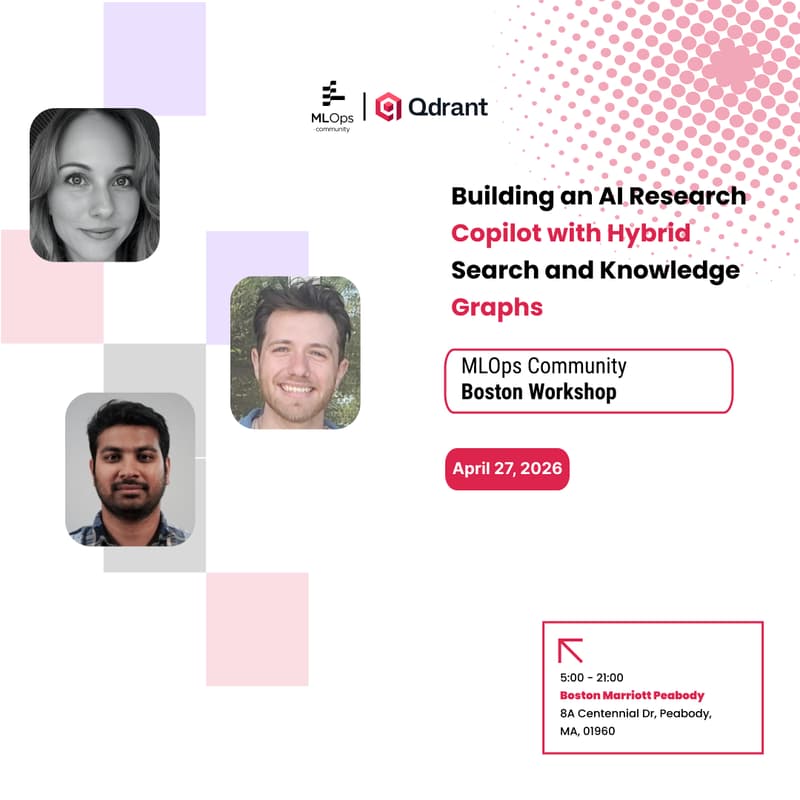


Building an AI Research Copilot with Hybrid Search and Knowledge Graphs
Qdrant + Neo4j for Scientific Discovery
PubMed contains over 39 million research abstracts. Traditional keyword search can't keep up. Researchers miss critical findings buried in massive datasets.
WHAT YOU'LL BUILD
An AI research copilot that combines vector search (Qdrant) and knowledge graphs (Neo4j) to navigate biomedical literature intelligently.
You'll explore a working system that:
Searches biomedical literature using hybrid semantic search
Dynamically selects retrieval strategies based on query intent
Enriches results using structured biomedical knowledge graphs
Demonstrates how agentic retrieval improves research discovery
HOW IT WORKS
You'll learn to combine:
Vector search for semantic understanding
Knowledge graphs for structured relationships
Agent-driven routing for smart query handling
Reranking to surface the most relevant results
This is practical systems design for AI-powered discovery tools.
AGENDA
5:00 – 5:40 PM | Arrival, Registration & Networking
Check-in, refreshments, and access to the demo environment
5:40 – 6:00 PM | Introduction
Overview of retrieval challenges in scientific research
6:00 – 6:20 PM | Architecture Walkthrough
Research copilot using Qdrant, Neo4j, and agent-driven workflows
6:20 – 7:20 PM | Hands-On Lab
Build and explore hybrid search + knowledge graph workflows
7:20 – 7:50 PM | Talk: Navigating Scientific Knowledge ( Stephanie Jarmak from Sourcegraph)
Structuring scientific knowledge for agent-driven discovery
7:50 – 8:20 PM | Talk: Evaluating Retrieval Agents (Kranthi Manchikanti from Microsoft)
Evaluation, safety, and reliability in agentic retrieval systems
8:20 – 8:50 PM | Wrap-Up & Networking
Key takeaways, Q&A, and networking
WHAT YOU'LL WALK AWAY WITH
A working AI research copilot you can explore and adapt
Practical understanding of hybrid retrieval architectures
Clear patterns for building agentic discovery systems
GitHub repository with full codebase
WHO SHOULD ATTEND
Built for intermediate to advanced builders:
AI/ML engineers
Data engineers working with retrieval systems
Research engineers in healthcare, biotech, life sciences
Technical teams building AI-powered discovery tools
Prerequisites: Comfortable with basic Python or API workflows and general AI/ML concepts. Prior experience with Qdrant or Neo4j not required.
Seats are limited