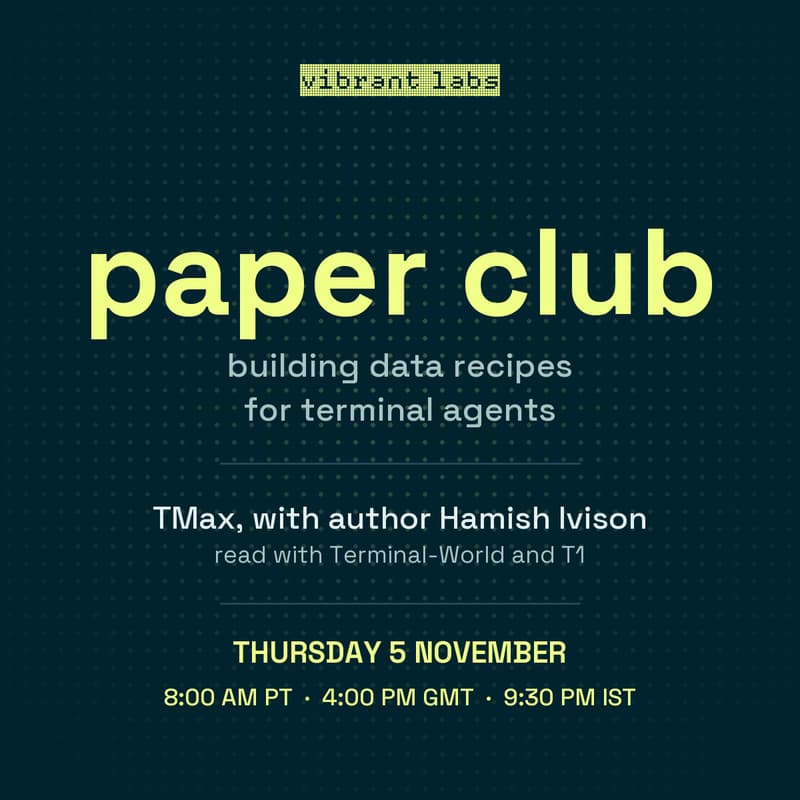

Autoscaling RL Paper Club — Building Data Recipes for Terminal Agents, with Hamish Ivison
Hamish Ivison, co-first author of TMax, joins us. We read TMax alongside two other recipes for training terminal agents, Terminal-World and T1, and take the session one ingredient at a time.
TMax is the open baseline: Tmax-15k, 14,600 synthetic terminal environments sampled across nine axes and turned into a Dockerfile, a verifier and instructions, with an outcome-only RL recipe that takes Qwen 3.5 9B to 27% on Terminal-Bench 2.0. It checks only that each image builds and lets RL filter out broken tasks.
Terminal-World builds environments from human-authored agent skills instead, deriving the task, sandbox, verifier and a teacher guideline from one skill, validating every artifact, and training by SFT alone. T1 is the large-scale RL end: a 122B MoE trained with PPO for 300+ tool-call turns, on audited tasks, rewarded by the number of verifier checks passed rather than pass/fail.
The ingredients we want to argue about: where tasks come from (sampled axes, skills, or extended reference solutions); whether RL filtering can stand in for validation; how much the reward's granularity matters; SFT versus RL; and whether a synthetic recipe can ever beat the model that generated it.
Papers
TMax: A simple recipe for terminal agents (Ivison, Yin et al.): https://arxiv.org/abs/2606.23321
Terminal-World: Scaling Terminal-Agent Environments via Agent Skills (Cheng et al.): https://arxiv.org/abs/2605.20876
T1: Terminal Agent Reinforcement Learning for Long-Horizon Tasks (Yang et al.): https://arxiv.org/abs/2609.11042
Notes: https://research.vibrantlabs.com/club/building-data-recipes-for-terminal-agents
Format
An hour. Hamish walks through TMax, then open questions and discussion across all three papers. You do not need to have finished the papers, and you do not need to work on this full time. Sessions are recorded — tell us and we keep you out of the recording.