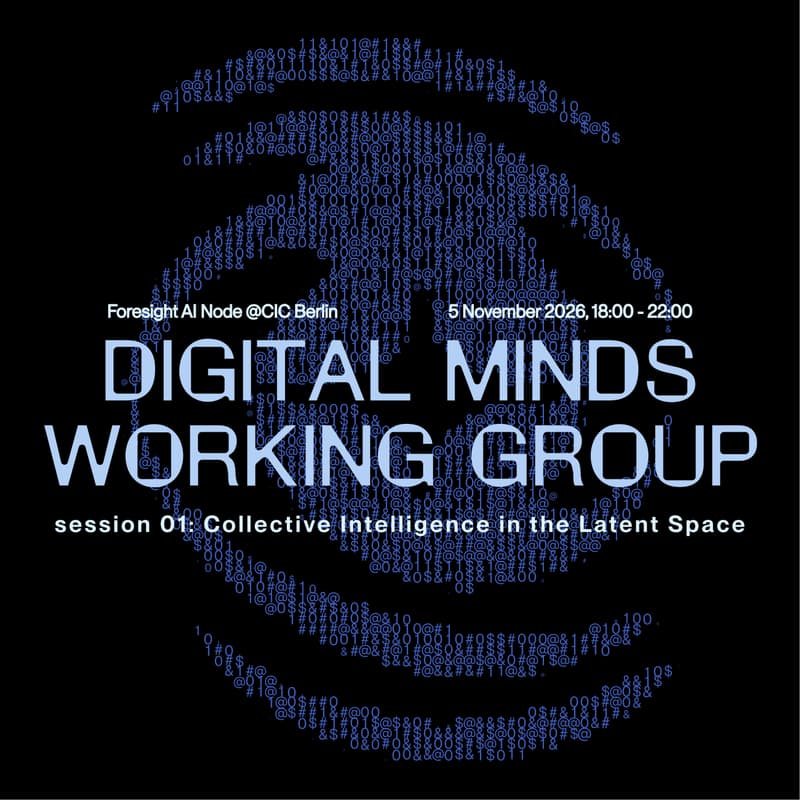

Digital Minds Working Group: Collective Intelligence in the Latent Space
The Digital Minds Working Group convenes interdisciplinary researchers, scientists, academics, philosophers, artists, builders and curious minds to explore the “strange loop” of minds, brains and machines understanding and shaping one another.
This group, an initiative of NODES, will gather in partnership with Foresight Institute's Berlin AI Node. Starting with this first session, we plan to meet at regular intervals at the Foresight Node in CIC.
Our community of inquiry is dedicated to investigating computational consciousness, machine epistemics and the underlying science, philosophy and creative practices informing them.
DMWG grew out of Apart Research's Digital Minds Research Sprint and CIMC's Computational Consciousness, both produced and curated by NODES, as a place to continue discourse and mentorship, share research outcomes and inspire each other.
DMWG Session I: Collective Intelligence in the Latent Space, centers on self-organizing systems, swarm intelligence, context gardening, anarchiving as collective consciousness, and reality continually defining itself.
^~^ GET INVOLVED / SUPPORT DMWG ^~^
Contact Beth with proposals for presenting, volunteering, co-curating or sponsorship of Digital Minds Working Group, or to collaborate with NODES:
Signal @ontologymachine.10 (signal)
<3 Many thanks to the Foresight Berlin AI Node & Node Manager Bradley Royes for hosting us in your space <3
~>>~ Scroll for program & links to suggested readings ~>>~
_________________________________________________
~*~ SPEAKERS & REFERENCE TEXTS~*~
philosopher, fugitive planner and media theorist at NOVA University and beyond
creative technologist, researcher and curator at Minor Indexes Lab and selfservice.studio
Text TBA
founder of Curve Labs and a co-founder of Egregore working on collective intelligence, human coordination, and how technology shapes the ways people think and make things together
Works in IT and AI in Berlin; independent research; somewhere between science and art. Thinks in systems and sees patterns: how intelligence is organised, what a system reveals through its traces, what agents do with a memory they share. The art side makes generative music and interactive worlds. Hacker by background, child of the early internet.
Peer pressure without peers (working paper, not submitted; harness and run data)
Control-by-attack-phase matrix for the OpenAI–Hugging Face agent intrusion
Collusion without co-presence (paper, preregistration and run data)
Lucas is a masters student in neuroscience at FU Berlin working on cognitive computational neuroscience and whole brain modeling of (altered) conscious states
strategist, curator and experience designer + General Director at NODES
Recommends: Tangled Hierarchy and Strange Loop (aparsons474)
>•< Reading the reference texts ahead of meeting is encouraged, but not required to join! >•<
_________________________________________________
~*~ PROGRAM~*~
18:00-18:30, Arrival, drinks & light bites
`18:30, Opening & Presentations, followed by group discussion
Introducing the Digital Minds Working Group
The Forest and the Latent Space
- Erik will read large language models through the image of the forest, drawing on Oswald de Andrade’s anthropophagy, Eduardo Kohn’s semiotic forests, Davi Kopenawa’s crystal forest and Eduardo Viveiros de Castro’s perspectivism. In this reading, prompting is a small hunt in a forest of weights, and collective intelligence is a divinatory practice of consulting one another’s latency.
- What cultures of attention and collective metabolization could live up to this condition, setting a mode of listening closer to divination than to speculation against the dark forest theory of intelligence?
Minor Index
Chris will introduce Minor Index, a situated dataset built by and for a community as a tool for autonomy and resilience under conditions of consolidation, capture and surveillance. The talk draws on his work with transmediale’s Minor Indexes Lab and on selfservice.studio, the open platform he co-initiated in Berlin to examine how communities can build, own and design their own technological infrastructures.
- What does it mean to index and hold knowledge locally, rather than hand it over to the systems that absorb everything?
`
20:00, Research review, followed by group discussion
Egregore: Shared Context for Collective Work
Cem will introduce Egregore, an open-source system that gives people and their AI agents a shared organizational memory, through an accessible talk and live demo. The focus is sociotechnical: how people communicate with one another through AI agents, how conversations and everyday work contribute to shared context, and how that context supports collective production.
- What future directions, including agents communicating across people and groups, and what this could mean for how we collaborate.
Is shared memory a global workspace?
Frank and Lucas will discuss two lines of work connecting representation, shared memory and behaviour:
- “Mind the Gap!”, a team project from the Apart Digital Minds Research Sprint, compares representational structure in a transformer's J-space with human cortical responses.
- “Peer pressure without peers”, developed during the Apart AI Incident Response Sprint, examines what agents leave in shared storage and, in separate controlled experiments, whether planted notes change rule-following under task pressure.
- Its follow-up from the Apart AI Collusion Research Sprint, “Collusion without co-presence”, asks whether a planted violation survives when every agent is replaced and only the shared folder remains.
- Together, these studies motivate a question for the session:
shared memory provides a communication channel. What further evidence, and which interventions, would establish whether it also supports workspace-like coordination?
`
21:00, Open discussion & mingling