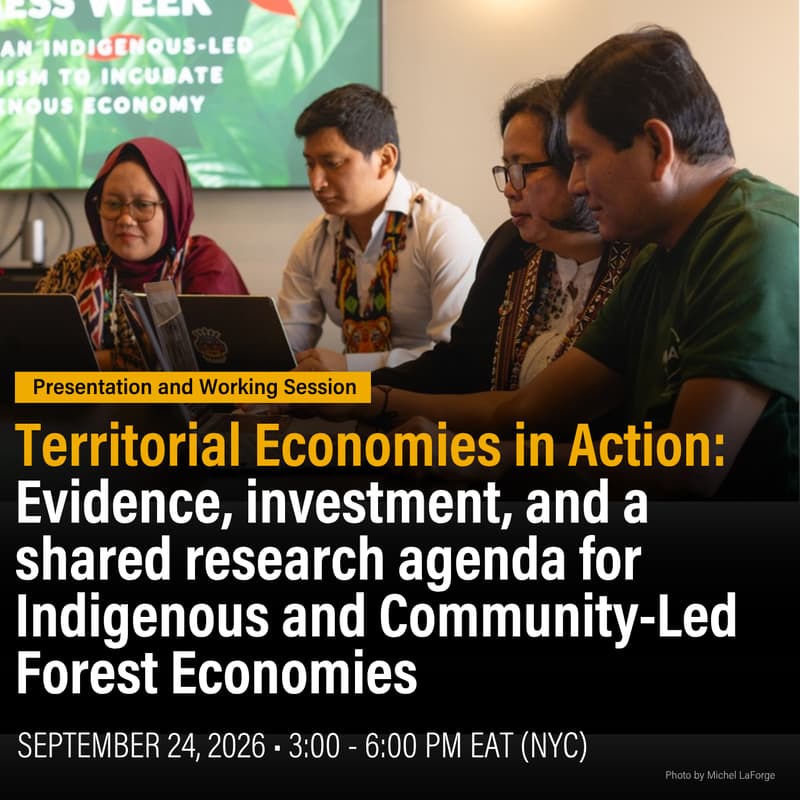

Territorial Economies in Action: Evidence, investment, and a shared agenda for Indigenous and Community-Led Forest Economies
Indigenous Peoples, Afrodescendant Peoples and Local Communities are not simply beneficiaries of climate action or stewards of carbon assets. They are rights-holders, territorial authorities, owners, entrepreneurs, producers, knowledge-holders and leaders of economies that sustain livelihoods, retain value locally and protect the world’s forests.
Across tropical forest regions, organizations and communities are developing new research, maps, investment approaches, platforms and partnerships to make these economies more visible and strengthen the conditions in which they can thrive. Yet much of this work remains fragmented across institutions and regions.
Join the Global Alliance of Territorial Communities (GATC), United Nations Development Programme (UNDP), Rights and Resources Initiative (RRI), Amazon Investor Coalition (AIC), World Resources Institute (WRI), and the Community-Led Forest Economies movement and partners for an afternoon exploring how territorial and community-led economies can shape a more prosperous and resilient future for tropical forest regions.
This three-hour strategy session will bring together Indigenous and community leaders, researchers, funders, investors, multilateral institutions and movement partners to share what is already underway and explore how we can work more effectively together.
The first hour will feature brief presentations and discussion of ongoing research, mapping, finance and regional initiatives from participating organizations. The remaining two hours will be devoted to a facilitated working session focused on building a shared research and mapping agenda for the Community-Led Forest Economies movement.
Together, participants will explore:
What research and mapping efforts already exist, and where the most important gaps remain
Which questions partners could address more effectively together
How research can be community-prioritized, co-produced and governed in ways that respect data sovereignty and knowledge ownership
How shared evidence can support better policy, finance, markets and investment
What practical joint products, projects or collaborations should be developed next