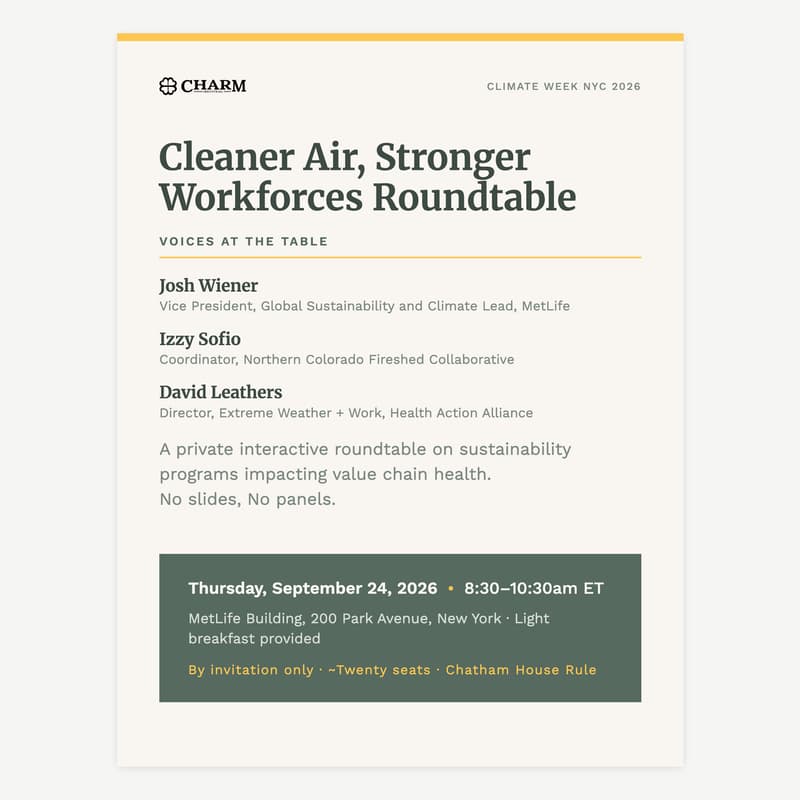

Wildfires, Air Quality, and Workforce Health with MetLife
A private roundtable on climate and employee health during Climate Week NYC hosted by Charm Industrial.
Thursday, September 24, 2026 · 8:30 to 10:30am ET · Midtown, New York · Light breakfast provided · Exact location shared upon confirmation.
Voices at the table
Izzy Sofio, Northern Colorado Fireshed Collaborative Izzy coordinates a Front Range network of agencies, water utilities, and nonprofits working to reduce catastrophic wildfire in a region carrying some of the heaviest ozone and smoke burdens in the country. She will ground the discussion in what fire-prone communities actually need from companies.
David Leathers, Director, Extreme Weather + Work David runs the Health Action Alliance's employer initiative on climate and worker health. It is advised by the National Commission on Climate and Workforce Health, co-chaired by Susan Potter, President of Mercer US and Canada, and former Senate Majority Leader Bill Frist, MD. David will share emerging trends and perspectives on the intersection of climate, employee health, and workforce resilience.
Josh Wiener, Vice President, Global Sustainability and Climate Lead, MetLife Josh leads sustainability globally for MetLife. His team guides how the company's products, services, and investments improve the well-being of people and communities.
Most companies measure climate risk to their buildings and their supply chains. Few measure it for their employees.
Charm Industrial invites twenty to twenty-five sustainability, health, and benefits leaders to a working session at the MetLife Building. No panel. No slides. Under the Chatham House Rule, we'll explore how climate-related risks are increasingly shaping workforce health, wellbeing, and business resilience.
Why this conversation, why now
In 2026, smoke from Canadian and US wildfires pushed unhealthy air onto more than 115 million Americans across the Midwest, Northeast, and Mid-Atlantic. The cost lands in health claims, absenteeism, and lost productivity, and for the first time employers can estimate it. The Health Action Alliance's Climate Health Cost Forecaster projects climate-related health costs down to the zip code.
The obvious fix is not keeping pace. In FY23, federal agencies treated 800,000 acres inside designated wildfire crisis zones, against 50 million priority acres that need work. The backlog grows every year.
Here is where it gets interesting. Thinning overgrown forests reduces catastrophic wildfire and the smoke it sends across the country, but the economics rarely close, because hauling and disposing of the leftover slash costs more than the material is worth.
Charm's carbon removal work in Colorado pays for that material instead. We turn it into a liquid called bio-oil and inject it deep underground, where it stays permanently. That cuts disposal costs by $400 to $2,000 an acre, so the same public dollar treats more land. And because the slash never burns in the open, each Charm pyrolyzer avoids about 77 metric tons of fine particulate pollution a year, worth roughly $13.4 million in annual public health benefits.
Cleaner air is not a side effect of this work. For an employer, it may be the part that shows up first.
MetLife and Charm Industrial will convene the discussion. The pairing is the argument in miniature: an insurer whose business is protecting people, working with a company whose business is cleaning the air those people breathe.
What you will take away
Insights into how climate-related risks, including wildfire smoke and poor air quality, can affect workforce health, productivity, and business performance.
Perspectives from employers, health experts, and community leaders on emerging approaches to workforce resilience.
A better understanding of the connection between climate action, employee wellbeing, and long-term business value.
Candid peer discussions on how organizations are assessing and responding to climate-related health risks, under Chatham House Rule.
Details
Two hours. Thirty minutes of coffee and conversation then sixty minutes of discussion, followed by a networking reception. Attendance is by invitation only, targeting 25 seats. Reply by Friday, September 11 to claim one, or to suggest a colleague.