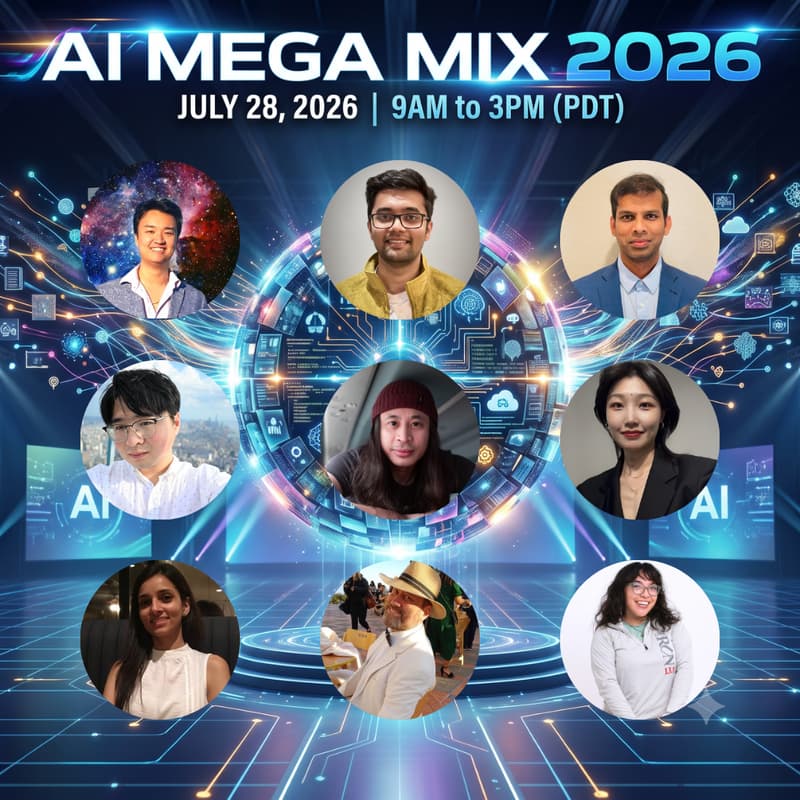

2026 AI Mega Mix
Why is this a "Mega Mix"?
We're featuring 9 talks across 4.5 hours. That's 9 different perspectives of what's going on in AI - and you can find it all in one place.
Who should attend?
This event is primarily tailored for early to mid career professionals working in IC engineering and product roles (3-10 years) related to AI + mid career ICs to early career leadership roles in engineering and product (7-15 years) in AI-adjacent areas.
What can I expect?
Each talk will be a ~25 minute talk with ~5 minutes of Q/A time. Talks will be from categories including mini workshops, technology deep dives, case studies, and live demos.
Apply to speak here.
Full Agenda TBA
9:00 - 9:05: Intro
9:05 - 9:30: Agentic RAG on Databricks (Speedrun)
Yujian Tang, Founder @ OSS4AI
9:30 - 10:00: Democratizing Machine Learning at Netflix: Building the Model Lifecycle Graph
Saish Sali, Senior Software Engineer @ Netflix
10:00 - 10:30: AI Execution at the Edge (CDNs)
Venkata Gopi Kolla, Lead Member of Technical Staff @ Salesforce
10:30 - 11:00: The Microsecond War Making Speech Faster Than Sound
Huapeng Zhou, Reinforcement Learning @ Boson AI
11:00 - 11:30: Your Agent's Context Is Stale: Real-Time Agentic Engineering with Kafka
Tun Shwe, AI Lead @ Lenses IO
11:30 - 12:00: Beyond Chatbots: Designing Feedback Loops for Trustworthy Agentic AI
Hannah Jiao, Product Designer @ Amazon
12:00 - 12:30: Using LLM as a Judge
Madhvi Sharma, Senior Engineering Manager @ Oracle
12:30 - 1:00: Closing the Barn Door: Governance as Architecture, Not Monitoring
Cory Waddingham, Head of Developer Relations @ Guild AI
1:00 - 1:30: Pull Requests 2.0: Version Control in the Agentic Era
Lizzie Siegle, Staff Developer Advocate @ Entire
Talks by Title/Abstract
Agentic RAG on Databricks (Speedrun): Learn how to use Databricks Free Edition to build and deploy an Agentic RAG app.
Democratizing Machine Learning at Netflix: Building the Model Lifecycle Graph: To effectively bridge the gap between fragmented internal infrastructure and centralized discovery, Netflix developed the Metadata Service (MDS) and its underlying Model Lifecycle Graph. Driven by a diverse and rapidly scaling machine learning ecosystem across domains like personalization, studio workflows, payments, and advertising, ML practitioners historically faced significant friction, navigating siloed systems to track model lineage, discovery, and business impact. MDS solves this fragmentation by ingesting real-time heterogeneous events from disparate systems, including pipeline orchestrators, model registries, and experimentation platforms and normalizes them into a unified entity model. By leveraging Datomic for complex, multi-hop relationship inference and Elasticsearch for instant cross-catalog discovery, the platform materializes a connected graph of the entire ML lifecycle. Ultimately, this system transitions Netflix from a model of isolated asset searches to one of contiguous, graph-based exploration, enabling teams to perform seamless lineage queries, rapid impact analysis, and proactive dependency mapping via a unified interface.
AI Execution at the Edge(CDNs): For this event, I plan to present an updated and condensed 25-minute version of the original 1-hour session, incorporating the latest developments in agentic AI. I'll include a new live demo showcasing how semantic caching is game changer when implemented at the edge (I work on this) as a practical optimization technique. I'm happy to share the full abstract and detailed outline if there's an email address where I can send them.
The Microsecond War Making Speech Faster Than Sound: How Higgs Audio v3 TTS is served on SGLang-Omni. TTS inference looks like LLM inference but breaks every one of its assumptions — so the system was rebuilt as a multi-stage asynchronous pipeline, then each stage was attacked with its own weapon: LRU caching, CUDA graphs, radix caching, and windowed streaming vocoding
Your Agent's Context Is Stale: Real-Time Agentic Engineering with Kafka: Every source on agentic engineering agrees on one thing: agents are only as good as the context they receive. So where does that context come from? The industry recommends documents, repositories, vector stores, AGENTS.md and other Markdown files. These are all important but they are static artefacts; they tell agents how the world looked when someone last wrote something down. This session will show you how to bring real-time context from Apache Kafka to your agents. We'll trace the evolution of coding tools through history and then bring the discussion to the present day, sharing how teams use MCP and skills to practice agentic engineering with real-time data streams.
Beyond Chatbots: Designing Feedback Loops for Trustworthy Agentic AI: AI agents are moving from experimental demos into real-world workflows, but building trust remains the biggest challenge. This talk explores how product teams can design effective human-AI collaboration through feedback loops, transparency, and user control. Drawing from experience designing AI-powered enterprise tools at Amazon and Remitly, I’ll share practical lessons on turning AI capabilities into reliable products that people can confidently use.
Using LLM as a Judge: Large language models are everywhere—but how do we know if they’re actually any good? This workshop demystifies AI evaluation by teaching participants to build an “LLM-as-Judge” system: a tool that uses an AI model to score and critique other AI-generated outputs.
Closing the Barn Door: Governance as Architecture, Not Monitoring: Most organizations monitor their AI agents obsessively, only to discover their observability was perfect right up to the moment of failure. This talk challenges the assumption that logging agent behavior is the same as controlling it. We'll explore why observability alone is a reactive tool and how proper governance architecture prevents failure modes before they happen. Using real examples from production agent deployments, we'll examine credential scoping, integration access control, and data boundary enforcement as foundational design patterns that make agents genuinely safe by design, not just well-documented in hindsight.
Pull Requests 2.0: Version Control in the Agentic Era: Git was designed in 2005 for a world where humans wrote every line, one deliberate commit at a time. The pull request assumes there's a human author who can explain their reasoning in review--but agents now write a large share of new code so quickly, and the reasoning that produced it disappears the moment the session ends. We're left with a diff that kept the answer and threw away the argument. This talk argues that the unit of software history must evolve from "what changed" to "what changed and why." We'll trace how coding tools reached this breaking point, look at what it takes to preserve an agent's full reasoning alongside the code it produces, and examine why reviewing AI-generated code increasingly falls to LLMs themselves...because human review can't scale to agent output. You'll leave with a mental model for what the post-PR SDLC might actually look like, and why the missing layer is memory, not a smarter model.