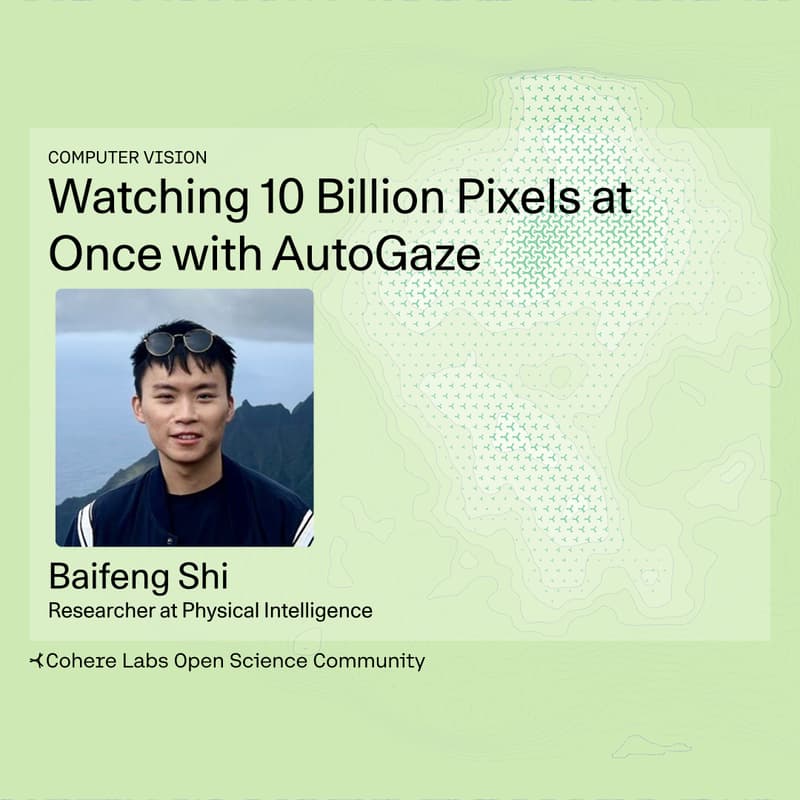

Baifeng Shi - Watching 10 Billion Pixels at Once with AutoGaze
Multi-modal large language models (MLLMs) have advanced general-purpose video understanding but struggle with long, high-resolution videos -- they process every pixel equally in their vision transformers (ViTs) or LLMs despite significant spatiotemporal redundancy. We introduce AutoGaze, a lightweight module that removes redundant patches before processed by a ViT or an MLLM. Trained with next-token prediction and reinforcement learning, AutoGaze autoregressively selects a minimal set of multi-scale patches that can reconstruct the video within a user-specified error threshold, eliminating redundancy while preserving information. Empirically, AutoGaze reduces visual tokens by 4x-100x and accelerates ViTs and MLLMs by up to 19x, enabling scaling MLLMs to 1K-frame 4K-resolution videos and achieving superior results on video benchmarks (e.g., 67.0% on VideoMME). Furthermore, we introduce HLVid: the first high-resolution, long-form video QA benchmark with 5-minute 4K-resolution videos, where an MLLM scaled with AutoGaze improves over the baseline by 10.1% and outperforms the previous best MLLM by 4.5%.
Bio: Baifeng Shi (https://bfshi.github.io/) is a researcher at Physical Intelligence. He previously graduated with a PhD degree from Berkeley AI Research (BAIR) at UC Berkeley, advised by Prof. Trevor Darrell. His research focuses on learning general-purpose vision and robotic models. He has published and presented in top conferences such as CVPR, ECCV, ICCV, ICML, NeurIPS, ICLR, and CoRL.