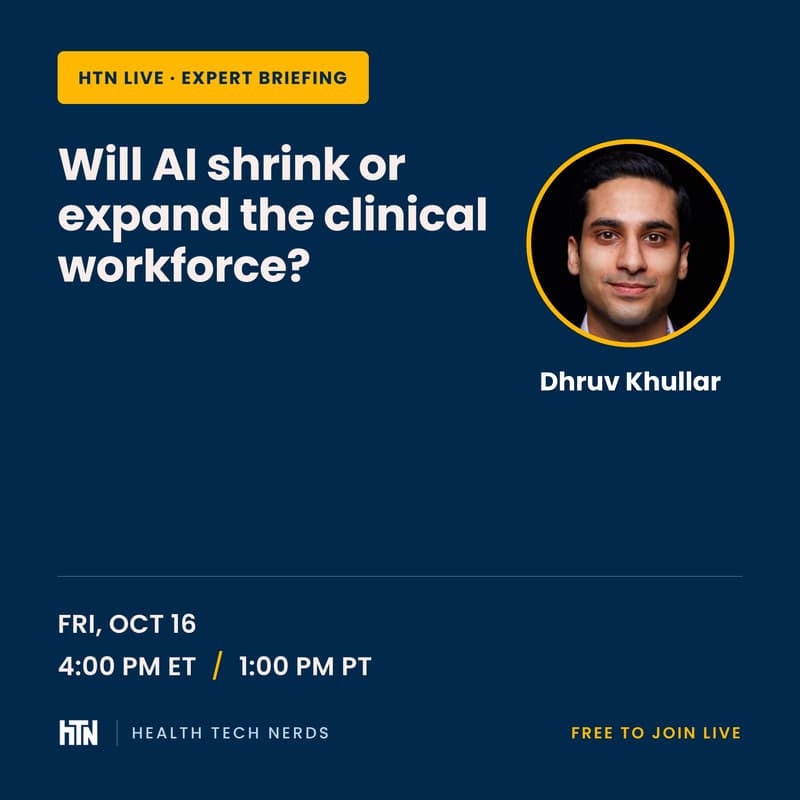

Will AI shrink or expand the clinical workforce?: an expert briefing with Dhruv Khullar
Many experts predict AI will take over enough clinical work to leave fewer jobs for radiologists, pathologists, psychiatrists and primary care clinicians. The federal government recently announced an initiative to develop AI agents that can care for patients autonomously. In a new NEJM Perspective, Dhruv Khullar argues that economic theory and history point the other way: over the long run, AI agents could expand the clinical workforce rather than shrink it.
He gives three reasons. First, the Jevons paradox: when technology makes a resource cheaper to use, demand often rises. There are more radiologists in the US today than a decade ago. Second, the "lump of labor" fallacy: the amount and type of work changes over time, and about a quarter of Americans already live in primary care shortage areas. Third, tasks versus skills: AI can automate tasks like visit documentation, but medicine depends on many interrelated skills, and the value of the human tasks that remain may rise. He also acknowledges that clinical roles will change and some jobs could be replaced, and that assumptions about the future workforce shape training, payment policy and investment.
Dhruv Khullar is an associate professor of health policy and economics at Weill Cornell Medical College and a writer at The New Yorker, where he covers medicine, health care and politics. His research focuses on value-based care, health care consolidation and medical innovation. He will join HTN Live for an expert briefing with HTN's Martin Cech.
Live event open to everyone, replay and transcript exclusively available for HTN Pros.