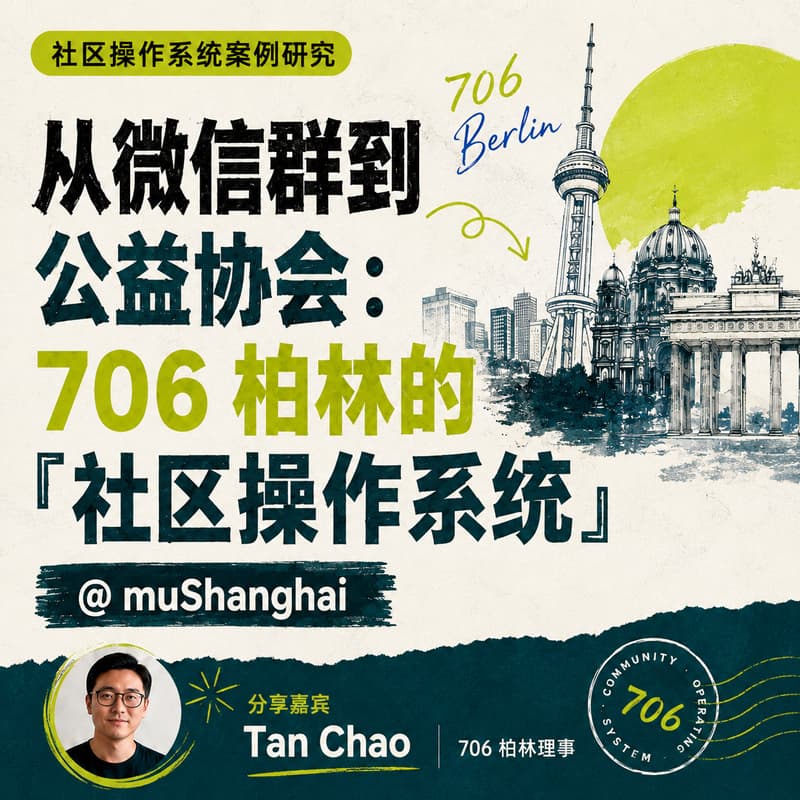
From WeChat Group to Non-Profit Association: 706 Berlin’s Community OS
🧩 From WeChat Group to Non-Profit Association: 706 Berlin’s Community OS 从微信群到公益协会:706 柏林的「社区操作系统」 @ muShanghai
706 Berlin did not begin as an institution.
It began, like many Chinese-speaking communities overseas, with a WeChat group, a few people, and a difficult but real question:
在中文语境下, 我们能不能找到一种更安全、更有趣、也更持久的方式, 去谈论公共议题、组织线下活动、建立彼此之间的信任?
From there, 706 Berlin gradually grew into a community organization with regular events, volunteer support systems, member assembly and council governance structures, non-profit association registration, public funding, cross-city cultural trips, and a long-term internal pathway for members to grow into organizers and governors.
This session is not just a story about “how 706 Berlin grew.”
It is a case study of Community Operation System:
How does a community move from passion to structure? How does it turn activities into organizational capability? How does it build a loop between people, events, money, and governance? And how can these lessons inspire the next generation of community tools built through vibe coding?
ℹ️ What to expect TL;DR
In this sharing session, Tan Chao, 706 Berlin Council Member, will walk us through:
• How 706 Berlin started from a WeChat group and turned sensitive-topic needs into playful offline gatherings
• How potlucks, self-disclosure icebreakers, public-issue events, and mock voting helped stabilize community participation
• Why “running on love” eventually became unsustainable
• How non-profit association registration and member assembly–council governance created compliance, accountability, and division of responsibility
• How small community grants became the “resume” for larger funding
• How funding became external recognition and helped the organization scale
• How 706 Berlin expanded into larger events, concerts, cultural trips, membership benefits, and repeatable activity formats
• How participants can grow into volunteers, hosts, members, and eventually council members
• What kind of digital tools a community like this actually needs
🧩 从微信群到公益协会:706 柏林的「社区操作系统」
From WeChat Group to Non-Profit Association: 706 Berlin’s Community OS
@ muShanghai
706 Berlin 并不是从一个“机构”开始的。
它和许多海外中文社群一样,最初只是一个微信群、几个人,以及一个困难但真实的问题:
在中文语境下,
我们能不能找到一种更安全、更有趣、也更持久的方式,
去谈论公共议题、组织线下活动、建立彼此之间的信任?
从这个问题出发,706 Berlin 逐渐成长为一个真正的社区组织:它有稳定的线下活动、志愿者支持体系、会员大会与理事会治理结构、公益协会注册、公共资金支持、跨城市文化旅行,也有一条让普通参与者逐步成长为志愿者、主持人、会员乃至治理者的长期内部路径。
2026 年,706 柏林也因其在公共参与、社群建设与民主实践方面的持续探索,被柏林民主委员会提名民主参与奖。这不仅是一份外部认可,也说明一个从微信群出发的中文社群,可以通过长期组织建设,逐渐进入城市公共生活的制度视野。
这场分享不只是一个关于“706 Berlin 如何成长”的故事。
它更是一次关于 Community Operation System|社区操作系统 的案例研究:
一个社区如何从热情走向结构?
如何把一次次活动沉淀成组织能力?
如何在人、活动、资金与治理之间建立闭环?
这些经验又如何启发下一代通过 vibe coding 建设出来的社区工具?
ℹ️ 你将收获什么 TL;DR
本场分享中,706 Berlin 理事 Tan Chao 将带我们梳理:
• 706 Berlin 如何从一个微信群开始,把敏感议题的讨论需求转化为更轻松、更好玩的线下聚会
• potluck、自我暴露式破冰、公共议题活动、模拟投票等形式,如何帮助社区稳定参与感
• 为什么一个社区不能长期只靠“用爱发电”
• 公益协会注册、会员大会与理事会治理,如何带来合规性、责任机制与清晰分工
• 小额社区基金如何成为申请更大公共资金的“履历”
• 资金如何变成外部认可,并帮助组织进一步扩大规模
• 706 Berlin 如何发展出大型活动、音乐会、文化旅行、会员权益与可复制的活动模板
• 参与者如何逐步成长为志愿者、Host、会员,甚至理事 / 治理者
• 像 706 Berlin 这样的社区,究竟真正需要什么样的数字工具