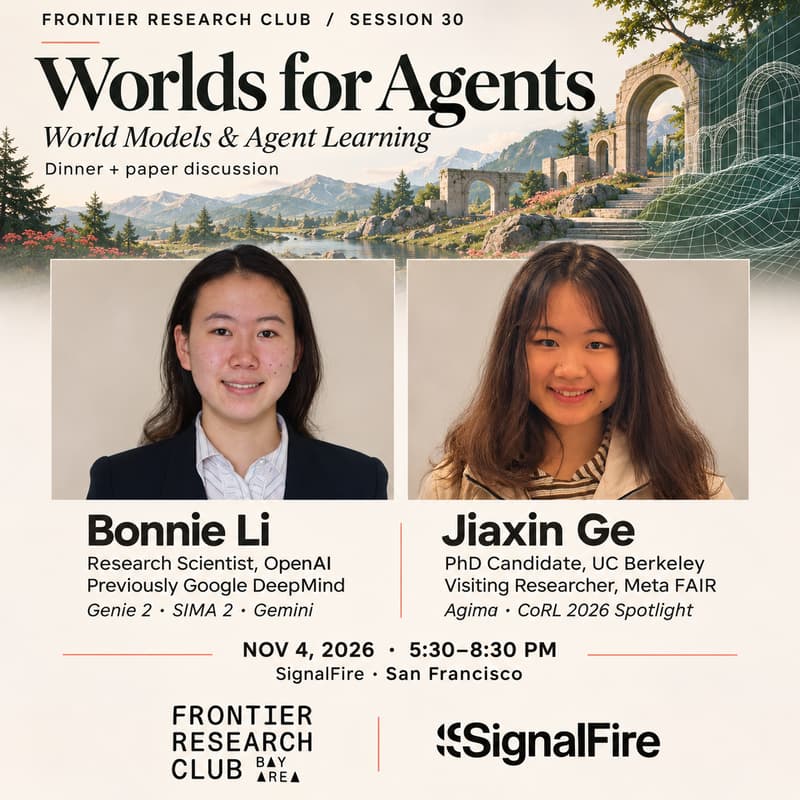

Bay Area Frontier Research Club #30 | Worlds for Agents (dinner + paper discussion @ SignalFire)
Worlds for Agents: World Models and the Agents That Learn Inside Them
A Frontier Research Club session hosted at SignalFire, with talks from OpenAI and Berkeley AI Research / Meta FAIR.
If a model can generate a world, an agent can practice in it. This session asks how far that loop actually goes.
World models promise to make agent training cheap: generate a world, let an agent act in it, score the attempt, repeat. In late 2025, DeepMind’s SIMA 2 agent kept improving inside worlds generated by Genie 3, with no new human demonstrations.
Whether this scales comes down to two questions this session takes in order: what should a world model actually learn to predict, and what can an agent do once it can imagine where its actions lead?
Bonnie Li (Research Scientist, OpenAI; formerly Google DeepMind, where she was a key contributor to Genie 2 and SIMA 2) takes the first question.
Jiaxin Ge (Berkeley AI Research and Meta FAIR; lead author of Agima and co-lead of RATs, a CoRL 2026 Spotlight) takes the second.
Pre-reads: Pre-read: Contrastive World Models (arXiv 2609.22175), Genie 2: A Large-Scale Foundation World Model (DeepMind Blog), SIMA 2: A Generalist Embodied Agent for Virtual Worlds (arXiv 2512.04797), Train An Imaginative Agent (arXiv 2610.26845, project page at agima.net), and Playful Agentic Robot Learning (arXiv 2606.19419). Come having read them; the discussion starts at depth.
The Frontier Research Club is a curated forum for rigorous, technical discussion at the frontier of AI. We convene researchers from the frontier labs, Stanford, Berkeley and leading startups to examine concrete work (papers, methods and results) with a bias toward assumptions, evaluation methodology, failure modes, and what would count as convincing evidence.
Each session features 2 talks selected for rigor and discussion value. Presentations are intentionally brief so the majority of time is reserved for questions and critique. Papers and supporting materials are shared in advance to ensure a high-baseline conversation.
Agenda
5:30pm: Doors open
5:30pm – 6:30pm: Networking + light dinner
6:30pm – 8:00pm: Research presentations + discussion
8:00pm – 8:30pm: Networking
Presenters & topics
Bonnie Li is a Research Scientist at OpenAI. She joined from Google DeepMind, where she was a core contributor to Genie 2, DeepMind’s large-scale foundation world model, and SIMA 2, its generalist agent that learns inside 3D virtual worlds, and a core contributor to Gemini 2.5 and 3.
Her ICML 2025 paper LMAct with Volodymyr Mnih, tested whether frontier models can learn to act from long multimodal demonstrations in context. She last spoke at FRC in May on scaling RL compute for LLMs (watch the talk).
What should a world model actually learn to predict, and how big does it need to be? In From Latent World Models to Generative Worlds, Bonnie will trace two directions for world models, which let agents predict what happens next and learn in imagination. The first is small and abstract: Contrastive World Models, which drops the pixel decoder entirely and keeps only the information that predicts what comes next.
The second is large-scale: generative models that render whole interactive worlds, from Genie 2 to real-time worlds that stay consistent for minutes. Agents like SIMA 2 can follow instructions inside these worlds, and the newest models are starting to simulate robotic tasks.
She’ll close on what it will take for world models to become the training ground for general agents.
Pre-read: Contrastive World Models (arXiv 2609.22175), Genie 2: A Large-Scale Foundation World Model (DeepMind Blog), and SIMA 2: A Generalist Embodied Agent for Virtual Worlds (arXiv 2512.04797).
Jiaxin Ge is a final-year Computer Science PhD student at UC Berkeley, advised by Trevor Darrell at Berkeley AI Research (BAIR), and a Visiting Researcher at Meta FAIR. She is lead author of Agima and co-lead of RATs, a CoRL 2026 Spotlight on robots that build their own skill library through self-directed play, which she presents in Austin next week.
Her first- and co-first-author work spans CVPR 2025 (AutoPresent), ECCV 2024 (Recursive Visual Programming), ICLR 2026 (ECHO), NeurIPS 2026 (VisGym), ACL, and EMNLP, with collaborators including Ken Goldberg, Jitendra Malik, Ion Stoica, Sewon Min, and Luke Zettlemoyer. She did her undergraduate degree at Peking University and chaired the ICCV 2025 workshop on what’s next in multimodal foundation models.
What changes when an agent can picture where its actions lead before it commits? Jiaxin will present Agima, a training framework that unifies policy and world modeling in a single omni model, so the agent generates and reasons over imagined futures. Trained only on two-box Sokoban puzzles, Agima solves 40% of four-box puzzles while seeing the real board just once every five moves, against 2% for a planner that acts without imagining.
She’ll show how supervised fine-tuning and agentic reinforcement learning teach the model to plan under sparse feedback, avoid irreversible mistakes, and learn when and where to look ahead.
She’ll close with a few minutes on RATs, her CoRL 2026 Spotlight work with Ken Goldberg and Trevor Darrell, in which a robot agent invents its own practice tasks before any real task arrives, writes and verifies the code to solve them, and banks what works in a skill library that transfers to a real robot arm without fine-tuning. The arc runs from agents that imagine their futures to robots that invent their own practice.
Pre-read: Train An Imaginative Agent (arXiv 2610.26845, project page at agima.net) and Playful Agentic Robot Learning (arXiv 2606.19419).
Want to present your work?
If you have a research paper you’d like to discuss at one of our next sessions, please submit it for consideration.
Submit your paper here!
Who should attend
Researchers working on world models, video generation and simulation
Reinforcement learning and embodied-AI researchers training agents in virtual environments
Robotics teams working on sim-to-real transfer
Game, simulation and interactive-media engineers building generated worlds
Infrastructure teams training and serving large video and world models
Founders and technical leaders building physical AI and agent products
Capacity is limited.
We will take photos and short video clips for event recap and promotion. By attending, you consent to being photographed and recorded, and to the use of those images and clips by the organizers on social media and other event marketing channels.
🌐 Connect with Frontier Research Club
Luma Calendar: luma.com/frontiersyndicate
YouTube: FrontierResearchClub
LinkedIn: frontier-research-club
Instagram: @frontierresearchclub
Email: kristopher@frontiersyndicate.vc
Hosted by
The Frontier Syndicate is a venture community connecting frontier tech researchers, builders, and investors through curated convenings and early-stage capital. Across the Bay Area, we host a recurring series of research forums, builder nights, and intimate investor dinners — and back exceptional companies emerging from the labs, communities, and technical networks we convene.
SignalFire is an AI-native venture firm investing in early-stage applied AI. Its Beacon AI platform gives portfolio founders data-driven support across recruiting, go-to-market and growth.