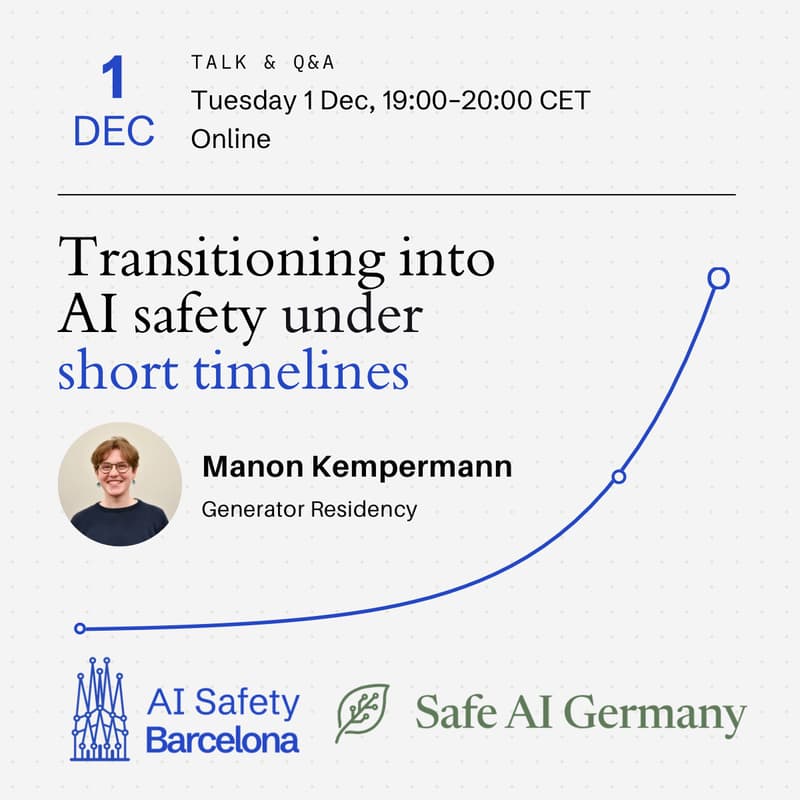

Transitioning into AI safety under short timelines
On 5 November, METR published an assessment estimating that Anthropic's models are improving roughly twice as fast as before on well-specified tasks, mostly thanks to AI itself. Ajeya Cotra, who works at METR, called it "the most important update we have gotten about AI risk in the last couple of years".
The report has taken the AI safety field by storm, and many experts now believe there's a decent chance that recursive self-improvement (RSI) — where AI does its own research and improves itself — could arrive in the next 6 to 12 months. If this is true, our personal window for acting could be narrowing quickly, unless we do something that significantly slows down the current pace of AI development.
In light of this news, we're running a session to help make sense of the situation and of what it means for you. If you're looking to get into AI safety, we'll be asking: what can you do if recursive self-improvement (RSI) and superintelligence is only a short time away? And what comes after we succeed at pacing AI development?
The session is primarily oriented towards people based in Europe, so we'll keep a strong focus on what you can do from here.
What will be covered
The session will feature a 30-minute talk by Manon Kempermann, covering:
What "short timelines" means for your decisions
Why talent still matters if timelines are short, and which skills and roles will be useful after a major intervention
Concrete advice for people who are early in their careers or new to the field
The talk will be followed by 30 minutes of Q&A with Manon.
Speaker profile
Manon Kempermann is a recent Generator Resident, where she ran the Longitude DC Intensive, a programme to bring technical professionals into AI policy. Previously, she founded AI Safety Saarland and helped launch Safe AI Germany (SAIGE), where she was programme director of the SAIGE Incubator. She has advised multiple AI safety groups and mentored dozens of people transitioning into AI safety.
She currently works out of Constellation in Berkeley, where over the past weeks she has had many conversations with people from METR, Redwood and other AI safety organisations about how to reorient to shorter timelines. She runs The AI Safety Cyclist Substack, where she recently wrote "Short timelines, then what?".
Who should attend?
This session is for anyone based in Europe who is very concerned by the recent updates and wants to figure out how to have an impact while we still can. We're especially excited to welcome mid-career and senior people, and people who are already a few steps into an AI safety transition or already working in the field.
It can also be valuable if you're sceptical, or unsure how to think about this situation at all.