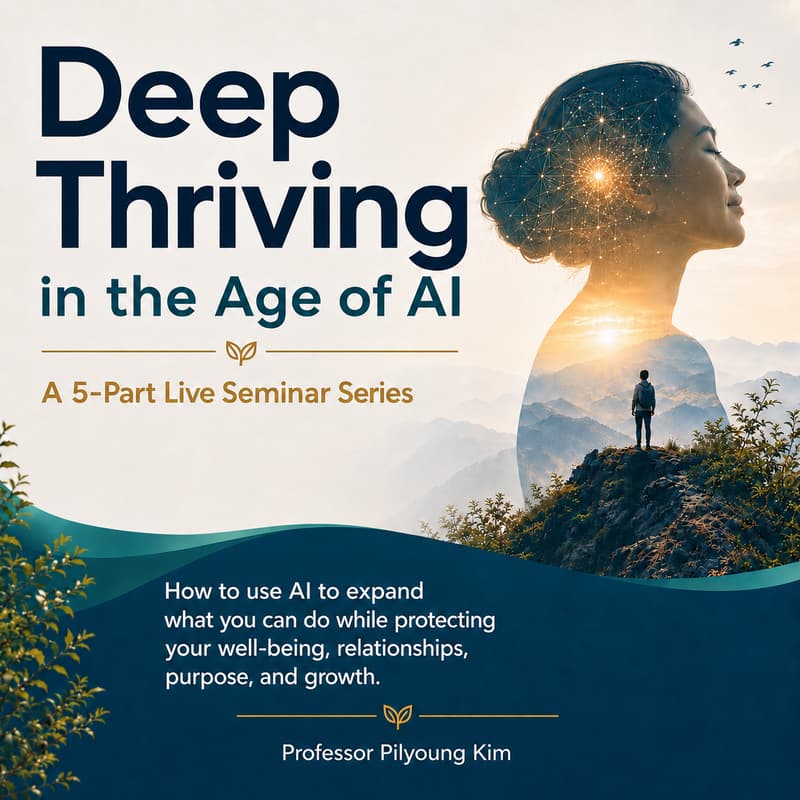

Deep Thriving in the Age of AI: Part 1
AI may be increasing your productivity. But is it helping you thrive across work and life?
AI can help us work faster, explore new ideas, and begin projects that once seemed out of reach. Yet it can also blur work-life boundaries, create pressure to keep up, and raise difficult questions about our skills, careers, values, and well-being.
How can I thrive in the age of AI?
What is deep thriving?
Deep thriving means that AI expands what you can do while you preserve your energy, agency, judgment, professional identity, relationships, well-being, and sense of meaning over time.
What we will explore
In this five-part live series, we will draw on research from psychology, neuroscience, human development, and workplace studies to examine the factors that support deep thriving.
The series is designed to help you understand how AI may influence your work as well as your personal growth, well-being, and sense of meaning.
This is the first seminar in a planned five-part live series. Each session can be attended independently. Future dates will be announced separately.
In Part 1, we will ask the question: Are You Truly Thriving with AI?
What you will take away
By joining the series, you will:
Assess whether you are currently thriving
Learn about important factors that scientific research suggests for thriving
Identify the strengths, skills, and resources you would like to develop
Who this is for
This series is for professionals who:
Use AI regularly, occasionally, or feel pressure to begin using it
Want to make more intentional decisions about where AI belongs in their work and lives
Join the live session at no cost.
About the instructor
Professor Pilyoung Kim, Ph.D. is a developmental psychologist, neuroscientist, Professor of Psychology (University of Denver), and Director of the Center for Brain, AI, and Child. Her research examines human development, emotions, relationships, well-being, and the emerging psychological dynamics of human–AI relationships.
She has advised and contributed to AI safety and policy initiatives involving OpenAI, Google, leading AI policy organizations, and a U.S. Congressional briefing.
Drawing on more than 20 years of university teaching and more than 100 scholarly publications, Professor Kim created this seminar to help people benefit from AI while preserving their agency, judgment, relationships, well-being, and sense of meaning.