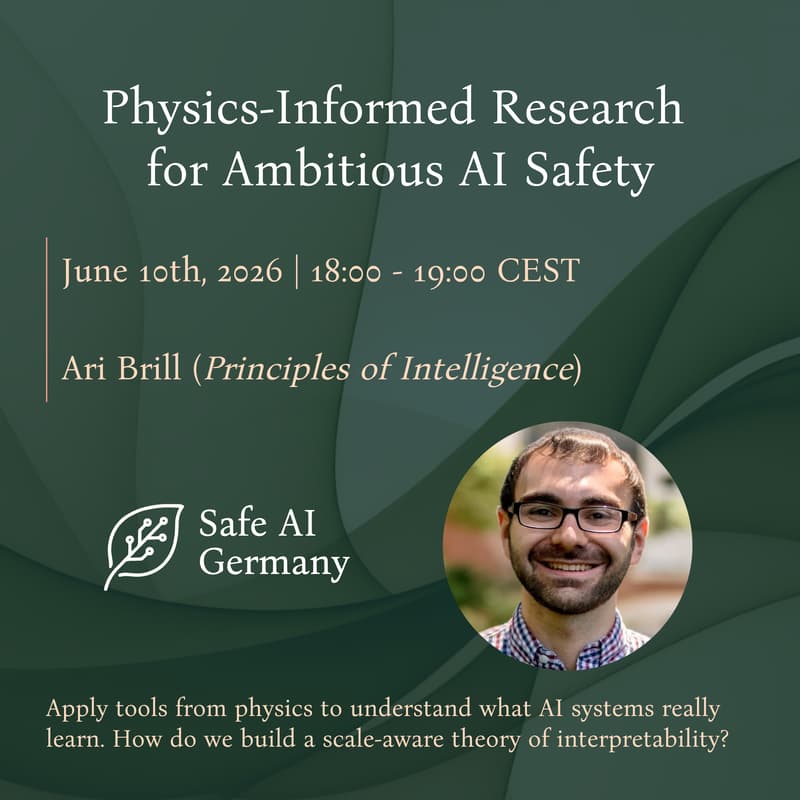

Physics-Informed Research for Ambitious AI Safety
Ambitious AI safety research is needed to avoid existential risks from superintelligent but misaligned AI systems. Methods from physics can help us understand deep learning systems and mathematically model crucial properties of natural learning tasks, building towards a scale-aware theory for enabling ambitious mechanistic interpretability.
On Wednesday, June 10th, Safe AI Germany (SAIGE) is hosting Ari Brill (PIBBSS), to explore how physics can teach us about AI systems we don't yet understand.
What will be covered
- Physics-informed research directions in technical AI safety;
- How modelling the structure of natural data distributions can help us interpret what AI systems learn.
Speaker profile
Ari Brill works at Principles of Intelligence (PIBBSS), where he leads the Data Models & Validation team for the PIRAMID Project (Physics-Informed Research for Ambitious Mechanistic Interpretability Development). His research investigates how data models that exhibit critical phenomena and scale-free structure can be applied to improve AI interpretability tools. Before joining Principles of Intelligence, Ari developed methods to analyse gamma-ray emission powered by supermassive black holes as a postdoctoral fellow at NASA Goddard Space Flight Center.
Who should attend?
Technical AI Safety researchers, STEM students, and anyone who is interested in how physics-informed methods could unlock deeper AI interpretability. Ari will provide the necessary technical background before going into any details!