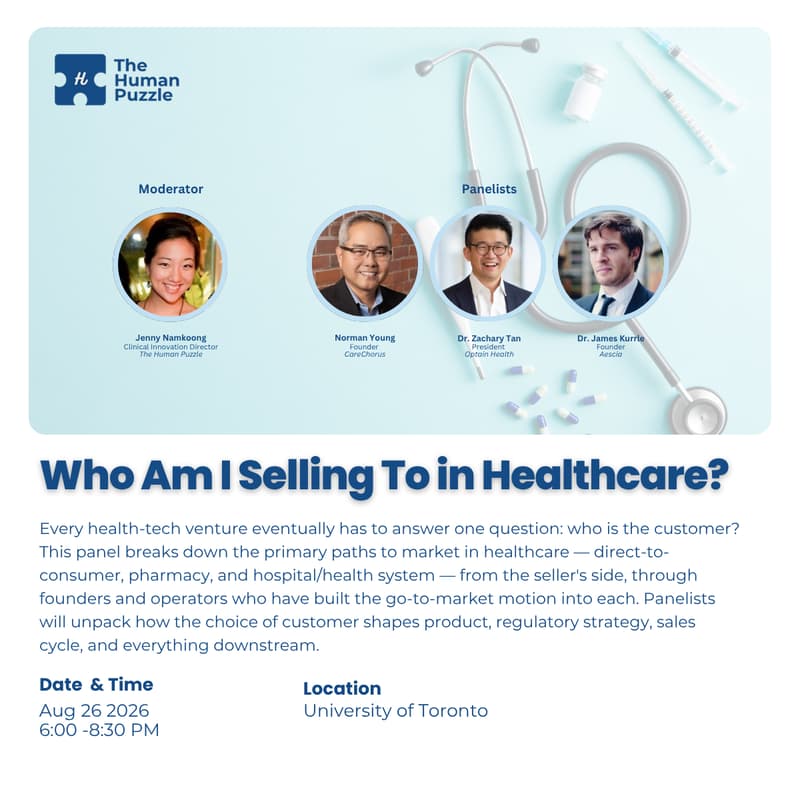

Who Am I Selling To in Healthcare?
Event Description
Every health-tech venture eventually has to answer one question: who is the customer? This panel breaks down the primary paths to market in healthcare — direct-to-consumer, pharmacy, and hospital/health system — from the seller's side, through founders and operators who have built the go-to-market motion into each. Panelists will unpack how the choice of customer shapes product, regulatory strategy, sales cycle, and everything downstream.
Why Attend
Attendees will gain insights to:
How direct-to-consumer, pharmacy, and hospital/health-system models differ in sales cycle length, regulatory burden, and revenue predictability
What it actually takes to sell into a hospital system versus a pharmacy versus a patient directly
How founders decided which customer to sell to first, and when — or whether — they expanded into others
Ideal For
Founders and early-stage health-tech teams deciding on a go-to-market path
Clinicians and hospital administrators evaluating vendor relationships
Investors assessing go-to-market risk in health-tech
Program
6:00 to 6:15 PM · Check In and Networking
6:15 to 6:20 PM · Opening Remarks
6:20 to 7:00 PM · Moderated Panel Discussion
7:00 to 7:10 PM · Audience Q and A
7:10 to 8:30 PM · Networking and Closing
Panelists
Norman Young Norman founded CareChorus after experiencing the healthcare system from both sides — as a cancer survivor in his twenties, and later watching family and friends struggle with fragmented records, medical jargon, and not knowing what to ask. The tools he'd spent his career building helped doctors see patient data clearly; nothing existed to help patients and caregivers see their own care clearly.
His career spans 25 years in healthcare software, from early digital radiology to MRI systems. In 2005, he founded ClearCanvas, an open-source medical imaging platform still used by clinicians around the world. In 2021, the American College of Radiology recognized his contributions with its Global Humanitarian Award.
He founded CareChorus Health Foundation to bring that same clarity to the people who need it most — a system where patients are heard, information flows, and care works as a team.
Dr. Zachary Tan is a physician-scientist working at the intersection of medicine, academia, and technology.
He is President of Optain Health, a company applying AI, robotic retinal imaging, and teleophthalmology to enable earlier detection of eye and systemic diseases. Drawing on oculomics - the science of using the eye as a window into whole-body health - Optain's platform captures retinal images without dilation / specialist training, and uses AI to screen for diabetic retinopathy, cardiovascular disease risk, and other major eye diseases. The technology is specifically designed to extend specialist-level screening to rural and regional patients who would otherwise go undiagnosed, with science developed in Australia and now scaled to hundreds of sites globally.
Previously, Dr Tan was General Partner at Aegis Ventures, a healthcare venture studio, where he founded and invested in companies across AI and virtual care, including Ascertain, an AI agent platform to automate healthcare operations. Before that, he was a leader at Osara Health, a virtual cancer-care platform now serving millions of eligible lives across four countries.
Dr Tan has authored over 35 publications in ophthalmology, healthcare AI, and epidemiology. He serves on the U.S. Board of the Fred Hollows Foundation and ANDHealth's international investment committee, and was named to the Forbes 30 Under 30 in Healthcare & Science. He was a a Bloomberg Fellow through the Schwarzman Scholars Program at Tsinghua University, an MMed from the University of Sydney, and an MD from the University of Queensland.
Dr. James Kurrle Dr. Kurrle is a physician and the founder of Aescia, which builds software for the window around a procedure, the part where the patient is at home and nobody is watching. Nearly a decade in acute care showed him that the riskiest days are the ones the hospital never sees: the days before, when whether a patient is ready decides whether the procedure happens at all, and the weeks after, when people deteriorate quietly until they turn up in an emergency department.
Aescia checks in with patients daily, gives guidance matched to where they are in recovery, and connects them to a clinician when something is wrong. Clinical rules paired with predictive models determine who needs attention and when. It is in trial at a major teaching hospital.
A study of patients recovering from heart attack is planned across sites in five Canadian provinces, and paediatric versions covering respiratory recovery and pre-surgical preparation are in development with a Canadian children's hospital.
Moderated by:
Dr Jenny Namkoong is an interventional cardiologist whose work is organized around one question: how do we make complex cardiovascular problems more interpretable, teachable, and clinically actionable?
In the cath lab, that question has led her into chronic total occlusion and complex PCI, coronary physiology, and microvascular dysfunction — the spaces where symptoms, anatomy, and physiology don't line up neatly, and a decision still has to be made. She's performed 1,000+ coronary interventions as primary operator across hospitals in Australia and Canada, and holds a Master of Health Policy from the University of Sydney, where her focus expanded from the individual case to the systems that shape how care gets delivered.
She brings the same lens to health technology and evidence: not just whether something works, but whether it can reach patients safely, usefully, and equitably. As Director of Clinical Innovation at The Human Puzzle, she now sits at exactly that intersection — where clinical need, system design, and what actually gets built and bought have to line up.
About The Human Puzzle
a nonprofit working on bridging the gap between breakthrough discovery and systemic implementation.