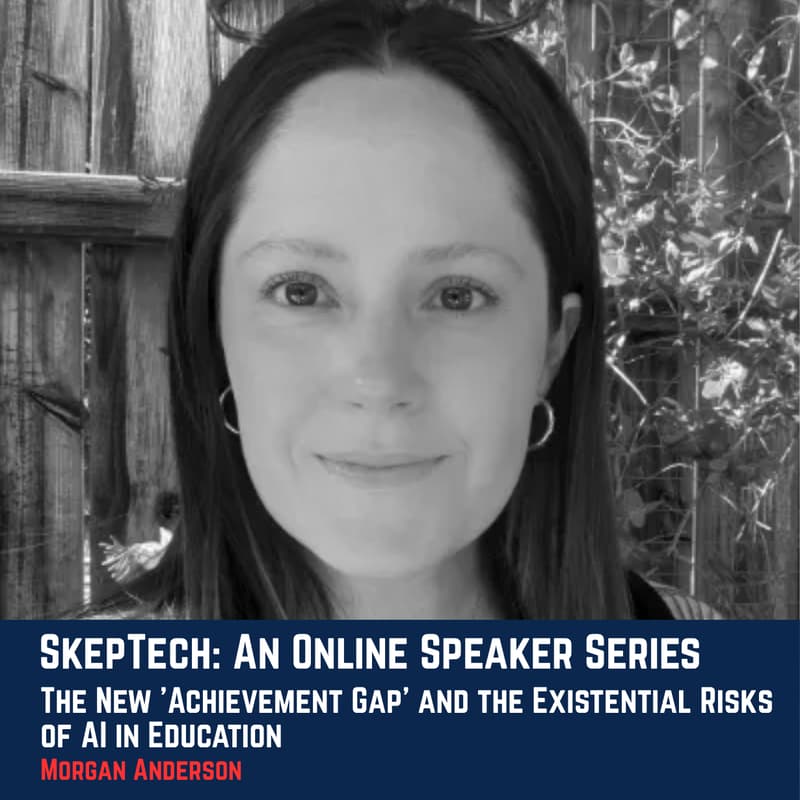

The New ‘Achievement Gap’ and the Existential Risks of Artificial Intelligence
Drawing inspiration from Gloria-Ladson Billings’ groundbreaking critique of the so-called “achievement gap” while synthesizing insights from philosophy of work and conceptions of achievement, this talk suggests that the use of Large Language Models (LLMs) in education risks equipping students with the ability to produce artifacts that have no relationship to the “efforts of individual human agents,” calling into question the robustness of their academic achievements. The talk will argue that we are at risk of facilitating a new sort of “achievement gap” where the elimination of productive struggle and intellectual friction pose existential risks to the aims of education.
About Morgan Anderson
Morgan Anderson is Associate Professor of Social Foundations of Education at the University of Northern Iowa. Her work explores the philosophical, pedagogical, and ethical challenges associated with digital technologies in educational settings. Her first book, Public Education in the Digital Age: Neoliberalism, Edtech, and the Future of Our Schools calls for a reassessment of the relationship between schools and digital technologies.
Note: attendees may be contacted about future CSLP events through a mailing list; if you do not wish to be included please contact our Communications Officer at david.pickup@concordia.ca