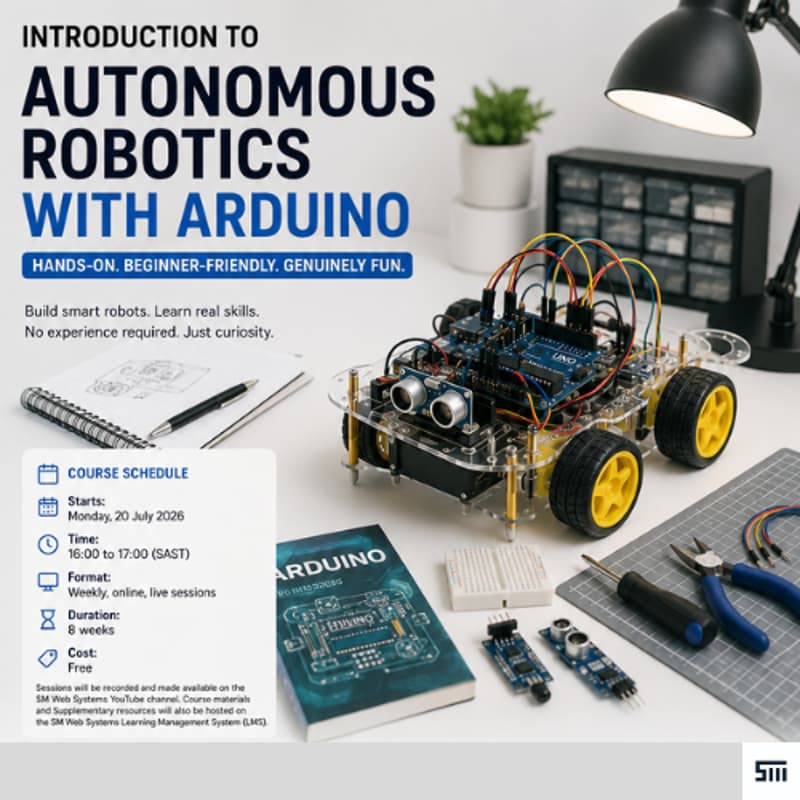
Introduction to Autonomous Robotics with Arduino Hands-On. Beginner-Friendly. Genuinely Fun.
Introduction to Autonomous Robotics with Arduino
Hands-On. Beginner-Friendly. Genuinely Fun.
Have you ever wanted to build a robot that actually thinks for itself? This is your chance.
This is a free, practical, project-based course designed to take you from zero to building real autonomous robots using Arduino. Whether you are a student, a curious tinkerer, or someone looking to break into engineering and embedded systems, this course was built for you. No robotics experience required. Just bring your curiosity.
Over 6 to 8 weeks, you will design, wire, program, and test robots that actually do things: follow lines, dodge obstacles, detect edges, respond to light, and even connect to your phone via Bluetooth. Every session is hands-on, every concept is grounded in a real build, and every student walks away with a working prototype and an NFT certificate to prove it.
Course Schedule
Starts: Monday, 8 February 2027
Time: 19:00 to 20:00 (SAST)
Format: Weekly, online, live sessions
Duration: 6 to 8 weeks
Cost: Free
Sessions will be recorded and made available on the SM Web Systems YouTube channel. Course materials and supplementary resources will also be hosted on the SM Web Systems Learning Management System (LMS).
What You Will Build
Six engaging hands-on projects:
Line-Following Robot - your robot learns to stay on track, literally
Obstacle-Avoiding Robot - real-time ultrasonic sensing and autonomous navigation
Edge-Detection Robot - autonomous safety logic that stops your robot from falling off a surface
Bluetooth-Controlled Robot - one of the most interactive and crowd-favourite builds, control it directly from your phone
Smart Parking Sensor System - a real-world application that mirrors systems used in vehicles today
Light-Following Robot - a beautiful introduction to analog sensing and photoresistor-based control
What You Will Learn
The fundamentals of Arduino and embedded systems programming (C/C++)
How to read and interpret data from ultrasonic and infrared sensors
Motor control with DC motors and motor drivers
Digital and analog input logic
Real-time decision-making algorithms for autonomous navigation
Wiring, breadboarding, and prototyping best practices
Tools and Technologies
Students will work with the following components independently: Arduino Uno, ultrasonic sensors, IR sensors, DC motors and motor drivers, breadboards, Bluetooth modules, photoresistors, and the Arduino IDE. A recommended kit list will be shared before the course begins.
Your Certificate
Students who complete the course will receive a verifiable NFT certificate of completion, a digital credential you can share on LinkedIn or in any portfolio, stored permanently on the blockchain.
Your Instructors
Georgina Taodzera is an Electrical and Electronic Engineering student at the University of Johannesburg, certified in both Basic and Advanced Programming for the Yaskawa YRC1000 Robotic System. She completed two internships in the Robotics Division at Yaskawa Southern Africa, one of the leading industrial robotics companies on the continent, gaining hands-on experience with professional-grade robotic systems. Alongside her engineering studies, she has spent over four years teaching Mathematics and Science through Superprof SA, which means she knows exactly how to break down complex technical concepts so they actually land. Georgina designed this curriculum and leads the technical content throughout the course.
Makaita Mudzengerere is a final-year Electrical and Electronic Engineering student at the University of Johannesburg with a strong focus on robotics, embedded systems, and automation. For her final-year project, she designed and built a mobile robotic system integrating obstacle avoidance and basic vision capabilities using Arduino, Raspberry Pi 3B+, and ESP32-CAM - the exact kind of hands-on, real-world build this course is all about. She completed an industrial robotics traineeship with Yaskawa Motoman, where she programmed and operated the YRC1000 robotic system, and previously gained exposure to power systems and live engineering environments through a role at Siyavuya Power Projects. She also holds a Certified Professional Arbiter (CPA – Chess) qualification, which speaks to her precision, analytical thinking, and composure under pressure. Makaita brings both technical credibility and the lived experience of being a student builder navigating this field right now.
Joelle Aganze is currently completing her BSc Honours in Computer Science at the University of the Western Cape, having completed her BSc in Computer Science at UWC in 2025. She is a Salzburg Global Fellow, a Golden Key International Honour Society member, and a QuantifyYourFuture 2025 alumna who gained hands-on data analysis experience working on projects with Absa, FirstRand, FNB, Nedbank, and Standard Bank. She currently serves as a Mathematics Tutor at UWC, is part of the TechForward program at Webmax Coding Academy, and has held leadership roles in Women in Computer Science UWC and Geekulcha UWC. Joelle brings peer energy, community-building experience, and a genuine commitment to making technology accessible to every kind of learner.
Mukhtar Meer is the Founder of SM Web Systems, a Johannesburg-based development studio and venture incubator that bridges the gap between emerging talent and real-world, production-grade technology projects. He is a Super Ambassador for the Stellar Development Foundation and brings over a decade of experience across blockchain, AI, EdTech, and operations. Mukhtar has served as a Technical Training Instructor at The Knowledge Academy, delivering courses across Linux, programming, blockchain, and cybersecurity to professionals globally. He has also held senior roles at Deep Knowledge Group and Velocity AI, and holds an MS in Marketing Management and Business Intelligence. Through this course, SM Web Systems is taking a deliberate step into the robotics and intelligent systems space, connecting the next generation of hardware builders with a broader ecosystem of technology, education, and opportunity. Mukhtar organizes and supports the program, making sure learners have the resources and community they need to succeed.
Who Should Attend
This course is open to all ages and all backgrounds. Whether you are in school, at university, working, or simply curious about how robots work, you are welcome here. No prior robotics experience is needed, though basic programming exposure is helpful.
Enrollment is open. Register to secure your place and join the community.
Organized by SM Web Systems (Pty) Ltd. Building the builders of tomorrow.
Kits (Draft):
I will further review and compile a more detailed document with supplier links and price comparisons. However, based on initial research, the students may require the following components:
2 × Acrylic transparent 4-wheel trolley base
1 × CH340 Uno R3 compatible board (with data cable)
1 × L298N motor driver module
1 × Ultrasonic sensor module
1 × Infrared sensor
1 × Four-way tracking (line following) module
4 × 5V DC gear motors (with wheels)
1 × Ultrasonic sensor bracket
8 × Motor fixing brackets (acrylic transparent)
4 × Speed code discs (black)
1 × 18650 battery box with switch
Assorted M3/M2 screws, nuts, and copper pillars (as listed below)
Various Dupont jumper wires (male-to-male, male-to-female in different lengths)
On average, the kit is expected to cost approximately R500+, depending on the configuration and supplier.