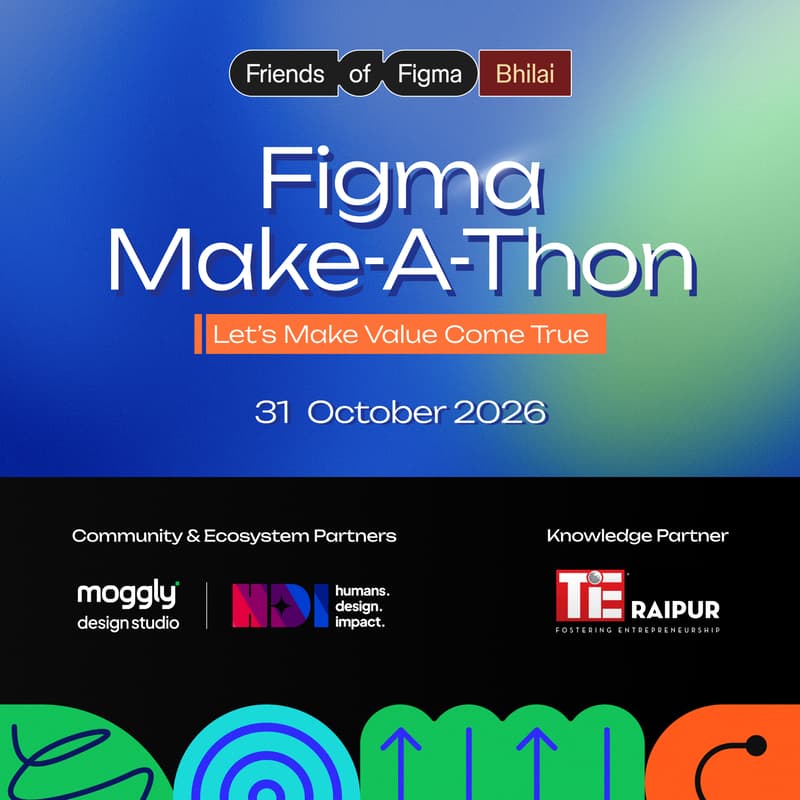
Figma Make-A-Thon 2026
MAKE-A-THON 2026
Friends of Figma Bhilai
Design it. Build it. Ship it. In one day.
Saturday, October 31, 2026 | Bhilai or Raipur in Chhattisgarh, India.
Most events end with ideas, presentations, and plans to build something someday. This one challenges you to turn an idea into a working prototype in a single day.
Make-a-thon 2026 by Friends of Figma Bhilai is a one-day, in-person building experience where designers, product managers, and AI builders come together to solve real-world problems through research, thoughtful design, and rapid prototyping.
As part of a global Friends of Figma initiative, Bhilai’s edition aims to demonstrate what happens when a community stops talking about possibilities and starts building solutions that matter.
The goal is simple: understand a real problem, design for a real person, and build something that could work in the real world.
Why this Make-a-thon is different
Real problems. Real people. Real constraints.
The challenges are rooted in complex systems that affect everyday life in India. Participants will explore problems across digital healthcare, public administration, and the judicial system, where fragmented information, outdated processes, and operational inefficiencies create genuine barriers for people.
Research before screens.
Great solutions begin with understanding, not assumptions. Teams will identify a specific user, conduct research, analyse existing workflows, and translate real-world insights into meaningful product decisions. The strength of the solution will depend on how well the team understands the person it is building for.
AI as a building partner.
Figma Make is the shared final canvas, but participants can use AI tools, no-code platforms, code, and other resources to bring their ideas to life. The focus is not on using AI for the sake of it, but on applying it thoughtfully to create useful, functional experiences.
Design beyond the interface.
A polished screen is only the beginning. Teams will consider accessibility, offline scenarios, system constraints, error handling, feasibility, and the broader ecosystem their solution belongs to. Every team must also communicate how its idea could progress from prototype to real-world implementation.
A community of Builders.
Students, working professionals, designers, product managers, and AI enthusiasts will collaborate in teams of five. The format encourages diverse perspectives, shared learning, and the kind of cross-functional collaboration that turns promising ideas into products.