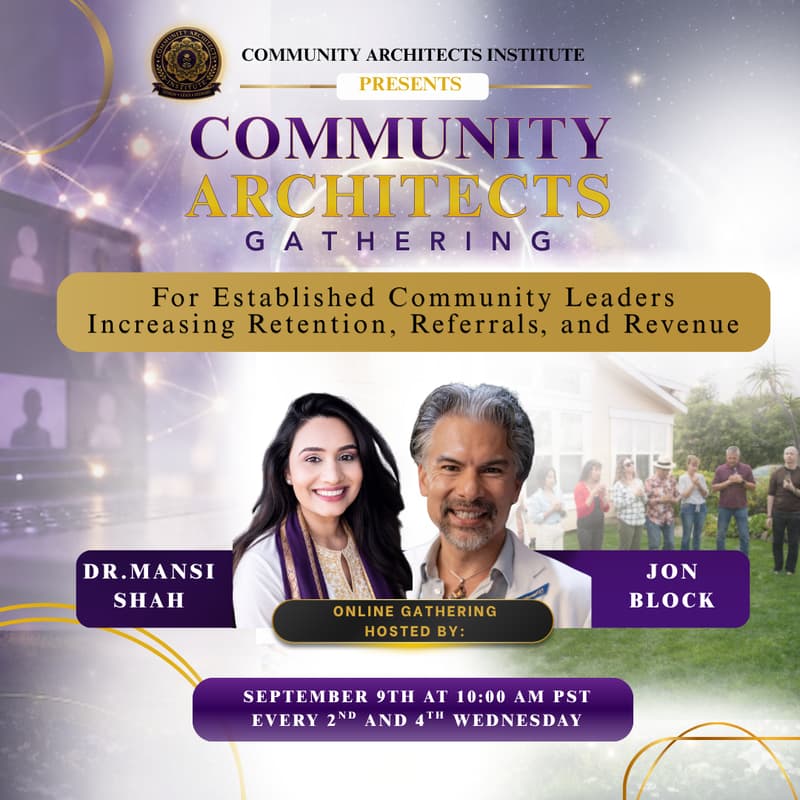

COMMUNITY ARCHITECTS GATHERING
COMMUNITY ARCHITECTS GATHERING
For Established Community Leaders Ready to Deepen Belonging, Participation & Impact — Online and In Person
You have already proven that people want to gather around what you are creating.
You have members.
An audience.
Regular attendees.
Customers who keep coming back.
People who identify with your work and want to be part of something larger than a transaction.
The question is no longer:
How do I find people?
It is:
How do I grow what already exists?
How do I create experiences people rave about and drive in referrals?
How do I preserve intimacy as the community grows?
How do I develop leaders so everything does not continue depending on me?
How do I connect the online and in-person dimensions into one coherent community experience?
That is the conversation we are having on September 9.
Who We Mean by “Established”
This gathering is intentionally designed for people who already have a functioning community, audience, membership, network, or recurring gathering.
You do not need to meet every measure below.
But you should recognize yourself in at least one of these categories.
If Your Community Is Primarily Online
You may have:
50+ active members in a paid or private community
500+ genuinely engaged people on an email list, platform, or community channel
A membership, mastermind, course community, professional network, or creator community that has been active for at least 6–12 months
Regular online gatherings with 20+ recurring participants
An audience that already buys, attends, replies, participates, refers others, or identifies with the community
Enough traction that your challenge is no longer simply getting attention — it is creating deeper connection and participation
If Your Community Is Primarily In Person
You may already:
Host recurring gatherings of 20+ people
Lead retreats, dinners, salons, workshops, masterminds, or events several times per year
Have 50+ people who regularly participate across your events or community
Run a venue, organization, membership, association, congregation, collective, or movement with a recognizable core community
See meaningful repeat attendance and referrals
Have people who want more connection between your gatherings, not only during them
Many of you will already live somewhere in between.
You may have an online audience and occasional retreats.
A recurring event series with a digital community.
A membership that gathers once or twice each year.
A thriving offline network that now needs better continuity between gatherings.
That hybrid territory is becoming increasingly important.
The Problems Change Once a Community Is Established
Early-stage community building asks:
How do we get people here?
Established community leadership asks much more interesting questions.
Engagement Has Plateaued
You have members — but only a fraction actively participate.
The same people speak up.
Others quietly observe.
You find yourself continually trying to manufacture engagement.
Members Know You Better Than They Know Each Other
The relationship with the founder is strong.
The relationships between members are not.
If you disappeared tomorrow, would the community continue?
The Energy Disappears After the Event
You host an extraordinary retreat, gathering, conference, dinner, or workshop.
Everyone leaves inspired.
And two weeks later, the relationships have largely gone dormant.
Everything Still Depends on You
You initiate the conversations.
You produce the events.
You welcome everyone.
You maintain the culture.
You connect the people.
The community works — but the founder is still carrying too much of the architecture.
Growth Can Dilute the Culture
What worked beautifully with 30 people does not necessarily work with 300.
You want the community to grow without losing its soul.
Online and Offline Feel Like Separate Worlds
You have a thriving digital community but your live experiences feel disconnected from it.
Or you create powerful in-person experiences without a meaningful way for people to continue the relationships afterward.
Retention Becomes More Important Than Acquisition
You can attract people.
The deeper question becomes:
Why do they stay?
Why do they return?
Why do they invite others?
Why does this become part of their identity?
You Need Leaders, Not Just Members
Eventually, a thriving community needs people who initiate, welcome, facilitate, mentor, organize, and steward.
The founder cannot remain the center of every relationship forever.
These are Community Architecture problems.
And they are very different from simply building an audience.
What We’ll Explore
During this Gathering, we will explore what it takes to move an established community from attendance to belonging, participation, contribution, leadership, and stewardship.
We’ll look at:
How to strengthen member-to-member relationships
How to turn passive participants into active contributors
How to create rituals, traditions, and experiences people genuinely identify with
How to design gatherings that strengthen the community long after the event ends
How to create continuity between online and in-person experiences
How to preserve culture while growing
How to develop emerging leaders inside the community
How to reduce founder dependence without losing the founder’s vision
How to create a member journey that deepens over time
How belonging, culture, participation, and economics reinforce one another
This is not a passive webinar.
We want to hear what you are already building.
We’ll work with real examples from the room, identify where established communities commonly get stuck, and explore what more intentional Community Architecture could make possible.
This Gathering Is For You If...
You already have something real to architect.
You are not trying to figure out your first offer, find your first followers, or decide whether you want to create a community someday.
People are already gathering around you.
And you are asking:
How do we make this extraordinary?
Perhaps you are leading:
A paid membership
An online community
A mastermind
A professional association or network
A creator or education community
A retreat community
A wellness or transformational community
A recurring event series
A founder or investor network
A coworking, hospitality, or physical gathering space
A movement or mission-driven organization
A community attached to an established business
Different models.
Different people.
The same underlying challenge:
How do we create the conditions in which people genuinely connect, participate, contribute, lead, and belong?
If that is the question you are wrestling with, you are our kind of person.
Why This Matters Now
We have more ways to communicate than at any point in human history.
But communication is not the same thing as connection.
Followers are not necessarily community.
Attendance is not necessarily belonging.
A Slack channel is not culture.
A retreat is not automatically a community.
And a room full of people does not become meaningful simply because everyone showed up.
The next generation of extraordinary communities will be led by people who understand how to intentionally architect the relationships, culture, experiences, leadership, and environments that allow human beings to genuinely belong.
Sometimes that happens online.
Sometimes around a dinner table.
Sometimes at a retreat.
Sometimes inside an organization.
Usually, the strongest communities increasingly move between all of them.
The medium matters less than the architecture.
About Community Architecture
At Community Architects Institute, we study and practice the craft of intentionally creating the conditions in which people:
Connect.
Belong.
Participate.
Contribute.
Lead.
Steward.
We believe thriving communities do not happen accidentally.
They are architected.
And we believe some of the most important leaders of the coming decade will be those who know how to turn groups of people into cultures, communities, and ecosystems capable of becoming bigger than any single founder.
If you have already gathered the people, this conversation is about what becomes possible next.
Your Hosts
Jon Block
Jon has been practicing Community Architecture since 2008 across four very different worlds: music and arts indie scene, public speakers, tiny-house villages, and now the emerging profession of Community Architecture.
His path has always centered on bringing people together, shaping culture, designing experiences, and helping communities become more connected and alive.
He may also be the only person to have studied screenwriting at USC Film School, been hired by both HBO and Google to train employees in public speaking, and produced dozens of festivals, conferences, and retreats.
That combination of storytelling, facilitation, culture-building, and community design informs how he approaches the craft today.
Dr. Mansi Shah
Mansi is a PharmD, entrepreneur, wellness leader, retreat producer, and ecosystem builder whose work has consistently brought together health, leadership, transformation, and human connection.
She has built and supported multiple ventures and has spent years creating experiences for founders, investors, healers, educators, and purpose-driven leaders.
Her strength is in seeing the whole ecosystem: the people, the relationships, the environment, the experience, and the possibilities that emerge when the right humans are intentionally brought together.
Together
Together, Jon and Mansi have led 24 retreats and founded The ARC, a transformational retreat campus in San Diego County designed specifically for meaningful gathering, belonging, and human connection.
That work ultimately led to the creation of Community Architects Institute and a much bigger question:
What would it look like to establish Community Architecture as a real profession?
This Gathering is part of that conversation.
If you’ve already built the audience and you’re ready to deepen the community behind it, we’d love to have you with us.
September 9, 2026
10:00 AM PT
Online Gathering
Come ready to participate.
Come ready to think differently about what you’ve already built.
And come ready to explore what becomes possible when online communities become real human ecosystems.