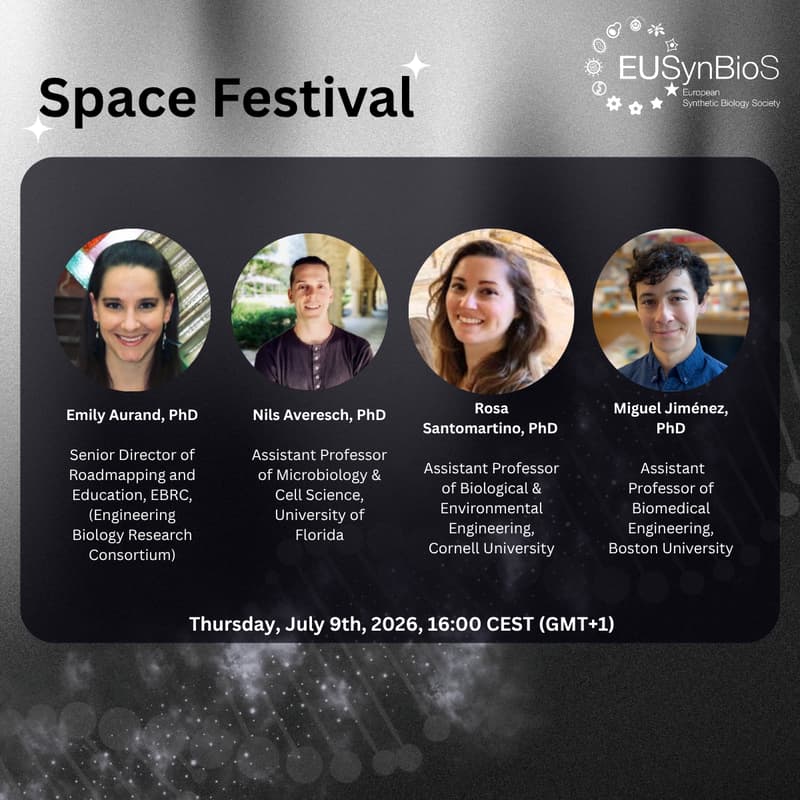

Off-World Infrastructure: Biomining, Smart Materials, and the Interplanetary Supply Chain (Panel)
If humanity is to establish permanent bases on the Moon, travel to Mars, and survive the high frontier, we cannot rely on cargo resupply from Earth. The logistics are impossible, and the costs are prohibitive. To stay out there, we have to transition from a supply-chain-dependent exploration model to a self-sustaining, closed-loop, biological manufacturing ecosystem.
Welcome to the marquee event of Week 2 - Shield & Build: Deep Space Health & Off-World Manufacturing.
Join us for a high-stakes, visionary panel discussion titled "Off-World Infrastructure: Biomining, Smart Materials, and the Interplanetary Supply Chain." This session brings together the strategic minds and trailblazing researchers behind the Engineering Biology Research Consortium (EBRC) Space Health Roadmap.
Moving from high-level global policy to active lab science, this roundtable features four world-class experts who are engineering the literal building blocks of deep-space survival. The panel will kickoff with rapid, bleeding-edge research updates from the front lines of space biotechnology, followed by an interactive, unscripted debate on the ultimate biological breakthroughs required to shield astronauts, harvest extraterrestrial resources, and manufacture mission-critical materials off-world.
What you’ll learn:
The EBRC Roadmap: A look at the definitive tactical framework guiding the future of space synthetic biology for global governments and agencies.
Asteroid Biomining: How microbes are being engineered to extract rare-earth elements from meteorites right now on the International Space Station (ISS).
Synthetic Extremophiles & Bioelectronics: How to stabilise living cell factories into dry powders to build ingestible diagnostic devices that monitor astronaut health in real-time.
In-Situ Resource Utilisation (ISRU): How to use metabolic engineering to convert single-carbon compounds, astronaut waste, and Martian regolith into high-performance structural polymers.
🎤 Speaker Profiles
Dr. Emily Aurand - Senior Director of Roadmapping and Education, EBRC
Dr. Emily Aurand is a neuroscientist and science policy expert who orchestrates the strategic future of the bioeconomy. Holding a PhD in Neuroscience from the University of Colorado, she serves as the Senior Director of Roadmapping at the EBRC, where she acts as the principal architect and editor of the highly influential EBRC Technical Research Roadmaps, bridging the gap between academic brilliance, industry scaling, and government funding.
Dr. Rosa Santomartino - Assistant Professor of Biological & Environmental Engineering, Cornell University
Dr. Rosa Santomartino is a world-renowned space microbiologist. Formerly a Leverhulme Research Fellow at the UK Centre for Astrobiology, her pioneering work includes serving as the Lead Author on breakthrough experiments aboard the ISS (like BioRock and BioAsteroid), proving that engineered fungi and bacteria can successfully mine platinum-group elements from extraterrestrial meteorites.
Dr. Miguel Jiménez - Assistant Professor of Biomedical Engineering, Boston University
Dr. Miguel Jiménez heads the Microbial Integration Group, working at the convergence of synthetic biology, materials science, and aerospace medicine. A former NASA TRISH and Broad Institute Fellow with a PhD from Columbia and a BA from Harvard, Miguel designs "microbial devices", integrating genetically engineered, stabilized microorganisms into bioelectronic capsules to monitor and protect human health in extreme environments.
Dr. Nils Averesch - Assistant Professor of Microbiology & Cell Science, University of Florida
Dr. Nils Averesch is a leading space biotechnologist specialising in metabolic engineering. A former Group Leader at Stanford University and Associate Scientist at NASA Ames Research Centre, Nils serves as a Co-Investigator for the NASA Space Technology Research Institute 'CUBES' (Centre for the Utilisation of Biological Engineering in Space), where his lab engineers microbial factories to turn space-harvested resources into advanced structural materials.