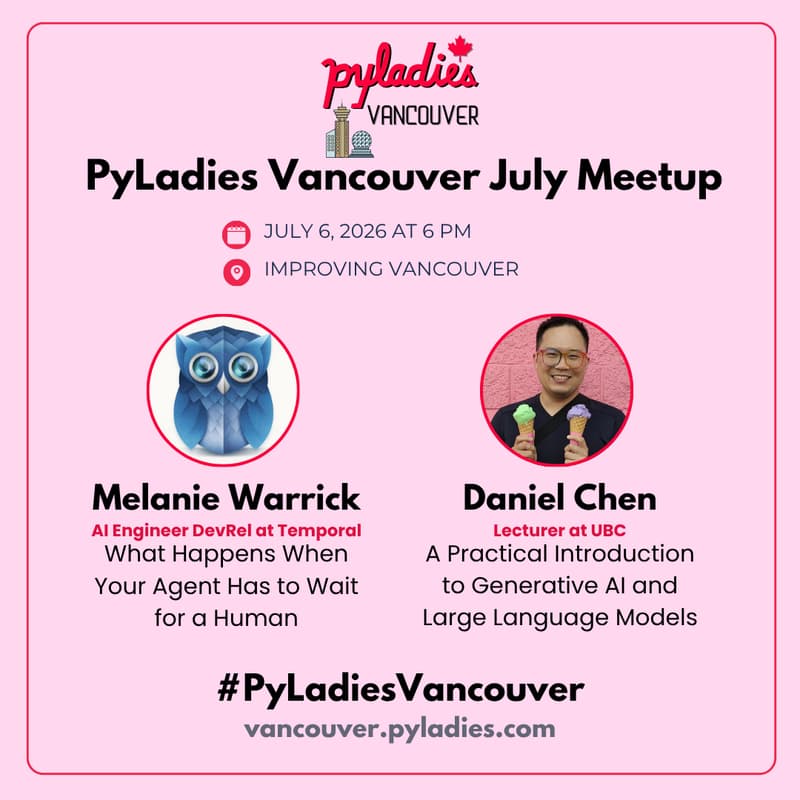

PyLadies Vancouver July 2026 Meetup
Join PyLadies Vancouver for our July meetup at Improving Vancouver! This month we have two talks on AI agents and large language models.
Talk 1: What Happens When Your Agent Has to Wait for a Human by Melanie Warrick
You built an agent in Python. It reasons, calls tools, handles its own steps, and it works. Then it hits a step that needs a human to approve something, and that approval might take five minutes or five days. Your process is now sitting there holding all of its state in memory, waiting. Then it crashes, or the session ends, and everything the agent figured out is gone.
This talk is about that moment. We'll start with the agentic loop at a high level (model, tool call, execute, feed the result back, repeat until the model decides it's done) and the harness around it that holds the agent's state. Waiting for a human is just one tool call in that loop, but it's the one that exposes a problem most agent setups never plan for: the loop's state is only as durable as the process running it.
From there we'll look at durable execution as the fix, using Temporal to make the loop survive crashes and long waits, with a short live demo. The pattern is portable, and you'll leave able to spot exactly where your own agents would quietly lose their work.
About Melanie Warrick
Melanie has been developing AI solutions for over a decade, ranging from neural networks built from scratch to fine-tuned domain-specific models to multi-agent orchestration in production. She co-founded Fight Health Insurance, a production GenAI platform for insurance appeals, and leads developer relations at Temporal focused on AI and durable execution. She hosts Vibe Check, a developer livestream on AI engineering patterns.
Talk 2: A Practical Introduction to Generative AI and Large Language Models by Daniel Chen
Generative AI (GenAI) and large language models (LLMs) have become some of the most talked-about technologies recently. While many people have experimented with tools such as ChatGPT, it is often less clear how these systems work.
In this talk, we will explore the fundamentals of generative AI and LLMs from a practical perspective. We will discuss how these models generate responses, why they can produce different outputs to the same prompt, and what that means for applications that require reliability and reproducibility.
We will also look at examples of how LLMs can be incorporated into data science workflows and applications using Python. The focus will be on developing an intuition for what these models can and cannot do, and how to use them effectively as part of a broader data science toolkit. Attendees will leave with a clearer understanding of the technology and practical ideas for applying it in their own projects and build the basic fundamental knowledge of how these models work under the hood.
About Daniel Chen
Daniel is a Data Science Lecturer in the Statistics Department at the University of British Columbia and teaches for the UBC Master of Data Science program. He previously served as Data Science Educator and Developer Advocate at Posit, PBC.
LinkedIn · Blog · Mastodon · Bluesky
Agenda
6:00 PM — Doors open, pizza 🍕 & mingling
6:15 PM — PyLadies Vancouver intro & community updates
6: 25 PM — Message from Improving Vancouver
6:30 PM — Talk 1: What Happens When Your Agent Has to Wait for a Human (Melanie Warrick)
7:00 PM — Talk 2: A Practical Introduction to Generative AI and LLMs (Daniel Chen)
8:45 PM — Event ends
Support PyLadies Vancouver
Help us keep our meetups running! Donate to PyLadies Vancouver to support the costs of organizing community events like this one.
For a minimum donation of $25 USD, you can pick up a PyLadies Vancouver tote bag!
Thank you to our venue host: Improving Vancouver
A huge thank you to Improving Vancouver for hosting us in their space and providing pizza for the evening! 🍕
Improving Vancouver is an IT consulting and software development firm (formerly Bit Quill Technologies) based in Vancouver, BC. They specialize in application development, data engineering, and AI solutions — helping teams build modern, scalable, data-driven applications. We're grateful for their support of the local Python community.