
Top AI Researchers Roundtable & BBQ Party in Los Altos Hills
Event Overview
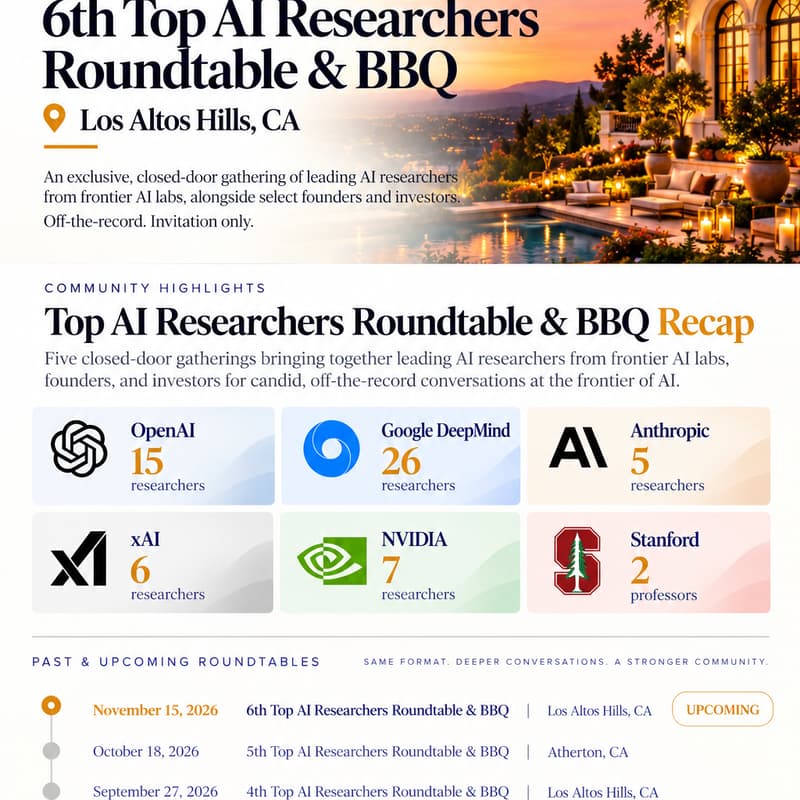
Since launching the series in May 2026, we’ve successfully hosted five exclusive, closed-door Top AI Researchers Roundtables, fostering meaningful connections and in-depth conversations among researchers and leaders from the world’s foremost AI labs and research institutions. Participants have included:
Ed Chi — VP of Research at Google DeepMind
15 researchers from OpenAI
5 researchers from Anthropic
26 researchers from Google DeepMind
6 researchers from xAI
7 researchers from NVIDIA
2 Stanford professors
Xuedong Huang — CTO, Zoom
Yuandong Tian — Co-founder of Recursive (Raising $650M)
We’re excited to continue this tradition with our 6th Top AI Researchers Roundtable, taking place on November 15, from 3:00 PM to 5:00 PM, at a private residence in Los Altos Hills.
This invitation-only gathering will once again bring together leading researchers from OpenAI, Google DeepMind, Anthropic, xAI, and other frontier AI labs and research institutions for an intimate, closed-door discussion exploring some of the most important questions shaping the future of artificial intelligence.
This will be a fully closed-door, off-the-record conversation focused on the future of AI systems—from frontier research breakthroughs and emerging technical challenges to the next wave of opportunities that could shape the industry over the coming years.
Following the roundtable, guests will continue the discussion over a private BBQ reception with fellow researchers, founders, investors, and industry leaders.
Core Discussion Topics
AI progress depends not only on better models, but also on how effectively we build and use the infrastructure behind them.
From GPU utilization and changing compute demands to hardware diversity, AI-assisted research, and scaling constraints, the next wave of breakthroughs raises fundamental questions about efficiency and system design.
This roundtable brings together leading AI researchers to explore five critical questions shaping the future of AI infrastructure.
Rather than formal presentations, the discussion will focus on open questions, technical challenges, differing perspectives, and the breakthroughs needed to advance frontier AI.
QUESTION 1 · THE UTILIZATION GAP
Labs are committing to unprecedented amounts of compute. How much of it actually translates into learning?
Anthropic’s IPO disclosures reveal at least $518 billion in planned infrastructure spending over the coming decade, much of it tied to long-term commitments that are difficult to cancel. But contracted capacity is not the same as useful training compute. Microsoft’s MAI-Base-2 report offers a concrete example: a 2.8-trillion-parameter MoE model trained on 16,000 GB200 GPUs achieved an average MFU of 21%, with goodput of 89%. The gap between theoretical hardware capacity and actual training performance remains substantial.
Follow-up questions
Where does the remaining compute go today—and which sources of inefficiency are hardest to eliminate?
As RL and post-training become more important, is MFU still the right metric, or do we need a better measure of how efficiently compute produces learning?
If you could choose between 20% more compute and 20% better utilization, which would make a bigger difference to model development?
QUESTION 2 · THE CHANGING COMPUTE MIX
How will the rise of reasoning models and AI agents change what AI infrastructure needs to look like?
AI workloads are becoming more diverse. Training a model, running extensive reasoning at inference time, and deploying agents that execute code or interact with external tools can place very different demands on computing systems. Recent infrastructure announcements, including Oracle’s plans for NVIDIA Vera CPU cloud services aimed at agentic workloads, highlight how the supporting infrastructure may evolve beyond GPUs alone.
Follow-up questions
How will the balance between pretraining, post-training, and inference evolve as models become more capable?
As agents spend more time using tools, running code, and interacting with environments, where do the main computing bottlenecks shift?
Will future AI systems require fundamentally different infrastructure, or can existing systems adapt to these new workloads?
QUESTION 3 · ONE MODEL, MANY CHIPS
How much does the hardware shape the way we build AI models?
Anthropic has described using multiple accelerator platforms—including Nvidia GPUs, Google TPUs, AWS Trainium, and AMD hardware—to meet its compute needs. This growing diversity raises an important research question: different chips offer different trade-offs in memory, performance, and software support, but moving workloads across platforms can require significant engineering effort.
Follow-up questions
How difficult is it to move a frontier training workload across different chip architectures, and what are the biggest challenges?
To what extent should model architecture be optimized for the hardware, rather than designed independently of it?
Could greater hardware diversity lead to meaningful new approaches to model design, or will software compatibility remain the main challenge?
QUESTION 4 · AI RESEARCH ON AI
Can AI meaningfully accelerate the development of the next generation of AI?
AI systems are increasingly helping researchers write code, analyze results, generate hypotheses, and run experiments. Anthropic has publicly described the growing role of Claude in its internal AI research and engineering work. If AI systems become more capable research collaborators, they could change not only the cost of experimentation but also the pace at which new models are developed.
Follow-up questions
Which parts of AI research are already benefiting most from AI assistance, and which remain difficult to automate?
What would it take for AI-assisted research to produce a sustained acceleration in model development?
How would we know whether AI research is genuinely accelerating, rather than simply becoming cheaper or faster to execute?
QUESTION 5 · SCALING UNDER CONSTRAINTS
If more compute becomes harder to obtain, what will drive the next wave of AI progress?
Frontier AI infrastructure increasingly depends on more than chips. Power availability, networking, memory, and construction timelines all affect how quickly new capacity can come online. As major labs commit to increasingly large infrastructure projects, a key research question is whether future progress will depend primarily on scaling hardware or on finding more efficient ways to use it.
Follow-up questions
If access to more compute becomes constrained, how would that change research priorities: larger models, more training, more inference-time compute, or more efficient algorithms?
How much can algorithmic progress compensate for limits in hardware and power availability?
Could training across geographically separated clusters become a practical way to expand capacity, or would the coordination costs outweigh the benefits?
Event Format
30 curated attendees only
Invitation-only
No media / no public recordings
Chatham House Rule-style discussion
Intimate, high-signal conversations among top researchers and operators
Why This Matters
The future of AI will not be shaped solely by public announcements or viral demos.
It will be shaped by small groups of people exchanging ideas, debating technical tradeoffs, and building trusted relationships behind the scenes.
The BFC AI Researcher Inner Circle is designed to create:
Deep technical and strategic dialogue
Cross-organization insight exchange
Authentic relationship-building among frontier researchers
A trusted environment for discussing sensitive ideas and future directions
About the Sponsors
We are where insight and AI shape the future.
Llama Ventures is a Silicon Valley–based early-stage venture firm investing in AI companies from Pre-Seed through Series A. With offices in Sunnyvale and San Francisco, the firm has invested in 60+ companies across AI infrastructure, enterprise software, healthcare, fintech, and deep-tech, and manages $300M+ in direct fund capital alongside a $600M+ fund of funds. Founded by entrepreneurs and technology leaders, Llama Ventures partners closely with founders, providing strategic support and access to a global network of operators, engineers, customers, and investors.
Apera AI | Silicon Valley-Based AI Gateway
One API. 200+ Leading AI Models. 35% Average Cost Savings.
Access the world's leading AI models through a single, reliable, cost-efficient gateway. Simplify AI integration, optimize performance, and reduce inference costs by an average of 35%.
TRUSTED IN PRODUCTION
Powering production AI workloads for 60+ customers.
Want to reduce your AI token costs? Feel free to book a 30-minute consultation with our team:
👉 https://calendly.com/apera-ai-model-review/30min
OrphLux is turning data chaos into training truth, providing the data backbone that helps robotics, world models, and next-generation AI systems learn from the real world. We specialize in three core areas:
•Embodied AI — large-scale, real-world data collection and operation trajectories that teach robots and physical AI systems to perceive, reason, and act in dynamic environments.
•Benchmark Data — rigorous, high-quality evaluation datasets that test and validate generative AI and physical AI systems from development through deployment.
•Expert Ecosystem — a global network of domain specialists and PhD-level experts delivering precision annotation, instruction writing, and preference ranking at scale.
At scale, OrphLux operates 12 global delivery centers across Asia, North America, and South America, with access to more than 100,000 PhD and domain experts.
About Bay Area Founders Club
The Bay Area Founders Club (BFC), founded by Dr. Paul Fang in Silicon Valley in 2022 and managed by a dedicated group of Stanford alumni and students, is a thriving community of over 100,000 members, including more than 5,000 startups and over 1000 venture capital firms. With most startups in our network raising $1-10 million, and some exceeding $20 million, our mission is to empower creators who aspire to make a global impact. We provide the essential resources, support, and connections needed to transform visionary ideas into reality.
Unlock insider access and elevate your founder journey — join BFC NOW.
Learn more: https://www.bayareafoundersclub.com