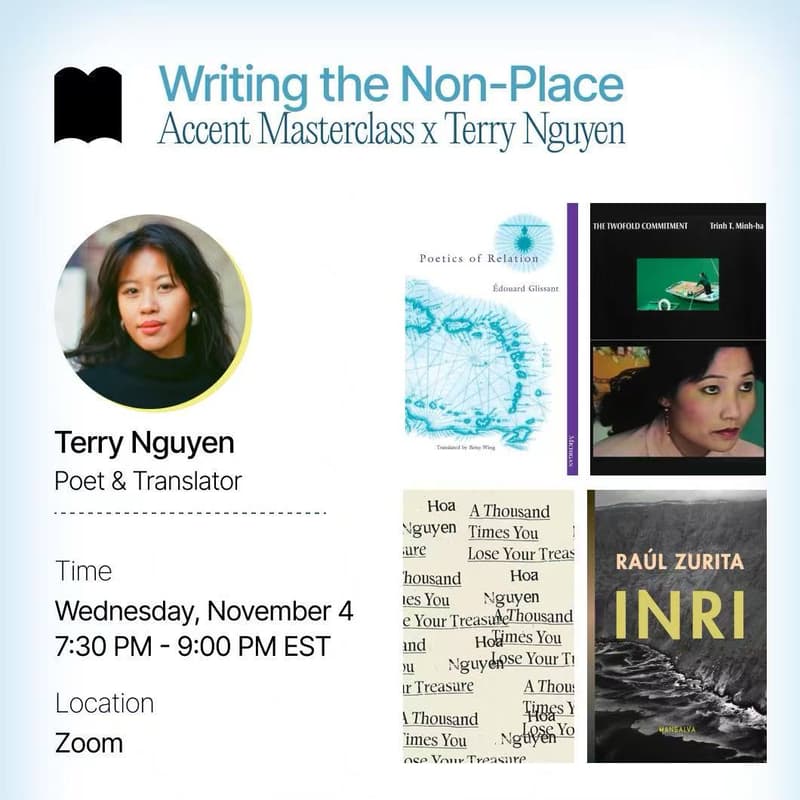

Accent Crafttalk x Terry Nguyen | Writing the Non-Place: On Transcultural Memory and Migration
Accent welcomes Terry Nguyen to teach students how to bring setting into their writing and to contend with the changing role of place in our lives as globalization unsettles the landscapes that we grow attached to. This class has both a critical and creative component, drawing on the writings of Édouard Glissant, Trinh T. Minh-ha, Hoa Nguyen, and others to build a framework that helps students generate writing in real time.
Terry Nguyen’s writing in insightful, moving, and charismatic, tracing patterns in media to reveal broader currents in art and culture. Her close engagement with contemporary critical conversations deepens her work, enabling her to grapple with complex modern phenomena with clarity and grounded insight.
This workshop will investigate how notions of place and belonging surface in students’ writing, and how our relationships to place and displacement shape how we write. Setting is essential to every kind of writing, and we tend to assume that the stories, poems, or essays we write occupy fixed ground. But as migration and rapid industrialization remake the world, fewer of us (including our fictive or poetic counterparts) exist in stable places. We write from temporary sublets, hotel rooms, coffee shops, and towns that no longer exist in the form we once knew.
The anthropologist Marc Augé coined the term “non-place” to describe the transient places we pass through without fully inhabiting, spaces like supermarkets, malls, and transportation hubs, that carry little historical or relational significance. This class borrows Augé’s term and expands upon it: How is our understanding of place—and belonging—impacted by migration, globalization, and the passage of time? Where is our writing located, and how are these sites inhabited, remembered, or imagined? How can the non-place be a generative force?
This course is informed by the theoretical writings of Édouard Glissant (Poetics of Relation) and Trinh T. Minh-ha (The Twofold Commitment), and by poets like Hoa Nguyen, Raul Inri, and Lisa Robertson, whose work moves between archives and geographies. In his essay "Errantry, Exile," Glissant writes: "Uprooting can work toward identity, and exile can be seen as beneficial, when these are experienced as a search for the Other rather than as an expansion of territory ... Sometimes, by taking up the problems of the Other, it is possible to find oneself."
Diasporic literature is often unsettled and itinerant by nature. Rather than strive toward completion or belonging, this class engages with writing as a means of place-making, a way of building a provisional home and identity on the page.
Terry Nguyễn is a poet and translator from Garden Grove, CA. An MFA candidate at Columbia University, she works across genres—including essays, arts criticism, performance, and photography—to explore how narrative, memory, and identity are constructed. Her critical writing can be found in Art in America, Brooklyn Rail, New York Magazine, The Nation, and her poetry is published or forthcoming in Ugly Duckling Presse’s Second Factory, Asia Art Archive, No, Dear, and Iterant. She has taught an iteration of this workshop in central Vietnam with AirHuế.
Writing by Terry Nguyen
"Across myriad blue essays, poems, novels, and musings, I’ve come to recognize blue’s utter ineffability—that which distinguishes it from other colors on a visual, cultural, and metaphysical plane...Writers are aesthetes and obsessives, blue creatures enticed and inspired by the abstract. There is a thrill, I presume, in attempting to define something as linguistically impenetrable as color, for language is not the most effective medium to do so. Simpler instead to paint a blue canvas, as Yves Klein or Agnes Martin have, to get one’s point across. A monochromatic painting retains the purity of blue—“a blue in itself, disengaged from all formal justifications,” to quote Klein—whereas blue texts mire the color with complexity, as writers are wont to do."
"Writing teaches us to pay attention, becoming a material home for both archives of destruction and the telling presence of frogs. When we strive to balance our personal felt truth with the details of the world that surrounds us, we can create projects that are inhabited by a plurality of perspectives and voices, similar to a community. It is possible for writing to not simply be a representation of an experience or an event, but to embody it through language and image."
"Not-understanding is not a state of not questioning, of obedient muteness. Rather, it supposes a limitless faith in the abyss that can be found in the turmoil of questioning."
Inland Empress: Poem published in Sarka Publishing