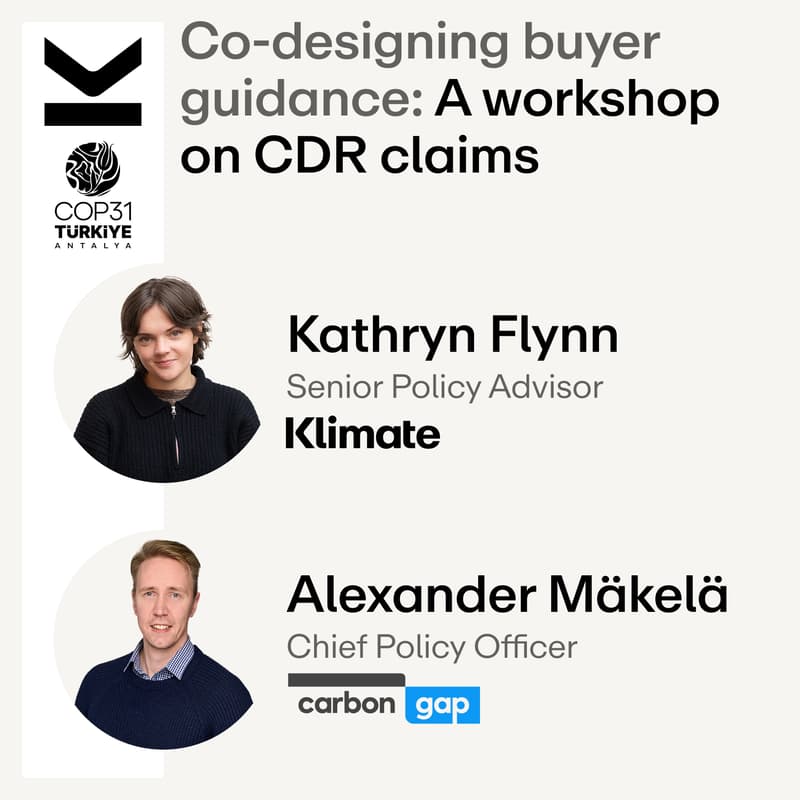

Co-designing buyer guidance: a workshop on CDR claims
What makes carbon removal claims guidance useful, and how can it help unlock voluntary demand?
Klimate, Carbon Gap and the NCRA are running a workshop at the Think Negative Pavilion during COP31. We start with what corporate buyers say they need to invest in carbon dioxide removal (CDR) and communicate about it with confidence. We then test what claims guidance for units under the EU Carbon Removals and Carbon Farming Regulation (CRCF) should look like. Feedback from the session will inform ongoing work on a claims framework for CRCF units.
When and where
Wednesday 18 November, 12:30 to 13:30
[Think Negative Pavilion, D250]
Who it’s for
Suppliers, climate professionals, corporate buyers and intermediaries working with carbon removal and the CRCF.
What we’ll ask of you
Come with a view (or lots of questions). We want to know which parts of claims guidance would help in procurement, business-case development and risk management, and what would stop you using it.
Who’s involved
Klimate contributes perspectives from corporate buyers. Carbon Gap and the NCRA contribute policy research on use cases for CRCF methodologies, used as worked examples.
The session is hosted by:
Alexander Mäkelä, Chief Policy Officer, Carbon Gap
Kathryn Flynn, Senior Policy Advisor, Klimate
What you’ll learn
Why voluntary claims guidance matters for demand, and what corporate buyers need from it
How to think about communicating a carbon removal purchase, with live feedback and questions answered
Agenda
Introduction
Klimate: why we need voluntary claims guidance, and what voluntary buyers want to say based on perspectives from corporates
Carbon Gap and NCRA: what a use case is, how to construct good guidance, and what users of guidance need to consider across CRCF, SBTi, the GHG Protocol, ISO, consumer protection rules and ESRS E1
Workshop: constructing claims guidance
We walk through the building blocks of guidance, from a use case to a claim
Live polling: which components matter most for companies, and which contribute most to the business case, procurement and legal or external exposure risk
Two worked examples, with feedback rounds on how clear and usable each claim is
Open discussion:
What gaps should the guidance address?
What endorsement or practical support would make organisations confident enough to use it?