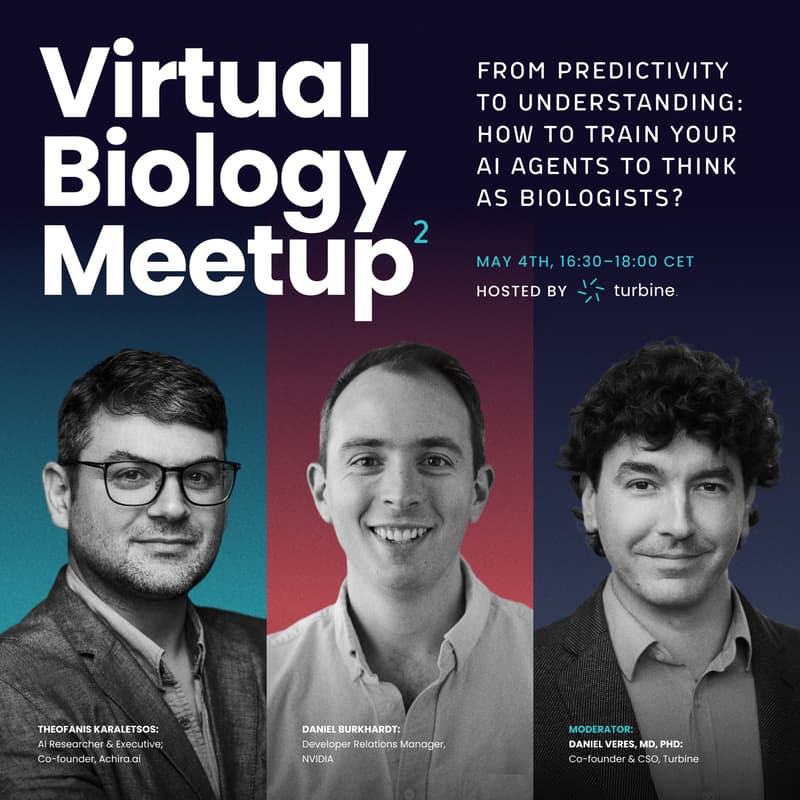
From Predictivity to Understanding - How to train your AI agents to think as biologists?
The past years proved that virtual cells are getting close to reliably predict biological outcomes. Could we make them start explaining the mechanisms at work too? In this episode, we move beyond the black box of predictive readouts to autonomous agency.
We'll explore how AI systems can transition from passive simulators to scientific partners in decision making, by mechanistic reasoning and bridging massive data to testable discovery.
Agenda
Session 1: Bridging Predictions to Mechanisms by Theofanis Karaletsos (Achira)
Shifting from prediction-heavy models to epistemologically grounded systems. How do we build AI that reasons about physics underlying biology rather than just "guessing" the next state?
Session 2: The Engineering Reality: Agents Doing Science by Daniel Burkhardt (NVIDIA)
How do we embed AI agents into 3rd-party tools and lab workflows? Moving from AI as a software layer to AI as an active participant in biological engineering.
Panel discussion moderated by Daniel Veres (Turbine)
Speakers & moderator
Theofanis Karaletsos
Co-founder, Achira.ai
Theo is a pioneer in probabilistic reasoning and AI for science. As Co-founder of Achira.ai, he focuses on scientific world models grounded in statistical physics. He previously served as Head of AI for Science at the Chan Zuckerberg Initiative (CZI), where he led foundational work on virtual cell modeling. His career includes leadership roles at Insitro (VP, Advanced ML) and as a founding member of Uber AI Labs.
Daniel Burkhardt, PhD
Developer Relations Manager, NVIDIA
Daniel operates at the intersection of AI infrastructure and life sciences, managing NVIDIA’s strategy for foundation models and AI agents. A core organizer of the "Open Problems in Single-Cell Analysis" project, he previously led ML research at Cellarity. He holds a PhD in Genetics from Yale, specializing in representation learning for complex biomedical datasets.
Daniel Veres, MD, PhD
Co-founder & CSO, Turbine
A physician-scientist and entrepreneur, Daniel focuses on translating computational biology into clinically actionable insights. At Turbine, he leads the development of AI-powered virtual biology platforms that model cellular behavior to accelerate drug discovery. He specializes in bridging the gap between simulation-driven approaches and real-world pharmaceutical R&D.
Format: 2 x 20 -min deep-dives + 45-min moderated panel / Q&A
Platform: Zoom, link to be distributed in this event soon