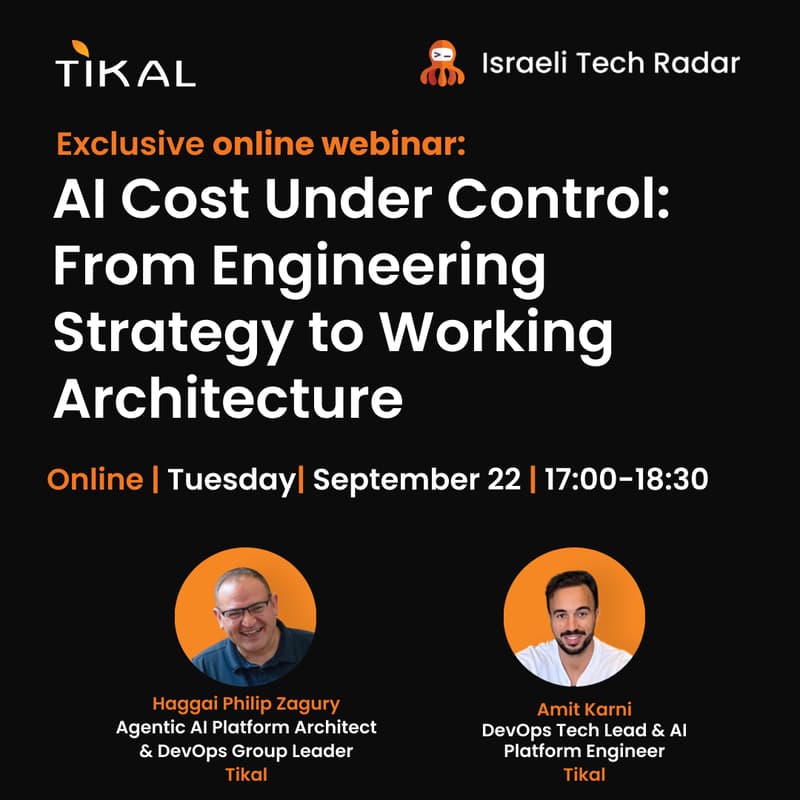

AI Cost Under Control: From Engineering Strategy to Working Architecture (Online)
Date: Tuesday, September 22, 2026
Time: 17:00 to 18:30
Location: Online webinar
*The webinar will be held in Hebrew
As AI usage expands across engineering teams, products, coding agents, and model providers, the cost data becomes increasingly fragmented. Usage is distributed across API keys, cloud accounts, tools, applications, and autonomous workflows, making it difficult for engineering leaders to see the full picture.
The monthly invoice shows the total spend, but it rarely reveals which team, application, agent, task, or model generated it. It does not show where context is repeatedly transmitted, where premium models are being used unnecessarily, which agent loops are consuming budget, or whether a lower cost model could deliver the same quality.
Without this visibility, organizations struggle to separate valuable AI workloads from avoidable token consumption. Even when monitoring exists, teams often lack the engineering controls required to turn that data into measurable cost reduction.
This webinar will present a practical framework for managing AI costs as an engineering discipline. We will explore how to establish a reliable baseline, centralize AI traffic, connect spend to actual workloads, and introduce context compression, model routing, budgets, guardrails, and continuous evaluations.
Participants will gain both an organizational playbook and a technical architecture for moving from fragmented cost data to active, continuous optimization, without requiring application rewrites or slowing product delivery.
On the Agenda
17:00 to 17:35
Taking Control of AI Cost: An Engineering Playbook // Haggai Philip Zagury, Agentic AI Platform Architect & DevOps Group Leader, Tikal
As AI adoption expands across engineering organizations, cost management becomes more than a FinOps concern. Teams use different models, tools, API keys, and workflows, while engineering leaders are expected to control spend without limiting experimentation or reducing development velocity.
In this session, Haggai will present a seven principle engineering playbook for turning fragmented AI usage into a measurable and governable process.
He will explain how organizations can establish a reliable baseline, centralize visibility across teams and agents, define ownership, and introduce budgets and guardrails before uncontrolled usage becomes a significant operational cost.
The session will also cover how model routing, context compression, prompt cache optimization, local inference, and continuous evaluations can work together as part of one cost management strategy.
The focus will be on building an ongoing engineering capability that connects AI spend to workload value and enables organizations to make informed decisions about model selection, infrastructure, and usage policies.
17:35 to 18:15
How I Cut My AI Agent’s Token Bill: A Three Layer Model // Amit Karni, DevOps Tech Lead & AI Platform Engineer, Tikal
AI agent costs rarely come from one expensive request. They accumulate as agents repeatedly transmit large contexts, generate unnecessary output, and carry increasingly bloated code and conversation histories into subsequent interactions.
In this session, Amit will share the practical model implemented at Tikal to reduce token consumption across three complementary layers: transport, output, and design.
He will demonstrate how context compression reduces the amount of data sent to the model, how agent steering limits unnecessary output, and how design guidance encourages coding agents to generate only the code required for the task.
Amit will also present the architecture behind the implementation, including a centralized model gateway and dynamic model routing. This architecture makes it possible to direct each workload to the most appropriate model, rather than using premium models by default.
The session will show how these optimization techniques can be combined into a controlled pipeline and scaled from a local experiment into an engineering capability that supports an entire team or organization.
18:15 to 18:30
Q&A
Who Should Attend?
This webinar is intended for engineering leaders, R&D managers, architects, DevOps and platform teams, and developers working with AI applications or agentic workflows who want to understand where their AI budget is going and how to reduce costs through engineering decisions.
About Tikal
Tikal is a hands-on tech consultancy living and breathing the Agentic world.
For more than 25 years, we have scaled engineering organizations. Today, we help them pioneer Agentic Engineering, where developers and AI agents build together.
AI is dissolving the traditional boundaries between disciplines, and that is exactly where we are strongest: deep, cross domain expertise in AI/ML, Backend, Data, DevOps, Fullstack, and Web. We integrate into engineering teams and deliver value from day one.
As the founders of the Israeli Tech Radar, we drive industry impact by sharing insights and guiding engineering leaders and teams across the tech industry.