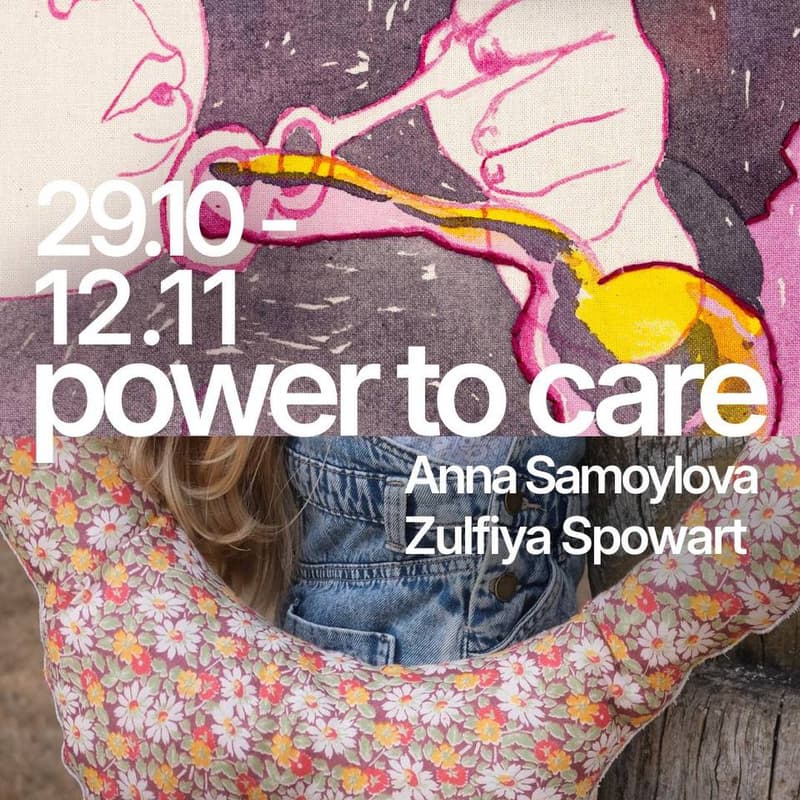
Power To Care. Duo exhibition by Anna Samoylova and Zulfiya Spowart
Private Viewing: Thursday 29 October, 6 – 9 pm
Exhibition Dates: 30 October – 13 November 2026
Opening Hours: by appointment
Curated by Irina Kuznik and Anzhela Popova
Location: Arc Space, 13 Tottenham Mews, London W1T 4AQ
What does it mean to care for something that cannot be restored?
Power to Care considers care as a way of inhabiting history: not through preservation alone, nor through the promise of repair, but through sustained attention to what history leaves behind.
“History is what hurts,” Fredric Jameson writes in The Political Unconscious (1981). History, in this sense, is not confined to the past. It persists through its effects – through bodies, materials, inherited narratives, domestic rituals and the structures that delimit what can be remembered, imagined or transformed.
Care begins within these conditions.
It begins when something interrupts indifference and asks us to remain: with a body, an image, a material, a memory, a place; with something fragile, unresolved or already disappearing. Yet attention is never immaterial. To care is to expend time, labour and resources. It is to enter into relations of responsibility whose burdens are neither equally visible nor equally distributed.
Power to Care therefore resists the reduction of care to tenderness or moral virtue. Here, care is understood as a practice of duration. It is repetitive, embodied and frequently invisible. It can sustain, but it can also exhaust. It can be chosen, inherited or imposed.
Across the practices of Anna Samoylova and Zulfiya Spowart, textile becomes a site through which these contradictions are made material.
Samoylova works with raw calico, hand embroidery, painting and printmaking to approach motherhood as a lived structure of care rather than an idealised image. Repetitive stitching registers attachment alongside fatigue, intimacy alongside ambivalence. Folkloric and mythological forms are repeatedly assembled and unsettled, turning the textile surface into an archive in which personal memory intersects with inherited cultural histories.
The labour of the hand is central. A stitch is both mark and duration: evidence that time has been given.
Spowart likewise approaches material as a carrier of memory, while questioning whether inheritance can ever amount to preservation. In Sun, Air and Water – Our Best Friends, she returns to a mosaic created during the Soviet era, still preserved within a functioning kindergarten in Tashkent. Translated through hand-stitched linen, reclaimed fabrics, iron oxidation and soft sculptural forms, the image is neither reconstructed nor returned to an imagined original condition. Instead, it undergoes another history. It fades. It migrates. It oxidises. It enters different bodies and environments.
Across both practices, inheritance emerges not as the passive transmission of an intact past, but as an active and unstable process. Materials age. Images detach themselves from their original contexts. Memories are altered by the gestures through which they are carried forward.
Care, from this perspective, does not necessarily mean preventing disappearance. It may instead mean remaining attentive to transformation.
The works gathered in Power to Care do not propose to heal history. Nor do they attempt to reconcile its contradictions. They stay with its traces: with what persists after an image has fragmented, after a political structure has disappeared, after an inherited form has lost the certainty of its original meaning.
Against an economy in which attention is increasingly fragmented, accelerated and commodified, the exhibition insists upon another temporality.
Stitching takes time. Oxidation takes time. Mothering takes time. Remembering takes time. Forgetting takes time. Looking carefully takes time.
These durations are not incidental to the works; they constitute them. Care becomes visible not simply through what is represented, but through the time embedded within matter—the repeated gesture, the altered surface, the image allowed to fade.
Power to Care asks what becomes perceptible when we remain with something long enough for its contradictions to appear.
Perhaps the power of care lies precisely here: not in keeping things intact, but in refusing indifference to their transformation.
To care is to decide that something – however vulnerable, unresolved or transient – is worthy of our time.
ABOUT THE ARTISTS
Anna Samoylova (b. 1995, Russia) is a London-based multidisciplinary artist working across painting, embroidery, textile and fabric printmaking. Her practice is rooted in personal and intergenerational memory, focusing on how everyday objects, women's labour, and inherited objects hold and pass on intimate stories.
She combines hand-stitching with print and paint on raw calico, approaching textile as both a material and an archival language. Her work investigates maternal experience and the objectification of the female body, presenting motherhood not as an idealised state but as a form of resistance to acceleration, disposability, and the invisibility of care labour.
Samoylova has held solo exhibitions at the Moscow Museum of Modern Art, Haze Gallery in Berlin, and Outhouse Gallery in London. Her work also has been shown internationally across the UK, France, Italy, and UAE.
Website: https://annasamoylova.com/
Instagram: annasamoylova18
Zulfiya Spowart (b. 1991, Uzbekistan) is a multidisciplinary artist based in London, UK, working across sculpture, installation, textiles and wood. Her practice explores embodied knowledge, material memory, and the invisible systems of care, labour and cultural transmission embedded in everyday objects. Working with recycled and previously used materials that retain traces of touch, repair and use, she approaches materiality as a living archive through which knowledge and experience are transmitted across generations.
Zulfiya focuses on her personal and family history, as well as the material culture of Central Asia, Spowart examines intergenerational inheritance, migration and the relationship between individual experience and broader social structures. Her work foregrounds forms of care and labour that often remain invisible, exploring how cultural knowledge is preserved and transmitted through bodily experience, everyday gestures and material practices.
Spowart recently exhibited at Annely Juda Fine Art in London and participated in the Uzbekistan Pavilion at the 2026 Venice Biennale.
Website: https://www.zulfiyaspowart.com/
Instagram: zulfiya_spowart