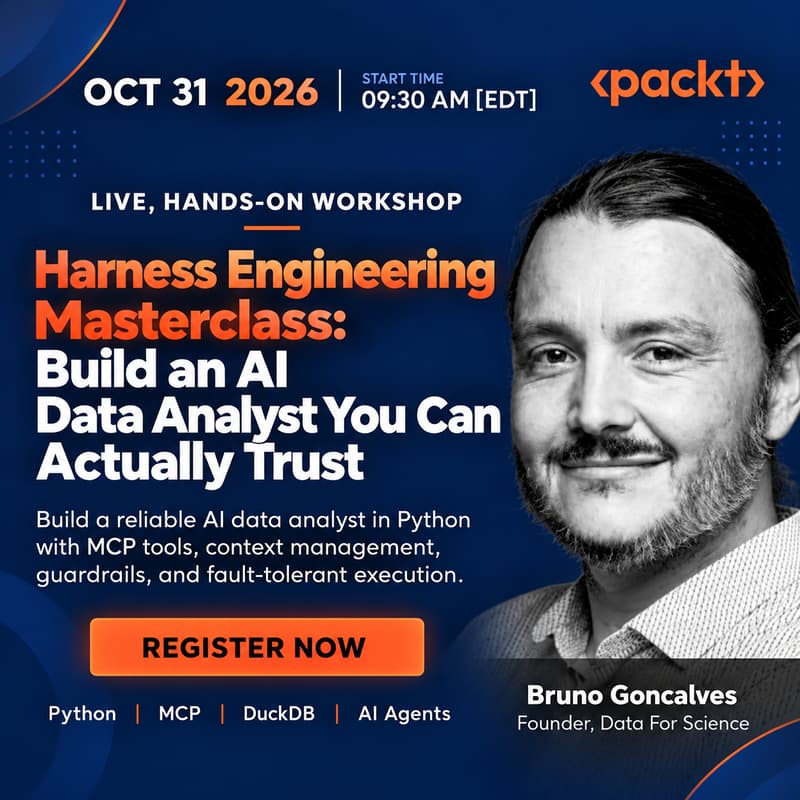

Harness Engineering: Build an AI Data Analyst You Can Actually Trust
Build AI agents in Python with MCP tools, context management, guardrails and fault-tolerant execution in this hands-on workshop.
Join international bestselling author Bruno Gonçalves for a 4-hour, hands-on Harness Engineering workshop focused on building reliable, production-ready AI agents. You will create an AI data analyst in Python and engineer the harness around the model: connecting it to MCP tools, managing context windows and memory, implementing AI agent guardrails, verifying outputs, and handling failures with retries, budgets and structured traces. By the end, you will have a reusable, framework-free LLM agent harness designed to make agentic AI systems safer, more reliable and easier to debug in production.
What you will get
Certificate of participation: Receive a certificate recognising your participation in the workshop.
Full HD recording: Revisit the live demonstrations, coding walkthroughs and hands-on builds after the workshop.
Workshop slide deck: Keep the session’s presentation materials for reference as you apply what you have learned.
A working AI data analyst and reusable Python harness: Build four connected components covering permissioned MCP tools, context management, layered guardrails and fault-tolerant run supervision.
A fault-injected test suite: Take away tests you can adapt into a continuous integration check for changes to your own agents.
Why you should attend this
Understand the engineering that frameworks hide: Write the code controlling your agent’s tools, context, outputs and recovery, so you can understand how the system behaves when something goes wrong.
Work through failures that matter: Tackle fabricated revenue explanations, overwhelming tool results, malicious instructions hidden in customer feedback and questions involving missing data.
Spend substantial time building: Each section combines concepts and live coding with hands-on development, a reference-solution walkthrough and a clean checkpoint to help you stay on track.
Apply the patterns beyond this workshop: Leave with a framework-free Python implementation and reusable components that transfer to the agent stacks you already use.
Build without expensive infrastructure: Run the exercises on your laptop using a mock model, a real MCP server and a local database. No GPU, cloud account or API key is required for the exercises.
What you will learn
Connect agents to MCP tools with explicit permissions: Discover tools from a third-party DuckDB MCP server, validate tool calls and enforce policies before potentially dangerous actions reach the server.
Manage context within a hard token budget: Use compact result summaries, expandable handles, conversation compaction and tiered memory to preserve relevant findings without overwhelming the model.
Build layered guardrails: Separate retrieved data from instructions, defend against indirect prompt injection and inspect SQL to block unauthorised writes, file access and network requests.
Verify the numbers in an AI-generated report: Link numerical claims to re-runnable queries, check values and units, flag incomplete reporting periods and reserve LLM judging for clarity and usefulness.
Make failures manageable and diagnosable: Implement timeouts, retries, re-planning, execution budgets and structured traces, then test how your agent responds to injected faults.
About the speaker
Bruno Gonçalves is the Founder of Data For Science: an author, trainer and consultant specialising in Generative AI and Machine Learning. He's previously held a tenured faculty position at Aix-Marseille Université and served as a Data Science Fellow at NYU’s Center for Data Science. Bruno holds a PhD in the Physics of Complex Systems. Bruno has taught thousands of practitioners through O’Reilly, Pearson and live workshops. His open-source harness notebooks explore production agent patterns from first principles.