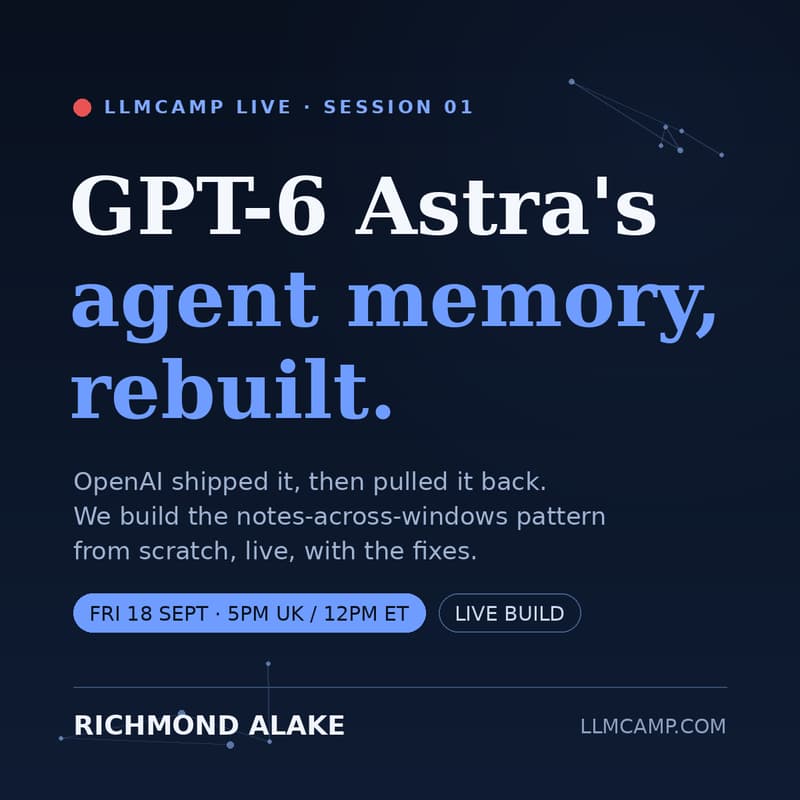

Building GPT-6 Astra's Memory Pattern From Scratch
OpenAI just shipped one of the most interesting memory features in any frontier product: with Astra, Codex keeps notes across context windows instead of repeatedly compacting, and earlier windows stay searchable even when a detail never made it into the notes.
Nobody outside OpenAI knows how they built it.
But the pattern they describe is implementable, and in this session we build an open-source version of it, live, using MemoRizz.
What we'll cover:
Why compaction loses information, and how the Astra pattern fixes it: decoded into an architecture you can build
Live build with MemoRizz: a note store with a write policy, plus searchable archives of previous context windows
Retrieval logic: when the agent answers from notes and when it searches the archive
Why this is hard at scale, and what it means that OpenAI ships it behind an experimental flag
You leave with the full implementation in a GitHub repo, shared in the session.
For engineers, Forward Deployed Engineers, AI architects and AI practitioners building agents that need to remember. Recorded; registrants get the replay link.
Hosted by Richmond Alake, who coined the discipline of Memory Engineering and is on a mission to create 100 AI Memory Engineers.
Richmond is the creator of the open-source MemoRizz library, Director of AI Developer Experience at Oracle, formerly AI/ML Developer Advocate at MongoDB, and the creator of two DeepLearning.AI courses on AI agents with Andrew Ng's team, and author of 100 Days of Agent Memory.