
The Inaugural Emmy Network Dialogue: Infinity, Intelligence, Reality
Infinity, Intelligence, Reality
The Emmy Network Dialogue Series | Inaugural Dialogue
Some questions never lose their grip on us. Is reality infinite? What is intelligence, and how does it reach the infinite? Can intelligence be built?
Some questions seem suddenly urgent. Is intelligence being built now? What do the mathematical capabilities of today’s AI systems mean for our quest to understand the universe and the infinite? Why does this matter for our work, our societies, and the morality and meaning in our lives?
The Inaugural Emmy Network Dialogue brings together three Emmy Network Fellows, all Fellows by Special Election of Keble College, University of Oxford, to discuss these questions and more, in an unscripted, moderated conversation at the outer edge of mathematics, philosophy and the science of intelligence. A reception follows the Dialogue. Everyone is welcome; attendance is free, but registration is required. Places are limited, so registrations are confirmed by the hosts.
In conversation
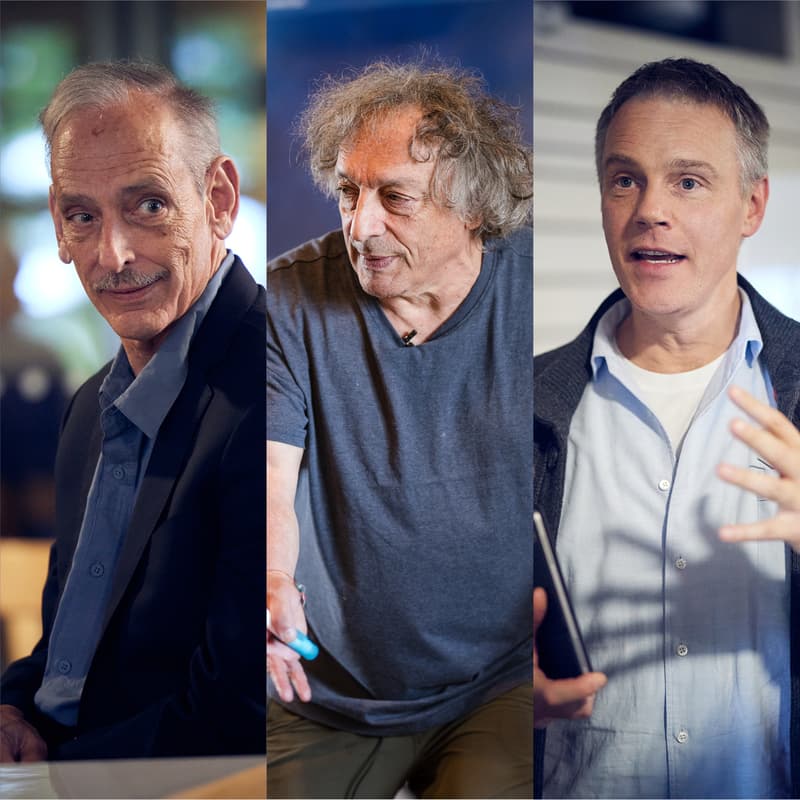
Hugh Woodin, Professor of Mathematics and of Philosophy at Harvard University, is a logician and set theorist. Early in his career he defined a new kind of large cardinal, the Woodin cardinals, now named for him, and he has since shown that these vast infinities, far from being ornamental, bring order to the number line. Some questions about infinity cannot be answered from the standard axioms of mathematics, among them Cantor’s Continuum Hypothesis: whether any infinity lies between the size of the whole numbers and that of the real numbers. His current wager is on a candidate structure he calls Ultimate L: if it exists, it would come so close to the full universe of sets that it would settle such questions, including, he argues, the Continuum Hypothesis, in the affirmative.
Jussi Westergren, Founder and Scientific Director of Emmy Network, works on the theory and simulation of complex systems, from the physical and chemical to the biological and socio-economic. Alongside his research, he has helped build early-stage technology companies, including the quantum computing company Algorithmiq, and was a founding investor in and adviser to DeepMind. His forthcoming book, Unfolding, argues that the infinities mathematics has catalogued so far are only a beginning, reaching past ‘collected infinities’ toward a notion of ‘prime infinity’: the inexhaustible field from which all structure emerges.
Joseph Almog, Professor Emeritus of Philosophy at UCLA, has argued for decades, in books on Descartes and Spinoza and in work on metaphysics and the philosophy of mathematics, that there is one universal Nature, that infinity is the key to understanding it, and that mathematics is woven into the fabric of space-time. His earlier work on language and perception looked not inside the head of the thinker, human or machine, but to the thinker’s encounters with the world. Some of his latest work returns to Descartes and the idea of an infinite source object: Nature in its most general sense. Other recent work asks how the infinite universe of sets relates to the physical universe, and whether the world is fundamentally made of objects, of actions or of both.
Moderated by
Steven Altschuler and Lani Wu, Emmy Network Extraordinary Fellows, are Professors at UCSF, where their laboratories work on basic questions in biology, disease and drug discovery. Their route to biology was not a straight line. They began in mathematics, in topology and geometric analysis, and held positions in Princeton’s mathematics department before co-leading a team at Microsoft Research that developed machine learning approaches to human-computer interaction. They then moved into systems biology and pharmacology, and today combine experimental biology, data science and modelling to uncover the design principles of biological systems.
About Emmy Network
Emmy Network gives people across its community, from students to established researchers, the time, independence and intellectual company to pursue questions that may not fit neatly within one field. A question might begin in mathematics, develop through conversation with an artist or an entrepreneur, and become a paper, a public programme, a company or a new line of inquiry. Emmy is based in Oxford at the Schwarzman Centre and affiliated with Keble College, where its philanthropic endowment supports research. The Dialogue Series shares this work with a wider public, and this is its first conversation.
If you have ever wondered about the universe and your place in it, this evening will touch on questions you may have long asked yourself, others you may never have thought of, and the surprising ways they illuminate one another. We hope you’ll join us.
Monday 7 December 2026
Sohmen Concert Hall, Stephen A. Schwarzman Centre for the Humanities, Woodstock Road, Oxford OX2 6GG
Dialogue 4–5.30pm (doors open 3.30pm)
Reception 5.30–6.30pm